
If you are asking how to know if a breaker is bad, repeated tripping alone cannot answer the question. A breaker can trip because it is responding to an overload or a fault elsewhere in the circuit. Establishing that the breaker itself has failed requires a qualified electrician to assess the device, its connections and the circuit it protects.
Start by separating what happened from what you think caused it. A room lost power, a particular appliance was running, or a breaker tripped again: those are useful observations. “The breaker needs replacing” is a diagnosis that those observations do not establish.
By ZiroSip · Updated October 26, 2026 · US residential circuit-breaker symptom guide
How to know if a breaker is bad: interpret the symptoms first
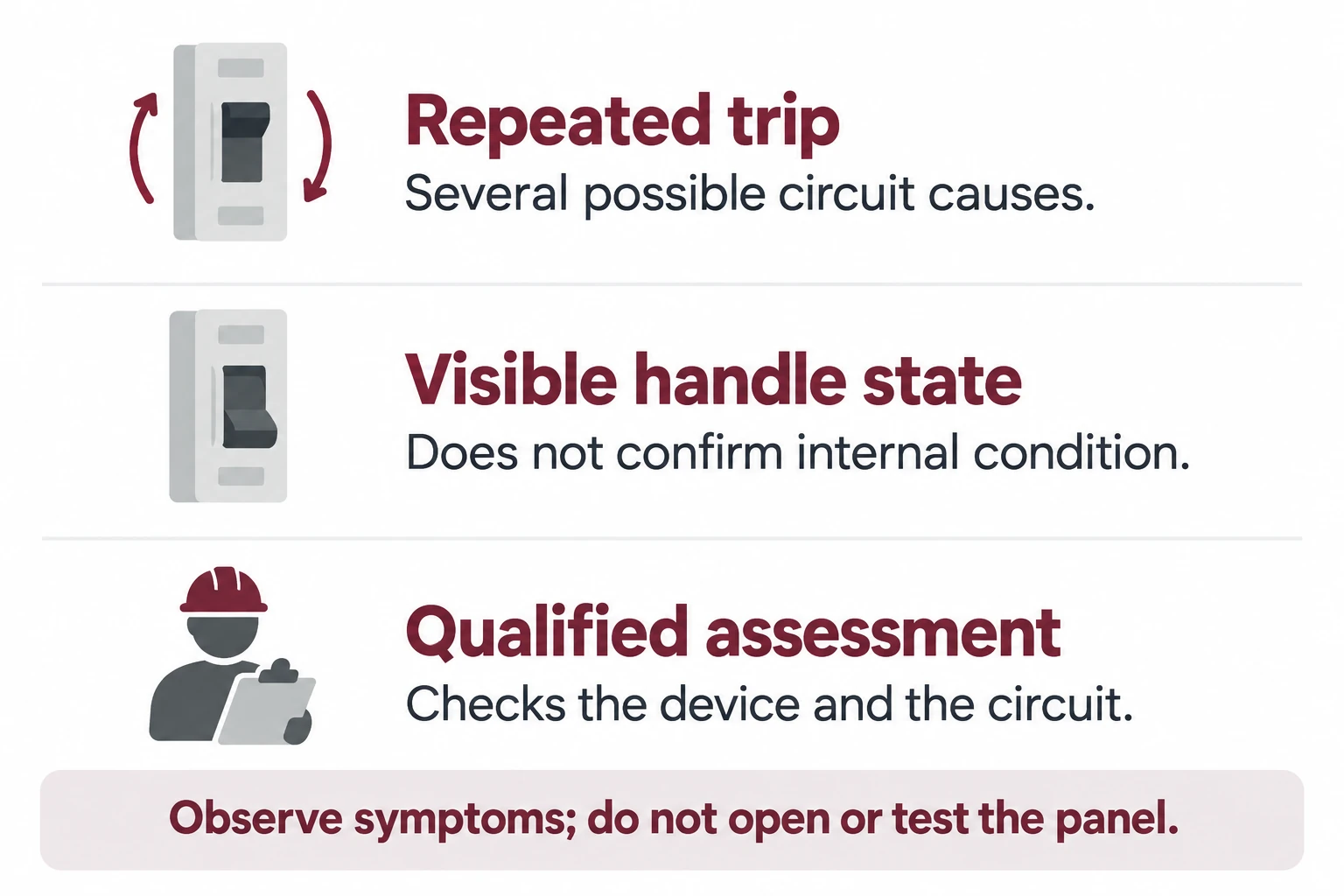
The same visible symptom can have different causes. EWEB’s consumer guidance lists several explanations for repeated trips, including too many connected appliances, damaged cords, short circuits and faulty wiring. A trip can therefore show that protection operated without telling you which part needs attention.
| What you already observed | What it can tell you | What it cannot establish |
|---|---|---|
| The circuit repeatedly loses power and the breaker trips | A recurring condition needs investigation | That the breaker is defective rather than responding to a fault |
| An event occurred while a particular appliance was running | The appliance and timing belong in the service history | That the appliance or the breaker is definitely the cause |
| A handle is visibly in a different position | There is a visible state to report, if already apparent | The condition of internal contacts or the correct replacement |
| Smoke, sparks or fire at electrical equipment | This is an emergency requiring immediate help | A safe opportunity to inspect, reset or photograph the equipment |
Use this table to describe an event that has already occurred. Do not deliberately add loads, reproduce a trip, approach damaged equipment or open the panel to complete it. An incomplete history is preferable to creating another hazardous event.
Can a circuit breaker go bad?
Yes. The manufacturer’s thermal-magnetic troubleshooting guidance identifies internal contact deterioration as one possible explanation after other causes have been considered. It also discusses overcurrent and connection problems. That distinction matters: replacing a suspected part without identifying the cause can leave the original problem unresolved.
The guidance applies to the manufacturer’s named product families. It does not turn a particular symptom, appliance or trip interval into a universal diagnosis for every residential breaker. A qualified assessment needs the actual equipment identity and the circumstances of the event.
When searching how to know if a circuit breaker is bad, it is tempting to look for one decisive household sign. The useful question is more specific: what evidence points toward the protective device itself, and what evidence still leaves the load, wiring or connections in question? A symptom list can organize that question, but cannot finish the assessment remotely.
A repeated trip is not a service-life clock
“It is old” and “it tripped several times” are useful history, not proof that a replacement has become necessary on a fixed schedule. This guide provides no universal breaker lifespan or trip-count replacement rule. The actual device and its condition matter more than an unsupported number attached to its age.
Why heat, handle position and internet tests have limits
A report that equipment felt warm is not a reliable temperature assessment. The manufacturer’s operating-temperature bulletin explains why judging a breaker by touch can lead to mistaken conclusions. An allowable condition depends on the relevant product and assessment criteria; a generic touch rule cannot settle it.
Do not touch a suspect panel or breaker to investigate warmth. Likewise, an infrared picture without the equipment context is not a pass/fail certificate. The issue for the electrician is whether the actual condition is acceptable for that equipment, not whether a photograph looks bright or a surface seems warm.
A handle position also cannot show the condition of hidden contacts. Reporting a position that is already visible is different from operating the device to see what happens. Indicator meanings and operating instructions need the exact product information; one manufacturer’s colored flag or handle arrangement should not be assumed universal.
Online guides may suggest removing the cover, taking energized measurements, swapping breakers or deliberately creating a load. Those are not observation tasks. This article does not provide those procedures or a resistance, voltage or temperature value that would authorize an unqualified person to make a repair.
Prepare a useful service-call record without opening the panel
The most useful contribution is a clear record of what you already know. The following is a proposed handoff format, not an electrical inspection checklist. Enter information from memory or existing records; leave anything unknown blank.
- Event: Which room, outlet group or appliance lost power, and when did it happen?
- Context: Which appliances were already operating, and was anything recently changed?
- Pattern: Was this one event or a recurring problem? Describe previous events without recreating them.
- Visible concerns: Report smoke, sparks, unusual odor or damage already noticed. Do not approach equipment to look for them.
- Equipment information: Share existing labels, documents or photographs only if already available. Do not remove covers to obtain a model number.
- Previous action: Explain any work or attempted reset that has already happened so the electrician has the complete history.
Keep observation and interpretation in separate sentences. “The kitchen circuit lost power while two appliances were running” is more informative than “the kitchen breaker is weak.” It preserves facts without steering the investigation toward a part that has not been shown to be faulty.
Two examples of a better handoff
Consider a hypothetical report that a circuit trips whenever a particular appliance is used. That pattern makes the appliance and its operating conditions relevant. It does not establish whether the cause is the appliance, the circuit’s loading, a connection or the breaker. The service request should describe the association and ask for the cause to be identified.
In a second hypothetical report, several events have occurred but the resident cannot connect them to a particular appliance. “No pattern noticed” is a valid entry. It does not prove an internal breaker fault. Recording approximate times and affected areas is more useful than repeating operations until a pattern appears.
Both examples leave the diagnosis open while giving the electrician a more accurate starting point. Neither is a completed investigation, and neither supports ordering a replacement solely from an internet symptom list.
When the priority is urgent help
If electrical equipment is smoking, sparking or on fire, move away from the danger and call 911 in the US. Do not approach it to operate a breaker, take a photograph or collect information. Southern California Edison’s safety guidance specifically identifies those conditions as reasons to call for emergency help.
For recurring trips without an active emergency, arrange a qualified electrician’s assessment rather than treating repeated resets as a solution. The practical answer to how to know if a breaker is going bad is to recognize the limits of the symptoms: describe the event accurately, act on urgent warning signs and let the device and circuit be assessed together.
References
- Southern California Edison: Electrical Equipment Fire or Visible Smoke — Emergency electrical-equipment warning signs.
- EWEB: Know Your Electric Panel — Repeated trips and possible circuit causes.
- Schneider Electric: thermal-magnetic breaker tripping — Manufacturer-specific diagnostic alternatives; updated January 5, 2026.
- Schneider Electric: Circuit Breaker Operating Temperatures — Operating-temperature assessment context; R02/25, March 18, 2025.