
Lint free wipes are designed to limit the fibers and particles introduced during cleaning. The label does not guarantee zero shedding or prove that a wipe suits every cleanroom task. Choose the material, edge finish and cleaning fluid together, then check the actual product evidence against the surface and contamination you need to control.
A wipe for collecting liquid from a work surface may need a different balance of absorption and cleanliness from one used on a sensitive component. Defining that job before comparing products makes “lint-free” a useful starting description rather than the entire purchasing specification.
By ZiroSip · Updated October 26, 2026
What lint free wipes actually tell you
Low shedding matters because a cleaning material can introduce contamination while removing it. Berkshire’s explanation of lint-free terminology acknowledges that fiber-based wipes can still generate particles and lint. The practical question is whether that release is acceptable under the conditions of your process.
That question is separate from sterility, electrostatic behavior or suitability for a particular cleaning fluid. Texwipe lists sterile and non-sterile, dry and pre-wetted, material and edge options separately. A choice in one category does not answer the others. A white appearance or cleanroom label cannot replace the missing product information.
For procurement, write down the surface, contaminant and intended fluid first. Then identify which failure matters: visible fibers left behind, unacceptable residue, poor liquid pickup, damage to the surface or loss of integrity during use. Those are different reasons to accept or reject a sample.
Compare materials and construction before comparing price
Material names and fabric construction describe different aspects of a cleanroom wiper. “Microfiber” describes the fiber scale; “knitted” or “nonwoven” describes construction. Ask for both instead of assuming a familiar material name identifies an equivalent product.
| Candidate family | Useful selection question | Evidence to request |
|---|---|---|
| Cellulose/polyester nonwoven | Does liquid pickup meet the task while shedding and residue remain acceptable? | Exact blend, actual-fluid absorption information and contamination test conditions |
| Knitted polyester | Does this construction provide the required cleanliness and handling durability? | Fabric construction, laundering/processing information and product-specific particle/fiber results |
| Cleanroom microfiber wiper | What is the fiber composition and how does the exact product behave on the intended surface? | Composition, construction, edge finish and a representative surface trial |
| Pre-wetted wipe | Does the supplied fabric/fluid combination suit the cleaning job and storage conditions? | Fluid identity, compatibility information, pack closure and applicable shelf-life documentation |
These are candidate questions rather than a ranking from worst to best. MicroCare’s technical discussion explains that absorption changes with the material and fluid, and that strong liquid pickup does not automatically mean the cleanest result. The fabric must also tolerate the task without unacceptable breakdown or residue.
Microfiber cleanroom wipes deserve the same scrutiny as other materials. The word alone does not state a polymer blend, edge treatment or cleanliness level. A soft hand-feel can be relevant to handling, but the purchasing decision still needs the product’s specification and a trial on the intended surface.
Compare price only after those conditions are aligned. If two quotations differ in construction, size, fluid or packaging, a lower price per pack does not yet describe the cost of completing the same cleaning task.
Cut edge, sealed edge and sealed border solve different questions
The wipe’s boundary is part of the cleaning surface. Berkshire’s edge guide describes cut, laser-sealed, ultrasonically sealed and bordered constructions. Sealing can reduce release at the boundary, while a particular edge can also change how the wipe contacts a delicate or rough surface.
A sealed edge and a sealed border are not interchangeable descriptions. Ask the supplier to identify the construction actually supplied. A wider bonded region, a narrow fused boundary and a plain cut edge need to be assessed as features of the particular wipe, rather than inferred from its name.
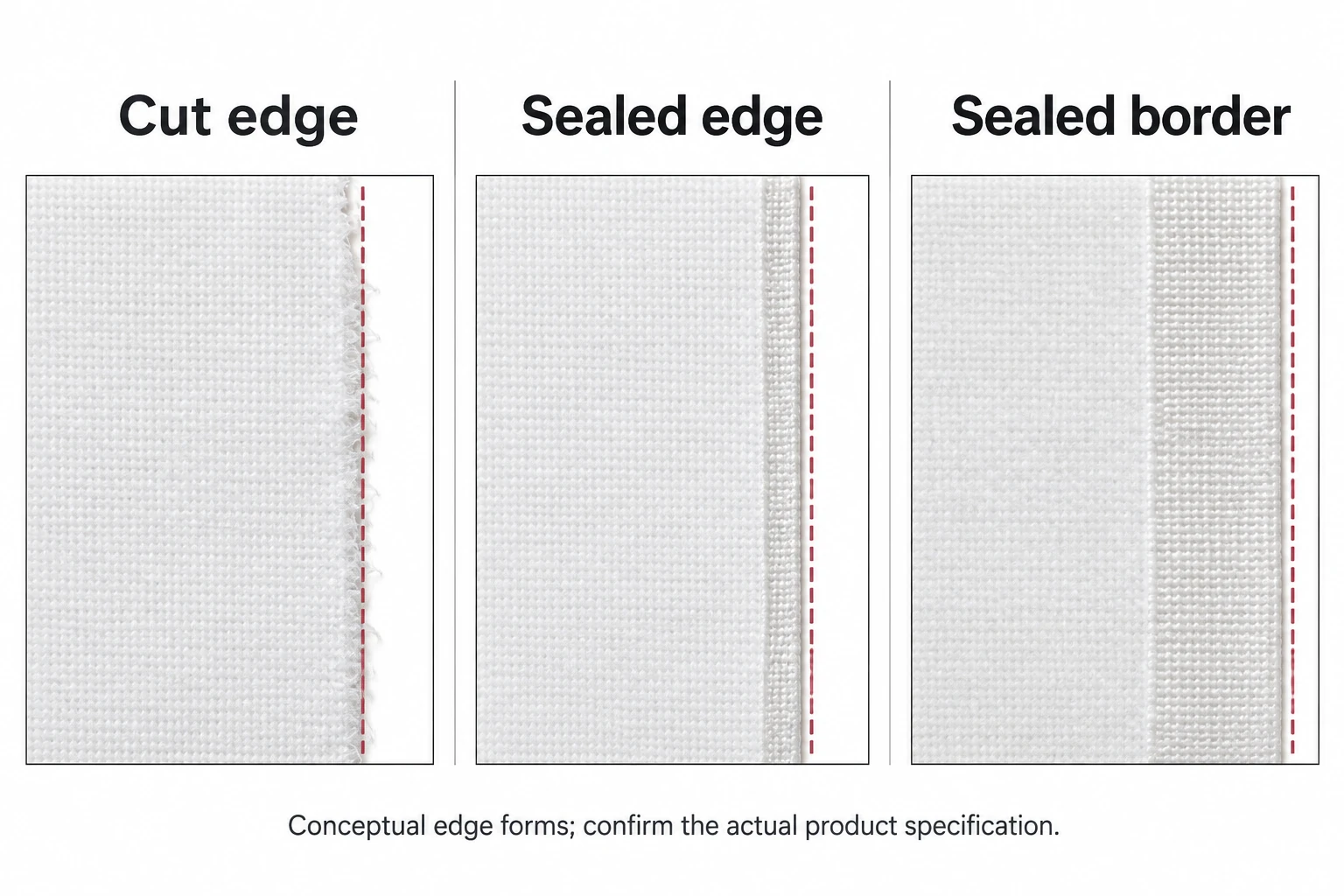
Do not turn a finishing method into a zero-shedding promise. A cut-edge option may be appropriate for a particular process, while a sealed option may fail another requirement. The relevant decision is whether the complete wipe meets the task’s surface, residue, durability and contamination criteria.
Ask for comparable evidence, not just a cleanliness adjective
Texwipe identifies fibers, particles, ions and residue among the properties tested for its wipers. These categories illustrate why a single claim such as “high purity” cannot tell a buyer everything. The exact evidence needed depends on what the process is sensitive to.
| Comparison point | What to clarify before comparing |
|---|---|
| Particle and fiber release | Method, wet or dry condition, units and sample basis |
| Residue and ionic information | What was measured, extraction conditions and reporting units |
| Cleaning fluid compatibility | The exact fluid and whether the wipe retains suitable integrity during the intended use |
| Surface contact | Acceptable appearance and condition after a representative trial |
| Packaging and identification | Pack format, closure, product identity and available lot information |
| Sterile or non-sterile supply | Which status is actually supplied and which supporting documents apply |
This is a proposed comparison record, not a universal laboratory acceptance standard. Place data side by side only when the methods and reporting basis are comparable. If a supplier reports particles in a different way, ask for the explanation before declaring one wipe cleaner.
For pre-wetted products, include the fabric, fluid and pack as a single supplied combination. MicroCare notes the importance of compatibility and a seal that maintains the intended wet condition. Do not assume that pouring another cleaner onto a dry alternative creates an equivalent product.
Keep any electrostatic-control requirement as its own specification. A low-lint claim does not supply the missing electrical-performance evidence. This distinction is especially relevant when a wipe is used near sensitive electronics: contamination control and electrostatic control need their own acceptance basis.
Use the actual cleaning station to narrow the choice
Consider two hypothetical stations in the same electronics facility. At one, the task is to collect a process liquid from a work surface. At the other, the operator must clean a more sensitive finished surface with little acceptable residue. Buying one familiar wipe for both stations could conceal two different acceptance decisions.
For the first station, the proposed trial would record liquid pickup, the number of wipes consumed and whether unwanted fibers or residue remain. For the second, the trial would emphasize the surface condition and the contamination criteria selected by that process owner. These are suggested observations; no trial results or measured performance are claimed here.
The two stations may ultimately accept the same product. What makes the decision defensible is that each task has been evaluated, not that the packaging looks suitable. Record the product identity, intended fluid, surface and acceptance outcome so a later substitution can be assessed against the same job.
What to request from a supplier
CH-ESD’s Laser Edge Clean Wiper page lists normal polyester and micro-denier woven and knitted families. It is a useful route for discussing a candidate construction. Ask which exact option matches your task and request its current specification and a sample before treating the family name as a complete qualification.
- Describe the task: Surface, contaminant, intended fluid and how the wipe will be used.
- Identify the candidate: Material composition, construction, dimensions, edge finish and pack format.
- Request evidence: Relevant test methods and results, compatibility information and any separately required sterile or electrostatic documentation.
- Record the sample decision: The evaluated product, conditions, observations and the process owner’s acceptance criteria.
The finished specification should let another buyer order the same qualified option without guessing from “lint-free,” “microfiber” or “cleanroom.” That is the point at which the label becomes a controlled purchasing decision.
References
- Berkshire: The Truth About Lint Free Wipes — Terminology and the limits of a lint-free label.
- Texwipe: Cleanroom Wipers — Material, edge, supply-status and testing categories.
- Berkshire: Cleanroom Wipe Edges Explained — Edge-construction distinctions; updated August 5, 2026.
- MicroCare: Electronics Cleaning Wipes — Material/fluid compatibility and packaging considerations.