

The importance of esd-safe material selection is growing in today’s electronics manufacturing market. Provided that ESD can cause damages to complex electronic devices, engineers, manufacturers, and source responsible for purchases are now looking for materials which perform well, but also meet safety requirements. The purpose of this knowledge base is to provide you with core concepts associated with ESD-safe materials, deliver the principles of choosing the right ESD-safe material, and describe the relevant standards ( e.g., ANSI ESD S20.20 material ), alongside insights for sourcing complete ESD product solutions.
What Makes a Material ESD-Safe?
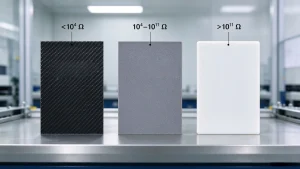
When the resistance of materials allows them to discharge the charges safely without generating sparks and harming sensitive components, such materials are ESD-safe. Traditionally, materials are divided into three major classes:
Conductive materials: Low resistance materials have resistance lower than 10⁴Ω, enabling electrical forces to travel easily through such materials and making them good for grounding applications. These materials can also quickly discharge static charges.
Dissipative materials:Materials with moderate resistance have resistance in the range of 10⁴Ω~10¹¹Ω and can discharge static charges without any abrupt release of electricity. These materials are widely used in the making of work surfaces, mats, and clothing.
Insulative materials:High resistance materials have resistance greater than 10¹¹Ω. As such, they do not allow the discharge of electrical charges, and thus they cannot be used in products designed for ESD protection unless treated.
The choice between conductive, dissipative, or insulative materials is determined by the application in question—workbenches, floors, containers, or packaging. The option should guarantee successful execution of ESD control while meeting the functional or other requirements for the process.
Key Factors in Esd-Safe Material Selection
Choosing the appropriate ESD‑proof material relies on many criteria, which guarantee compliance with the regulations and compatibility of the operation. The following are the main factors to be taken into account:
1. Resistance – Make sure that the resistance of the material is in accordance with the required ESD application. For instance, the working surface and floorings should have dissipative properties, while grounding trays may function from conductive materials.
2. Mechanical properties – Assess strength, flexibility, durability, and wear resistance. Packaging or storage solutions must tolerate repeated handling and mechanical stress.
3. Chemical Compatibility–Think about how materials react with cleaning products, fluxes, solvents, and other chemicals in the process in order to prevent deterioration or contamination.
4. Environmental Factors – The performance and durability may be affected by factors such as temperature and humidity, ultraviolet light exposure, and moisture content. It is essential to select materials that suit the environmental conditions in your facility.
5. Price and Supply – Find the right equilibrium between quality, conformity, as well as operational costs. Using standardized materials ensures straightforward purchasing and maintenance in the long run.
6. Maintaining Regulatory Compliance- Always ensure that decisions takes into account international standards such as ANSI ESD S20.20 in order to make sure that they can pass inspection and be compliant worldwide.
ANSI ESD S20.20 Material Requirements
The standard ANSI ESD S20.20 is the reference point for ESD control in electronics manufacturing. It provides specifications alike process creation, grounding of people, devices and, primarily, materials used for ESD-safe zones.
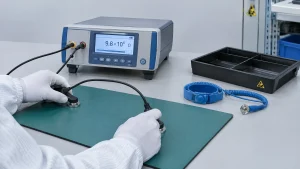
As stated in ANSI ESD S20.20, materials ought to be selected according to their resistance and application. For instance, the resistance values of worksurfaces must be within the range of 1 x 10⁶ to 1 x 10⁹ Ω. It is mandatory to test shoes and grounding devices as well as to choose packaging based on the sensitivity of components either dissipative or conductive. Moreover, keeping records of the material specifications as well as performing testing regularly is important.
Compliance with this standard guarantees the dependability of the work processes, minimizing the chance of mistakes in audits and instilling trust in customers, suppliers, and certifying agencies.
Common ESD-Safe Materials in Manufacturing
There is a wide variety of ESD safe materials that include polymers, coatings, textiles, and composites. Here are some of the more common options:
ESD-Safe Plastics: ESD control can be achieved in materials like high-density polyethylene (HDPE), polypropylene, ABS and polycarbonate plastics through the addition of substances such as carbon black, metal fiber, and anti-static coatings.These materials are commonly manufactured into trays, boxes and ESD magazine racks for SMT PCB handling.
ESD-Safe Rubber:a specialized rubber for producing mats, anti-static footwear, gaskets and seals , and it’s a conductive material that has been created with additives or some unmatched mixtures that ensure both constant resistance and long-term performance.
Electrostatically Dissipative Textiles: Clothing items, wristbands, and gloves are made from textiles that contain conductive yarns, which allow personnel to become grounded. Polyester/cotton fabrics with blended carbon or metal threads are the standard.
ESD-Safe Paper/Packaging : means corrugated ESD boxes, trays, and bubble wrap that are constructed from treated fiber pulp or using conductive agents, thus securing transport of delicate items.
Each material has exclusive benefits. The final choice will depend upon the needs of the particular application.
Application-Specific Guidance for Esd-Safe Material Selection
Every manufacturing operation has various areas and assignments that require careful material selection with ESD safety. Here are the guidelines for selecting the right material for the most common situations involving ESD:
Packaging & Containers – Choose boxes, bags, and trays that are conductive or dissipative based on the sensitivity of the device. Anti-static foam packing is another additional safety measure.
Safety of workers – using of wrist straps, heel straps, ESD footwear, and suitable attire should be started in the workplace. Regular inspections and record keeping should be implemented for audit purposes.
Regular checks on materials and adequate documentation are very important. The use of testing kits and devices to check for resistance and continuing compliance is advised.