

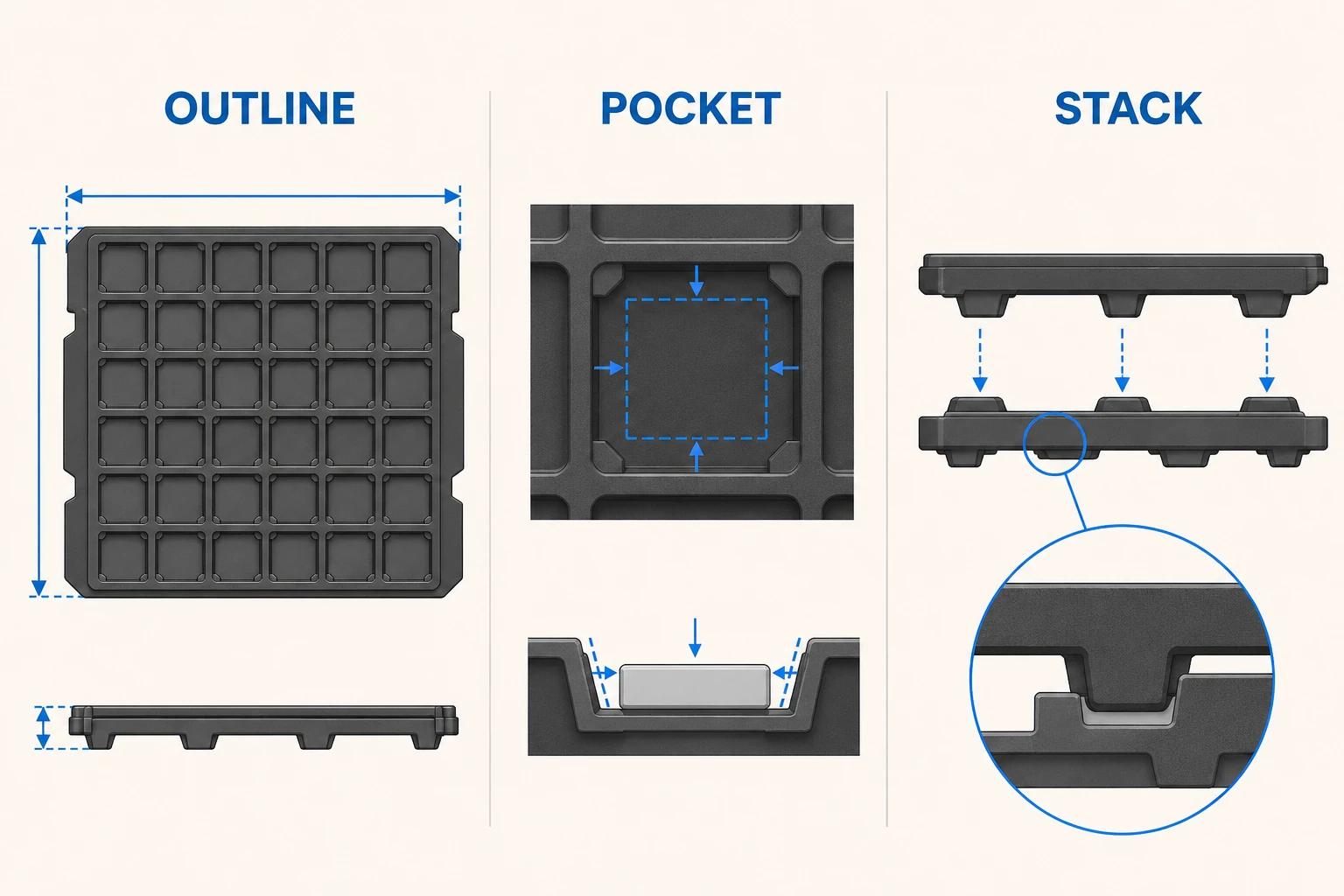
JEDEC tray dimensions must be checked at three levels: the tray outline, the pocket that supports the IC, and the stacking or equipment interface. A matching outside length and width does not establish that a tray will hold your semiconductor package correctly or run through your handling equipment.
Before ordering, obtain the drawing for the exact tray model and compare it with the package drawing and the equipment requirements. Use a catalog designation to shortlist a candidate; use the controlled drawing and a representative sample to decide whether that candidate fits.
JEDEC tray dimensions: separate the outline from the pocket
A published manufacturer drawing is a better starting point than an isolated dimension copied from a search result. For example, Analog Devices drawing 50-8211 Rev A shows an outline of 322.6 × 135.9 mm alongside separate package and pocket details. Those values describe that drawing, not every JEDEC tray and not a verified Quan Dun model.
When someone asks for a “standard JEDEC tray,” establish which part of the interface they mean. They may be describing a familiar external format while leaving the IC support geometry, pocket depth and stacking details unspecified. Those unanswered details belong in the drawing request.
| Dimension group | Compare against | Question to resolve before purchase |
|---|---|---|
| Outer outline and rails | Tray drawing and equipment interface requirements | Can the equipment locate, support and transfer this exact tray? |
| Pocket and support surfaces | IC package drawing, including features that must remain clear | Where will the component rest, and what clearance is required? |
| Matrix and orientation | Handling recipe and required component orientation | Does the pocket layout match the intended loading and pickup task? |
| Stack interface | Matching tray/lid drawings and intended stacked arrangement | Will the loaded stack maintain the required separation and orientation? |
Malaster’s technical handbook similarly treats rails, datums, orientation, pocket contact and stacking as distinct selection concerns. The practical procurement lesson is to approve the interfaces you actually use rather than an outline dimension alone.
Use actual model codes to narrow the drawing request
Quan Dun’s JEDEC-standard IC tray listing includes several BGA and QFN tray models. The following examples reproduce the listed model identifiers and matrices. They help identify which drawing to request; they are not a substitute for pocket dimensions or clearance tolerances.
| Listed designation | Listed model code | Listed matrix | Pockets in listed matrix |
|---|---|---|---|
| BGA6x8 | EA70608-10 | 16 × 30 | 480 |
| BGA8x8 | NXBG08080.912296REV.A | 12 × 29 | 348 |
| QFN5x5 | EAM050501-10 | 14 × 35 | 490 |
| QFN7x7 | EAM0707-10 | 10 × 26 | 260 |
The designation “QFN5x5” does not establish the measured clear pocket opening, tolerance or support profile. Likewise, the matrix count does not establish that every pocket can be used in your process. Ask for the matching drawing and clarify which package surfaces may touch the tray.
The public listing does not provide a complete verified outer-dimension and pocket-clearance drawing for each model. Keep those fields open in the inquiry rather than filling them with numbers from an unrelated supplier’s tray. This also prevents a later quotation from silently switching between similar catalog descriptions.
Check the loaded sample, not only the empty tray
A representative loaded sample can reveal whether the drawing interpretation matches the intended handling task. Agree the sample scope with the supplier and your process owner before approving a larger order. The checks below are a proposed acceptance framework, not evidence that a particular tray has passed them.
- Package fit: Confirm the actual IC package revision, intended contact surfaces and clearance needs. Record any condition that could constrain leads, balls or other sensitive features.
- Loading and removal: Evaluate the normal placement and pickup method, including orientation. Do not assume that a hand-loaded sample proves automated pickup compatibility.
- Equipment interface: Check the selected tray against the equipment’s documented requirements and the intended process recipe.
- Stacked condition: Evaluate the actual loaded arrangement, including its matching cover or adjacent tray where applicable.
- Record: Keep the tray model, drawing revision, sample identification, package revision and approval decision together.
Handle thermal, moisture and electrical requirements as additional model-specific checks. A dimensional match does not establish a permitted baking cycle, moisture-barrier function or verified ESD performance. Request the applicable material and test documentation when those properties are part of the use case.
Prepare a tray inquiry the supplier can resolve
Send the IC package drawing, the candidate tray designation and the equipment requirements with your inquiry. Add the quantity, intended loading arrangement, orientation, labeling needs and whether the order is for sample qualification or repeat supply.
Ask the supplier to return a model-specific drawing showing the outside interface, relevant pocket details, matrix and stacking arrangement. Make unresolved dimensions explicit. If an alternative tray is proposed, compare its drawing rather than approving it because the outside format looks similar.
For example, a request for EAM050501-10 should identify the actual QFN package revision and the handling task, not just “5 × 5 tray.” That gives the supplier a defined fit question and gives your team a record against which to evaluate the proposed sample.
Request a tray drawing and sample quotation from Quan Dun. Include the package and interface information above so that the quotation can identify the proposed tray model and the remaining qualification requirements.
References
- Analog Devices: Tray drawing 50-8211 Rev A — one manufacturer-specific example separating outline and package/pocket details.
- Malaster: JEDEC Tray Technical Handbook — tray interfaces and acceptance considerations.