
Polyester is not automatically waterproof. The fibre absorbs relatively little water, but water can still pass through a polyester fabric or a finished item’s seams and openings. A waterproof claim needs more than a “100% polyester” label: it needs a suitable fabric construction, a water-blocking layer where required, and evidence that matches the intended use.
Answering “is polyester waterproof” for a jacket, bag or equipment cover requires looking beyond the fibre label. A material can shed a splash yet be unsuitable for prolonged rain. Another can have a wet outer surface while a separate barrier underneath continues to block water.
Is polyester waterproof when the label says 100%?
No. “100% polyester” identifies fibre composition, not a waterproof rating. It does not tell you whether the fabric has a coating, a membrane, a water-repellent finish or sealed seams. Two items with the same composition label can therefore have very different uses.
The distinction starts with the difference between a fibre and a fabric. Fibres become yarns, and yarns form a woven or knitted structure. The fibre’s interaction with water is only one part of that structure’s behaviour. The fabric supplier UK Fabrics Online likewise distinguishes polyester’s low absorbency from the performance of the constructed and finished fabric.
A useful product description identifies both composition and construction. Compare “polyester cover” with “polyester face fabric with a specified backing and a documented seam treatment.” The second description gives you something to investigate. It still needs supporting evidence, but it does not ask the fibre name to stand in for the whole product.
What changes polyester from a fabric into a water barrier?
The important distinction is between the textile structure, its surface finish and any continuous barrier behind it. Treat these as separate features when reading a specification. A water-repellent finish and a waterproof backing do different jobs, even when both are present in the same item.
| Description | What it identifies | What to verify next |
|---|---|---|
| 100% polyester | The fibre composition | Fabric structure, finish and any backing |
| Closely woven polyester | A construction feature | Water-penetration evidence for the exact fabric |
| Water-repellent finish | A treatment intended to reduce surface wetting | Whether a separate penetration barrier exists |
| Coated or laminated polyester | An added layer or bonded construction | The layer’s stated function, condition and applicable test result |
| Waterproof finished item | A claim about the product as sold | Seams, closures, openings and finished-product evidence |
Durable water repellent, usually shortened to DWR, acts at the outer surface. A membrane is a separate construction element. GORE’s technical FAQ explains that the face fabric can stop beading water while an intact underlying waterproof membrane remains effective. That example shows why surface appearance alone cannot establish whether water is passing through the material.
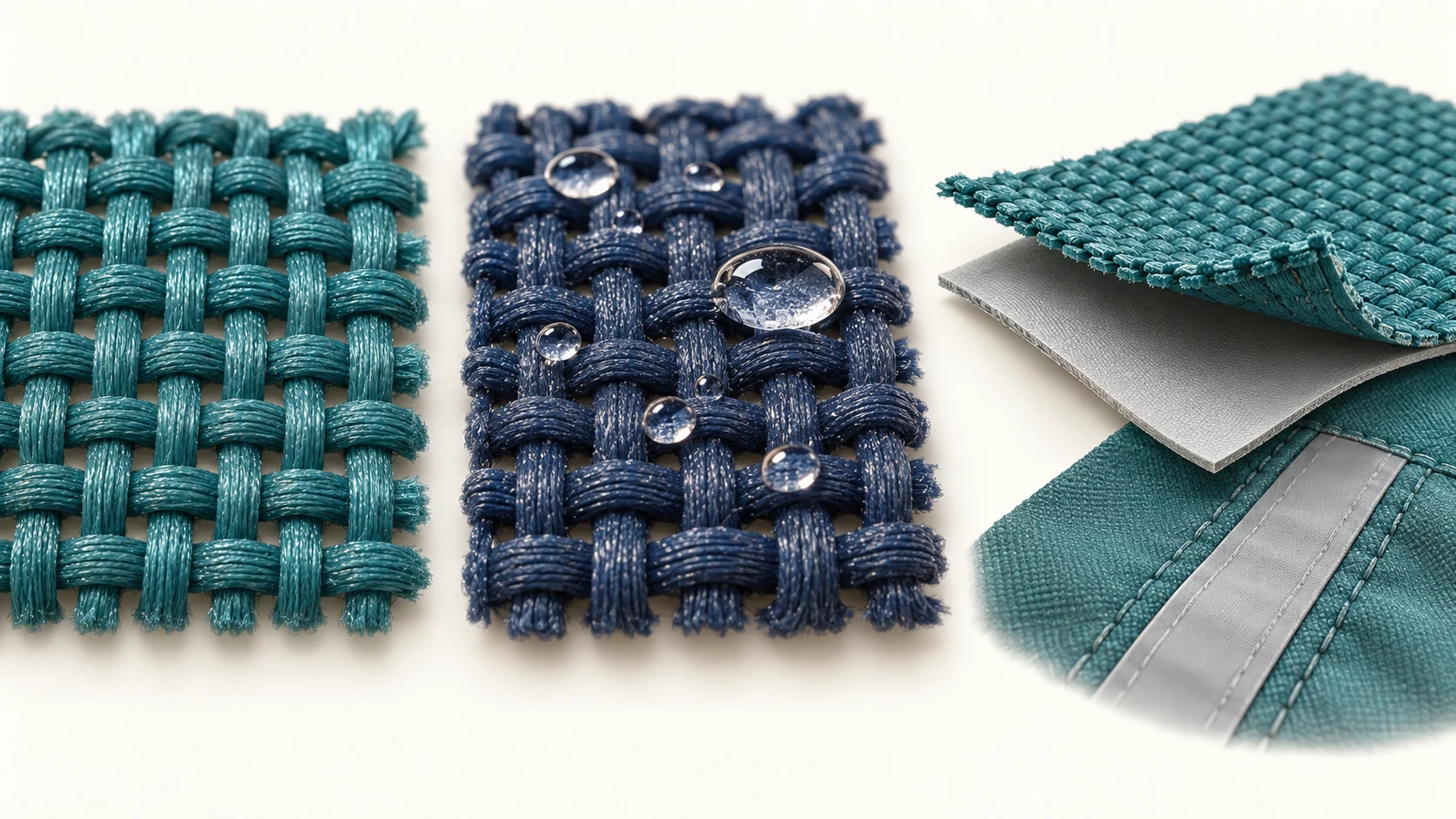
When a listing says only “treated polyester,” ask what the treatment does. A description that does not distinguish surface repellency from a water-blocking layer is incomplete for a waterproof purchase decision.
Can a waterproof fabric still make a bag or cover that leaks?
Yes. A fabric claim does not establish the performance of every seam, closure and opening in the finished item. Those details belong in the assessment whenever keeping the contents dry is part of the purchase requirement.
GORE’s explanation of its own waterproof apparel includes membranes, seam tapes, garment construction and other materials. It also identifies unsealed needle holes as a possible route for water after alterations. This is a manufacturer-specific example, rather than proof that every polyester product needs the same construction. It demonstrates why a swatch result cannot answer every finished-item question.
For a bag, ask whether the waterproof claim covers the main compartment, its closure and attachment points. For a cover, identify the areas expected to face rain and the openings that remain exposed. For fabric sold by the roll, ask the maker of the finished item how the selected construction will be joined and closed.
A useful requirement describes the actual exposure. “Keep the contents dry during outdoor storage” raises different questions from “shed occasional splashes during indoor handling.” Record the direction, duration and practical consequences of water exposure instead of accepting one broad adjective for both situations.
Which evidence distinguishes water repellency from waterproofness?
Ask what was tested, how it was tested and which result supports the claim. A photograph of droplets is evidence of an appearance at that moment. It is not a substitute for an identified water-penetration result.
Two ISO test descriptions make the distinction clear. ISO 4920 assesses resistance to surface wetting using a spray test. Its public abstract explicitly says the method is not intended to predict rain penetration. ISO 811 assesses fabric resistance to water penetration under hydrostatic pressure. These are different questions, so the results should not be treated as interchangeable.
Neither standard’s name, by itself, tells you whether a particular product meets your requirement. A report must identify the specimen and result, and the agreed specification must state what is acceptable. A fabric test also needs to be distinguished from a test of the assembled bag, garment or cover.
When comparing reports, look for the exact material reference, test method, specimen condition and reported outcome. If a supplier says a finish remains effective after care, ask what care or conditioning preceded the reported test. A new swatch and a used item are different evidence subjects; the paperwork should make that boundary visible.
How should you compare two polyester products?
Compare both products against the same exposure and evidence questions. The decision is easier when each claim has a defined subject, rather than a mixture of fibre labels, marketing descriptions and unrelated photographs.
Consider this hypothetical comparison. Product A is labelled “100% polyester, water repellent.” Product B is described as a polyester-faced laminate with a separate barrier and specified seam treatment. Product B gives you more construction information. That does not make it automatically suitable: you still need evidence for the intended exposure and the finished item.
If both sellers provide only a droplet photograph, neither has answered the water-penetration question. If one provides a fabric report, check whether your requirement concerns the fabric or the complete product. The aim is to find the missing answer before purchase, rather than rank products by how technical their descriptions sound.
- Identify the item: Record the exact fabric or product reference, including the relevant construction or backing.
- Describe the exposure: State whether the concern is a splash, rain or another defined condition, and what needs to remain dry.
- Match the evidence: Request a result that addresses that concern and identifies whether it applies to a swatch or the finished item.
- Check the boundaries: Clarify seams, closures, care instructions, exclusions and the condition in which the performance was assessed.
These questions are also useful for procurement records. Retain the product reference beside the supporting report, not just the supplier’s general fabric brochure. If a later order changes the backing or construction, ask whether the previous evidence still applies.
Will a waterproofing spray make any polyester item waterproof?
A spray application alone is not evidence that the whole item is waterproof. Establish which property the product is intended to restore or add, whether it is suitable for that material, and which areas remain outside its scope. Surface beading does not answer the questions about penetration, seams or closures.
Follow the finished item’s care instructions and the treatment manufacturer’s directions. Do not transfer a heating, washing or reproofing instruction from one branded laminate to an unrelated polyester fabric. If the construction or treatment is unknown, ask the supplier before changing it.
For a purchase that depends on keeping water out, the decisive information is the specified construction and relevant evidence. “100% polyester” is useful composition information. It is not the final answer to that decision.
References
- UK Fabrics Online: Is Polyester Waterproof? — supplier explanation of composition, fabric structure and treatment.
- EVS: ISO 811:2018 — official public description of fabric water-penetration testing by hydrostatic pressure.
- EVS: ISO 4920:2012 — official public description and scope limits of the surface-wetting spray test.
- GORE-TEX technical FAQ — membrane construction, seam treatment, DWR and care distinctions within the manufacturer’s product systems.