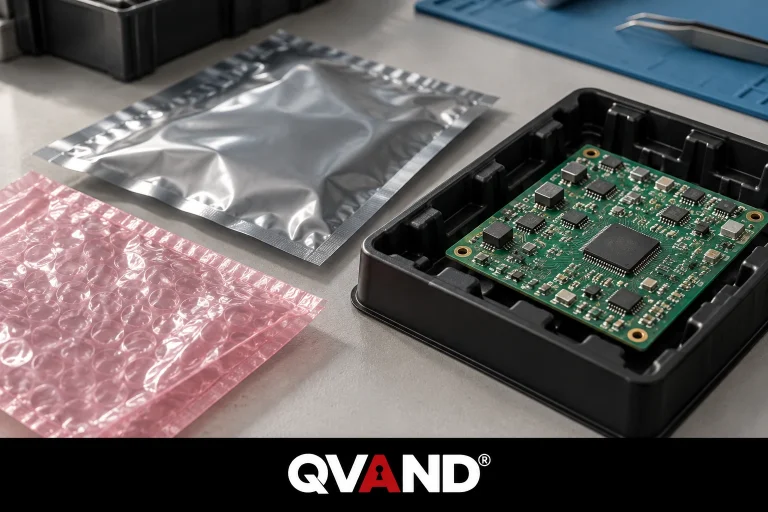


How do Faraday bags work? A Faraday bag uses a conductive shielding layer and a closed construction to reduce radio-frequency coupling into or out of the space around a small electronic device. The useful question is not whether the label sounds protective, but which signals, device, closure, and test conditions the bag is designed to address.
A Faraday bag can be relevant when a phone, key fob, handheld radio, tablet, test device, or stored electronic component needs temporary isolation from radio signals. It should not automatically be treated as an ESD control product, a universal signal blocker, or a substitute for a documented test result.
1. How a Faraday bag creates a shielding boundary
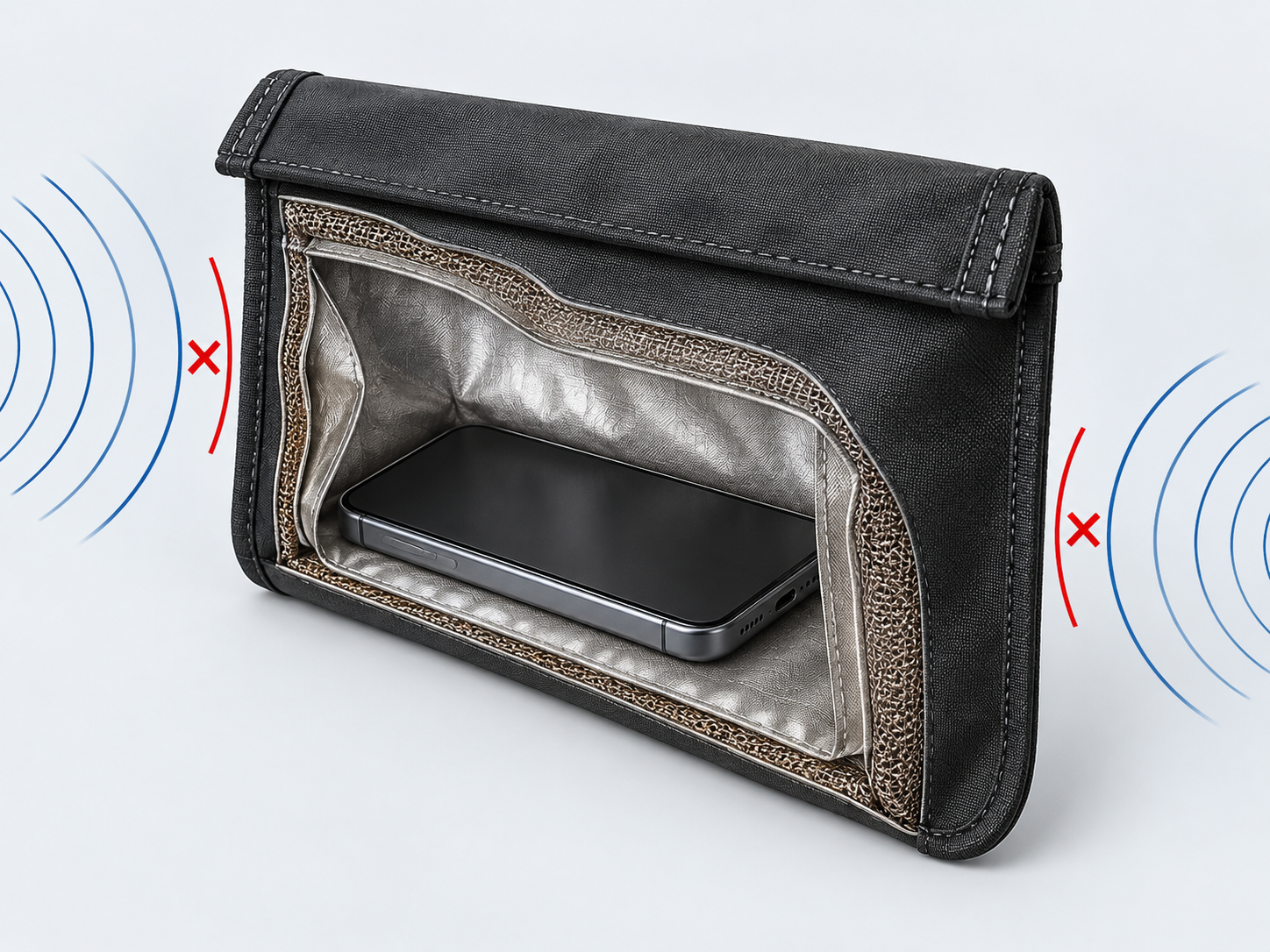
The bag surrounds the device with a conductive or shielding layer. When the enclosure is continuous enough for the intended application, incoming electromagnetic energy interacts with that layer instead of reaching the device in the same way as it would in open air. The result depends on the material system, the geometry, the signal frequency, and the integrity of the closure.
The opening is often the most important practical detail. A folded flap, zipper, seam, window, handle, or cable path can create a discontinuity in the shielding boundary. That is why a product photograph or a material name cannot establish the performance of the complete bag. The closure must be part of the test and the use case.
Frequency matters because the same construction can behave differently across the signals that a device encounters. A request that names the operating bands, nearby transmitters, and expected use distance gives a supplier a testable problem. A request for “complete protection” leaves the frequency range and acceptance condition undefined.
2. Faraday shielding is different from ESD protection
Radio-frequency shielding and electrostatic-discharge protection answer different questions. RF shielding concerns electromagnetic coupling across a frequency range. ESD protection concerns charge generation, charge dissipation, and the handling conditions that can expose a sensitive device to a discharge.
A bag may be described as antistatic, conductive, dissipative, or shielding, but those words do not prove the same function. A procurement request should identify whether the device needs radio isolation, static-charge control, physical packaging, or several of these requirements together. The test method should match the decision.
Grounding belongs to the system design and test method as well. A portable bag may be used as a passive enclosure, while a fixed enclosure may include bonding, filters, or controlled cable entry. Do not assume that grounding a bag creates a verified RF result; ask how the complete configuration was evaluated.
For an electronics workflow, review the bag as part of the route: when the device enters, how the opening is closed, whether a cable remains connected, how often the bag is reused, and what happens when the device leaves the bag. Those details are more useful than treating a product category name as a complete engineering specification.
Handling also affects repeatability. A pouch that is folded, compressed, opened repeatedly, or stored with a sharp component may develop wear at the seam or closure. Include inspection, cleaning, replacement, and traceability in the work instruction when the bag protects evidence, a test device, or a controlled electronics shipment.
The right comparison is therefore between complete configurations. Ask whether the bag is single-layer or multi-layer, how the closure is formed, whether an inner liner changes the use case, and whether the stated result applies to the packed device rather than an empty sample. These questions keep a high-volume category term tied to a usable purchasing decision.
3. What to verify before choosing a Faraday bag
- Device and route: record the device size, connectors, storage period, movement route, and whether the device must operate while enclosed.
- Shielding task: state the radio sources or signal bands that matter, rather than asking for a vague “all signals” result.
- Complete enclosure: ask how the flap, seam, zipper, window, handle, and any cable path are included in the evaluation.
- Evidence: request the model, test method, frequency conditions, result, revision date, and limitations attached to the report.
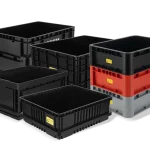
The CH-ESD product routes can help organize the handling decision. The ESD shielding bag page is a first-party route for reviewing a bag configuration, while the ESD Box category provides a separate rigid-storage route when portability is not the primary requirement.
Choose a flexible bag when the device needs temporary portable isolation and the closure can remain complete during the task. Consider a rigid enclosure when the workflow needs repeatable dimensions, stacking, mechanical protection, or a fixed access pattern. Either choice still needs evidence for the intended shielding task and frequency range.
FAQ
What is a Faraday bag?
A Faraday bag is a portable shielding enclosure intended to reduce radio-frequency coupling around a small device. The result depends on the bag construction, closure, frequency range, and test conditions.
Do Faraday bags block all signals?
A universal answer is not technically safe. Signal isolation depends on frequency, seams, closures, windows, cable paths, construction, and the test method. Ask for model-specific evidence for the signals that matter in your route.
References
- CISA EMP Protection and Resilience Guidelines — Faraday bag construction, frequency dependence, closure leakage, and evaluation limits.
- NIJ/OJP Forensic Pouch Evaluation Report — example of model-specific test context for a shielding pouch.
- ESA Electromagnetic Compatibility Test Centre — continuous conductive enclosure context for shielding.