
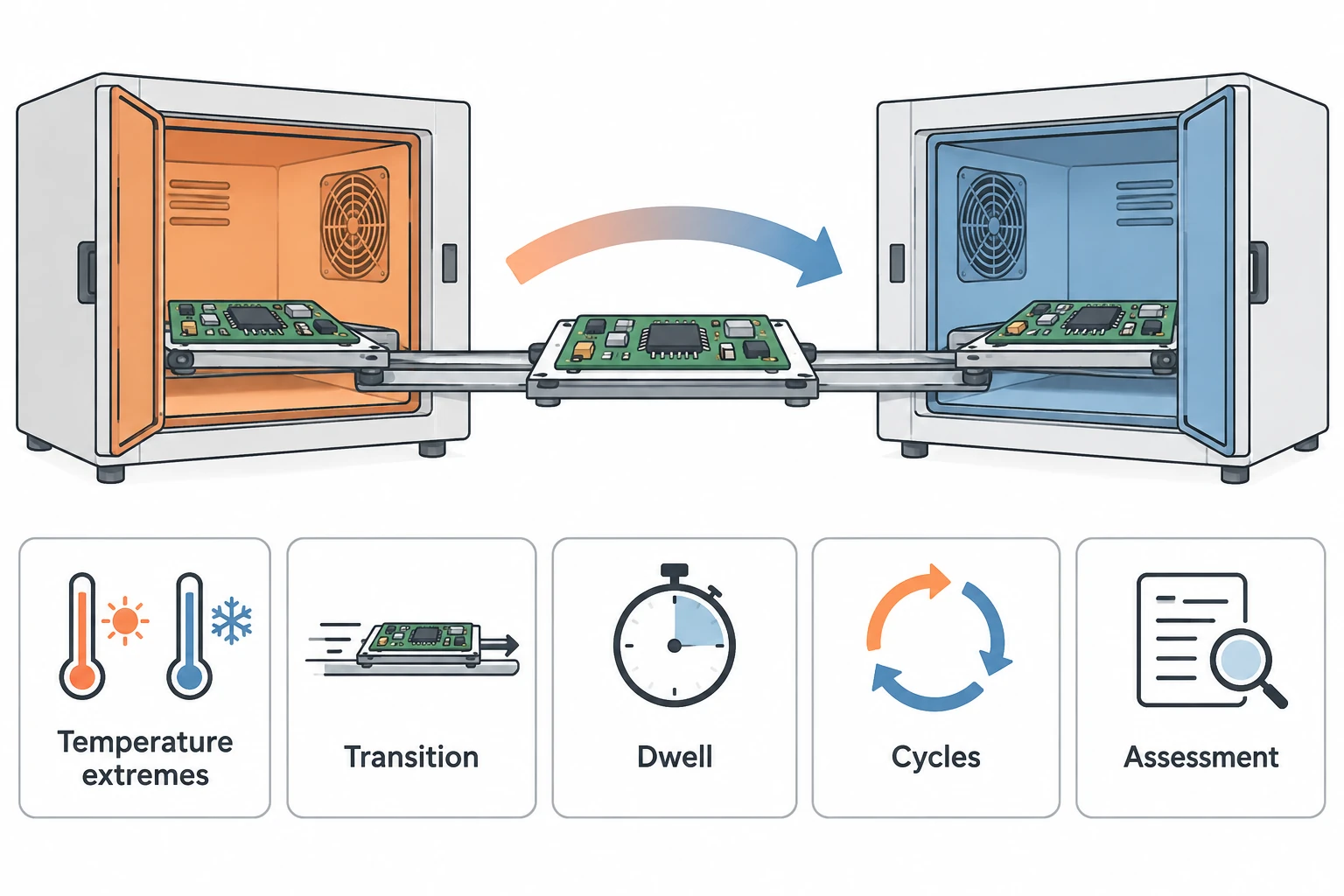
Thermal shock testing exposes a specimen to rapid changes between temperature conditions to investigate weaknesses in its materials and assembly. For electronics, the question is not simply whether a board survives a hot chamber. The transition between conditions, the specimen’s response and the assessment after exposure all matter.
A useful test request therefore identifies the assembly, the purpose of the test and the intended result to evaluate. A chamber’s advertised temperature range is not a ready-made requirement for every product placed inside it.
What thermal shock can reveal in electronics
The University of Alabama in Huntsville’s reliability laboratory describes rapid hot-to-cold transfers as a way to investigate components and solder stress fractures. This illustrates why an assembly can require more investigation than a static temperature exposure provides. It does not mean every observed failure is caused by the same mechanism.
ESPEC distinguishes reproducing expected conditions from deliberately applying stress to reveal weaknesses. That distinction should appear in the test objective. Are you evaluating a defined service exposure, investigating a suspected defect, or developing a production screen? Those purposes should not be merged into one unexplained “reliability test.”
Methods differ in how the specimen changes temperature
Thermal shock commonly involves rapid transfer between hot and cold conditions. Temperature cycling can follow a controlled temperature-change profile instead. The precise method and terminology must be tied to the chosen specification and apparatus rather than inferred from a broad laboratory service name.
| Record item | Why it matters to interpretation |
|---|---|
| Temperature extremes | Describe the selected exposure, not just chamber capability |
| Transition | Identifies how the specimen moves between conditions |
| Dwell | Documents time associated with each condition |
| Cycles | Records the repeated exposure used |
| Assessment | States which physical and functional changes are evaluated |
Ask the laboratory how specimen temperature is established or recorded where the method requires it. Air temperature and the temperature history of the assembly are different information. A useful report makes the applicable distinction explicit instead of leaving the buyer to infer it from a chamber setting.
Exposed controller assemblies and packaged units answer different questions
Consider a hypothetical controller evaluated first as an exposed assembly and later inside its shipping package. The specimen configuration has changed. Before comparing the results, record the board revision, enclosure, packaging, fixtures and operating state used in each assessment.
If the purpose is to investigate the controller itself, explain why any surrounding packaging is present. If the purpose concerns the packed product, retain the packaging specification with the result. Neither test should silently become evidence for every alternative foam insert, case or board configuration.
The same care applies to a repair or redesign. A replacement component or changed attachment is a reason to ask whether the previous evidence still describes the current assembly. It is not automatically proof that the product is worse, better or equivalent.
Plan the assessment before the exposure
Define what will be checked before testing and what comparison will be made afterwards. Record the observed condition and functional checks appropriate to the product. A report saying only “no visible damage” does not answer a separate requirement about operation, just as a successful functional check may not answer every mechanical question.
When a failure occurs, preserve its location, timing and specimen identity. Those details allow the responsible engineering team to investigate the mechanism. Increasing the stress or repeating a cycle without a defined question can produce more damaged samples without resolving the cause.
Handling equipment is not automatically a chamber fixture
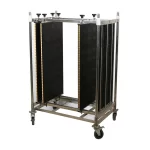
CH-ESD’s PCB magazine racks provide separate slots for board handling, inspection and storage. That category-level description does not establish suitability for a particular thermal-shock exposure. Verify the actual model’s materials, temperature limits and fixture requirements before including it in a test configuration.
Send the laboratory an assembly description, intended test purpose, relevant specification and proposed assessment. Keep the chosen conditions and report with the tested configuration. This produces a result that can support a specific engineering decision instead of an undefined claim that a product is “thermal-shock proof.”