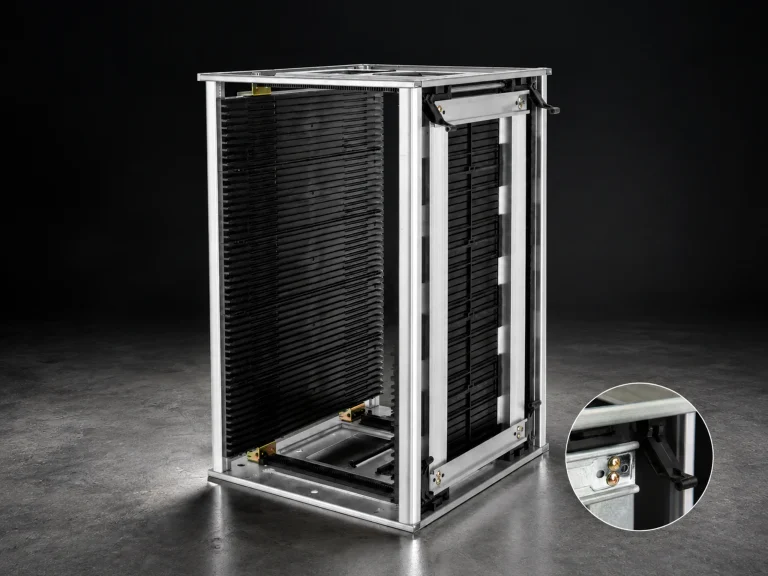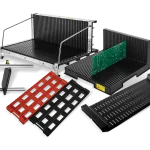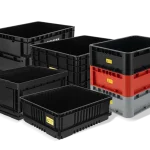


ESD storage containers, including storage boxes and tote containers, should be selected by what they must hold, how operators reach the contents, how parts are separated, and where the container moves. A lidded ESD tote box can suit contained storage and transfer, while an open or front-access format can be better when repeated picking is the main task.
Start with the part envelope and handling route. Then confirm the exact material, dimensions, load, closure, and documentation for the selected configuration. The CH-ESD ESD Box family provides the product route; the individual product page must support any model-specific value. Use “ESD storage box” and “ESD tote box” as selection terms only when the offered configuration supports the stated access and movement use case.
1. Match ESD storage containers to the component envelope
Measure the largest part package, board, bag, or nested assembly that must sit inside the container. Include clearance for labels, separators, protective layers, and the hand motion needed to remove the item. A container that technically holds the part can still be a poor choice if the operator must force the part in or disturb nearby items during retrieval.
The published ESD Box pages show why the model matters. The lidded thick-wall family lists several 600 × 400 outer formats with model-specific inner sizes, while the turnover-box family lists 400 × 300 outer formats with different inner dimensions. Treat those values as model data, not as a universal ESD container specification.
| Workflow question | What to confirm |
|---|---|
| What must fit? | Largest envelope, clearance, separators, and label space. |
| How is it reached? | Top, front, drawer, or lidded access and withdrawal frequency. |
| Where does it move? | Shelf, line-side station, cart, receiving area, or interdepartment route. |
Check both the external footprint and the usable inner space. External dimensions determine whether an ESD storage box fits the shelf, cart, or workstation; internal dimensions determine whether the part, divider, and retrieval clearance fit together. Confirm nesting or stacking only from the offered configuration, because a similar outer size does not prove the same support surface or load behavior.
A short trial with representative parts can expose issues that a catalog table misses. Check for labels hidden behind a shelf beam, reduced divider clearance, lid interference, and parts that shift during transfer. Record those observations against the model and drawing revision before approving the container.
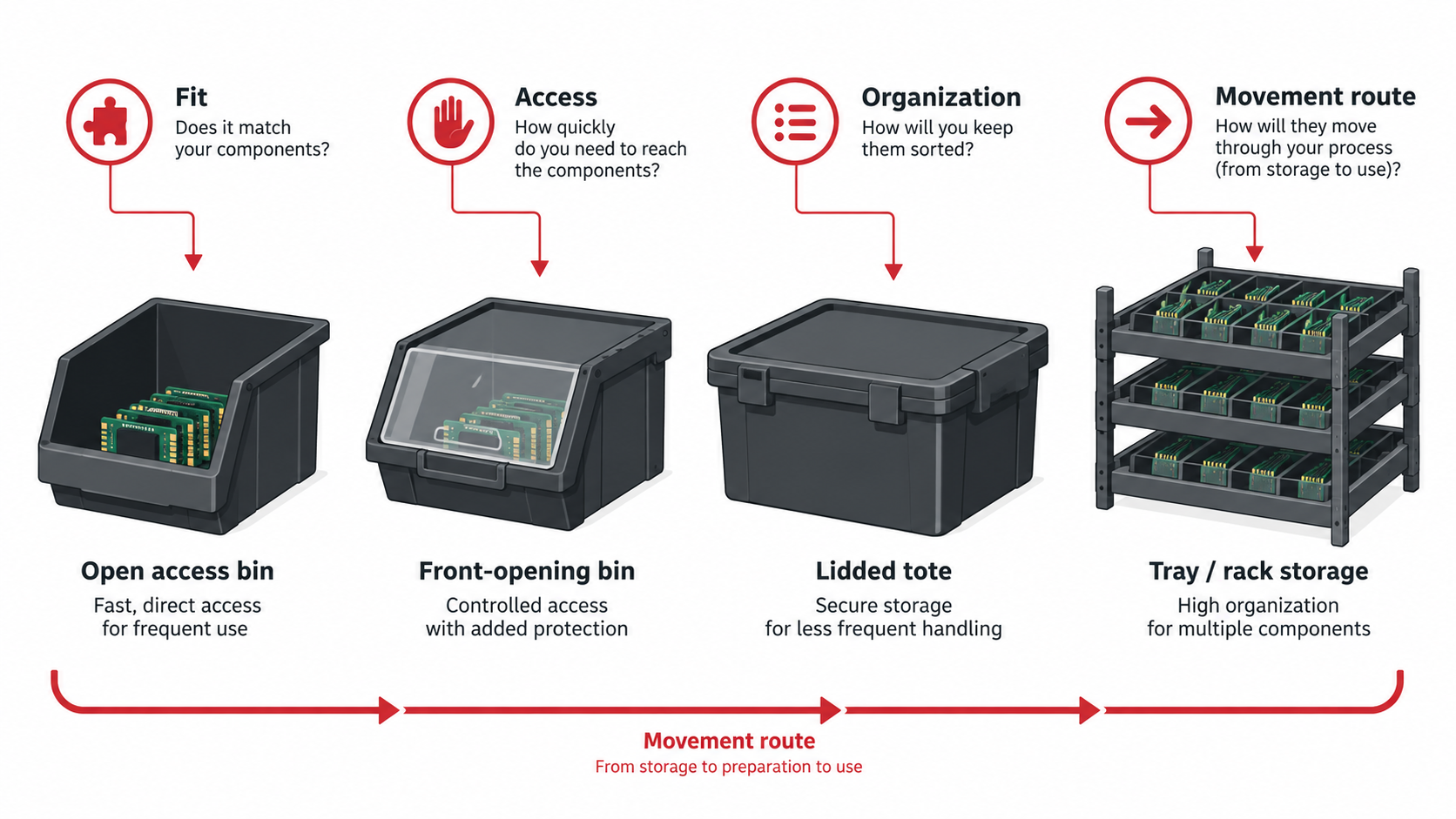
2. Choose open access, front access, or a lid
Open access supports visual identification and frequent picking. Front access works when the container sits on a shelf or rack and the operator normally reaches from the front. A lidded ESD box is useful when the process needs a contained package between handling steps, but the lid adds an opening and closing action that should fit the route.
Do not choose a lid simply because it sounds more protective. Confirm whether the container stays inside an ESD Protected Area, whether the item will leave that area, and whether the closure remains in place during movement. EOS/ESD guidance distinguishes the requirements for material-handling containers inside an EPA from packaging used outside it, so the route changes the evidence request.
3. Control mixing with dividers, labels, and repeatable positions
Organization features solve a different problem from ESD material properties. Dividers can separate SKUs or lots, but they consume usable space. Labels improve identification, but the label position must remain visible at the normal access point. If the same container moves through receiving, storage, and production, use the same position logic at each handoff.
- Separate parts that must not be mixed during replenishment.
- Reserve clearance for labels and dividers before approving the inner size.
- Define how an empty position is identified so the next operator does not infer its contents.
4. Connect the container to the ESD-control route
EOS/ESD Part 3 describes packaging and material-handling containers as low charging and dissipative or conductive inside an EPA. Outside the EPA, the packaging also needs a structure that provides discharge shielding. That distinction means a buyer should define the route before asking whether a box is “ESD safe.”
The container is one part of the control method. Grounding, handling procedures, storage location, and loading or unloading conditions still affect the risk. Ask the supplier to state which material classification, test basis, and conditions apply to the offered model. Do not transfer a number from one box family to another.
5. Request the configuration evidence before ordering
- Contents: component type, largest package, quantity, and whether parts are loose, bagged, boxed, or nested.
- Mechanical fit: external and internal dimensions, usable volume, load or stacking information, and support surface.
- Organization: divider layout, label position, lot separation, and replenishment method.
- ESD evidence: material classification, test method or test basis, applicable packaging documentation, and conditions attached to the result.
- Commercial fields: quantity by configuration, shipment packaging, identification marks, and revision or date of the supplied specification.
Review the ESD Box family after defining the use case
Once the envelope, access pattern, organization method, and route are clear, review the ESD Box category and compare the configuration-specific information on the product page. If the workflow needs a different access or organization pattern, the site also lists ESD Bins and ESD Trays; those are alternative product routes, not interchangeable specifications.
References
- EOS/ESD Association: ESD Fundamentals, Part 3 — packaging and material-handling container context inside and outside an EPA.
- EOS/ESD Association: ANSI/ESD S541-2026 — packaging properties and evaluation context for production, transport, and storage.
- IEC 61340-5-1:2024 — general ESD control-program scope for organizations handling electronic parts.