

What is a Faraday cage? A Faraday cage is a conductive enclosure that reduces electromagnetic coupling into or out of an enclosed space. The basic idea is simple, but the result depends on continuity, openings, seams, cable penetrations, construction, frequency, and the test setup. A metal-looking box is not automatically a qualified Faraday cage.
For electronics buyers, the practical job is to connect the shielding objective to the enclosure evidence. A cage for an EMC test environment, a portable RF enclosure, an EMP case, and an ESD storage box may look related while serving different functions.
1. How a Faraday cage shields an interior
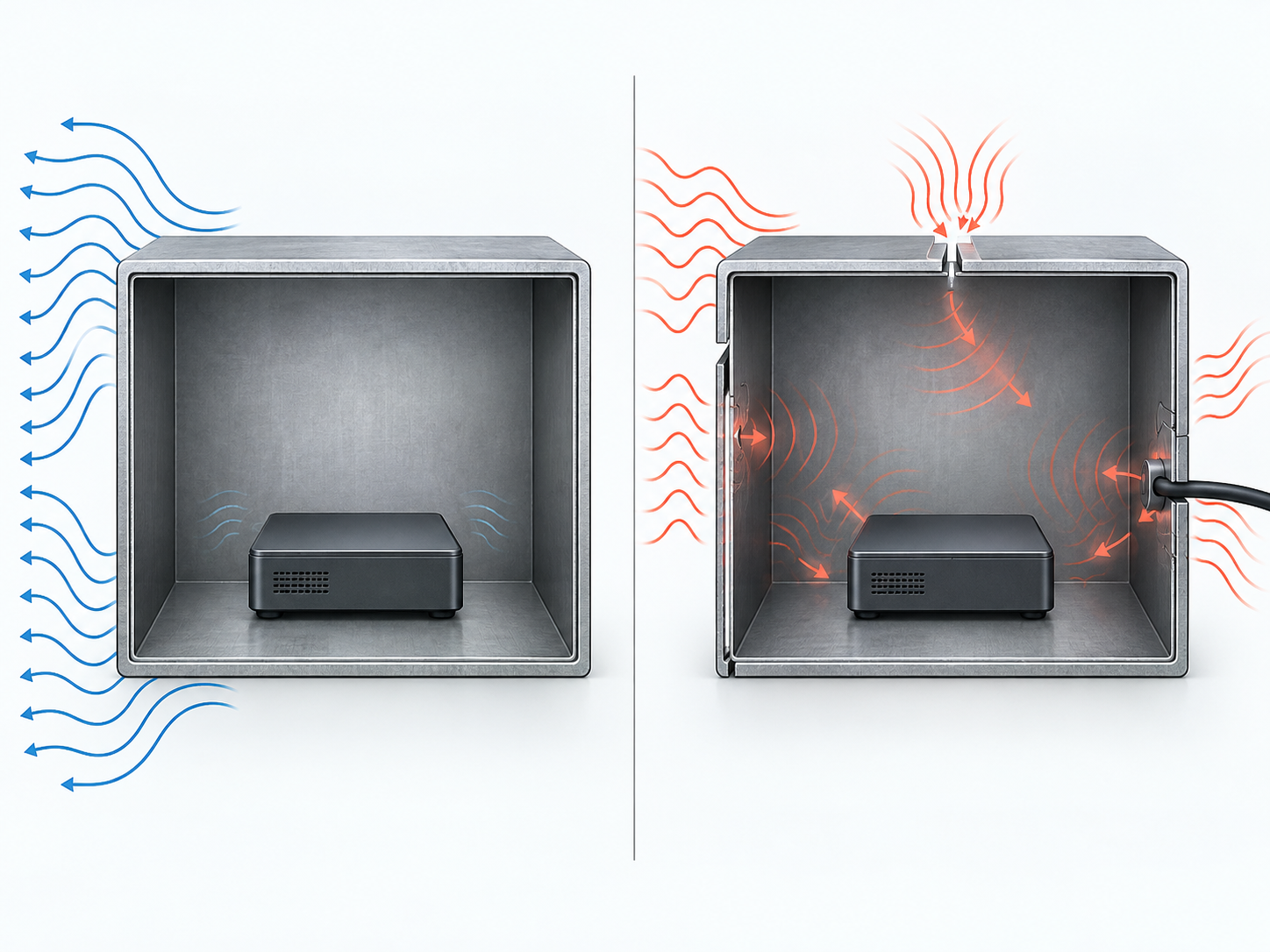
A continuous conductive surface gives charge and electromagnetic energy a path around the outside of the enclosure. The interior is separated from the external field according to the enclosure geometry and the conditions of the field. This is why a Faraday cage is usually described as a closed or substantially continuous conductive boundary.
The word “continuous” does not mean that every cage has the same result. Doors, seams, ventilation openings, display windows, joints, and cables can interrupt the boundary. A design must control those details for the frequency range and test condition that matter.
The enclosure therefore works as a system rather than as a material label. A conductive panel can perform differently when a door gap, mesh aperture, fastener, gasket, or connector is added. The size and shape of openings also matter in relation to the wavelength under evaluation, so the test setup must describe the complete assembled enclosure.
2. Which enclosure details change the result
- Openings and seams: check how doors, lids, joints, windows, and ventilation paths preserve the shielding boundary.
- Cable penetrations: identify every cable, connector, filter, and feed-through that crosses the enclosure.
- Frequency and geometry: define the electromagnetic environment and the enclosure dimensions before comparing materials or designs.
- Test configuration: request the method, antenna or source arrangement, device position, result, and limitations attached to the evidence.
A grounding connection may matter in a particular system, but it should be discussed with the enclosure design and test method. Do not reduce the entire problem to “add a ground wire” or “use metal.”
For a facility or laboratory request, record the source or receiver, frequency range, enclosure dimensions, door or lid arrangement, ventilation, cable entry, and acceptance limit. This turns “Faraday cage” into a reviewable engineering requirement. It also makes it possible to compare a permanent room, a test chamber, a portable case, and a small storage enclosure without treating them as interchangeable.
A useful acceptance record should also identify whether the enclosure was empty or loaded, whether the door or lid was fully closed, and where probes or antennas were positioned. Without those details, two results with the same headline number may describe different conditions. The evidence should stay attached to the exact model, revision, assembly, and test date.
When the enclosure changes, repeat the review rather than carrying an old result forward. A new gasket, cable gland, ventilation panel, or access window can change the boundary. Record those revisions with the test report so engineering, purchasing, and operators are evaluating the same configuration.
Keep that acceptance record with the enclosure revision and purchasing file.
3. A Faraday cage is not automatically an ESD storage box
ESD storage products are selected to manage handling, packaging, charge, and device protection in a defined workflow. A Faraday cage is selected to control electromagnetic coupling around an enclosed space. Some systems may need both functions, but one product label does not prove both.
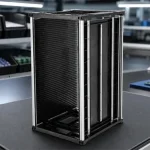
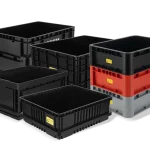
The CH-ESD ESD Box category lists storage formats. A relevant lidded ESD storage box can be evaluated for component handling, closure, route, and material evidence. It should not be described as an RF Faraday cage unless a current model-level shielding report supports that claim.
That distinction is useful during purchasing. If the requirement is safe movement and storage of sensitive parts, ask about material classification, charge behavior, dimensions, stacking, lid fit, and handling instructions. If the requirement is electromagnetic isolation, ask for shielding effectiveness evidence under the relevant frequency and assembled configuration. One checklist should not be used as a substitute for the other.
For a mixed electronics workflow, separate the two records even when the same container is being considered. Keep the ESD handling specification with the packaging decision and keep the RF result with the shielding requirement. That prevents a conductive or static-dissipative description from being reused as evidence for electromagnetic performance.
FAQ
What is a Faraday cage?
A Faraday cage is a conductive enclosure intended to reduce electromagnetic influence inside or outside the enclosure. The actual result depends on continuity, openings, frequency, geometry, and test conditions.
How does a Faraday cage block electromagnetic fields?
The conductive boundary redistributes charge and provides a path around the enclosure, reducing coupling into the interior under the relevant conditions. Openings, seams, cables, and construction can change the result, so a specific enclosure needs specific evidence.
References
- ESA Electromagnetic Compatibility Test Centre — continuous conductive shielded chamber context.
- NASA Shielding Guidance — continuous surfaces, openings, penetrations, and enclosure integrity.
- Physics Classroom: Electric Fields and Conductors — educational explanation of conducting surfaces and shielding.