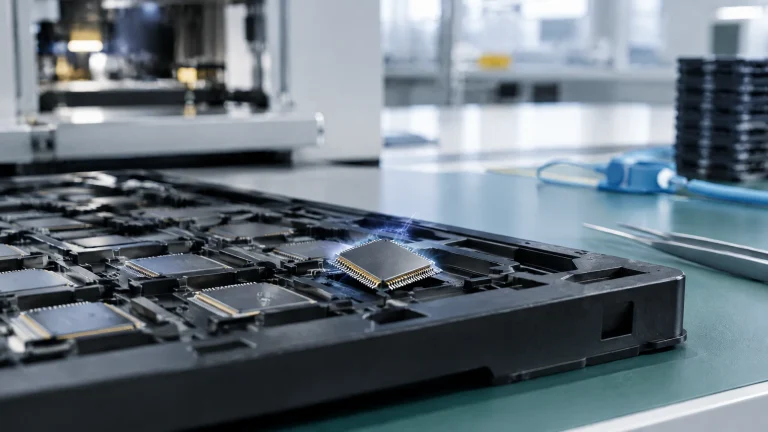


How does static electricity work? Static electricity is an imbalance of electrical charge that remains on or near a material instead of flowing immediately through a circuit. The imbalance can build at a surface, influence nearby objects, and eventually find a path to discharge.
For electronics, the important sequence is charge generation, accumulation, and transfer. A person, packaging material, tool, fixture, or circuit board can become part of that sequence during ordinary movement and handling.
How Does Static Electricity Work? Charge Imbalance First
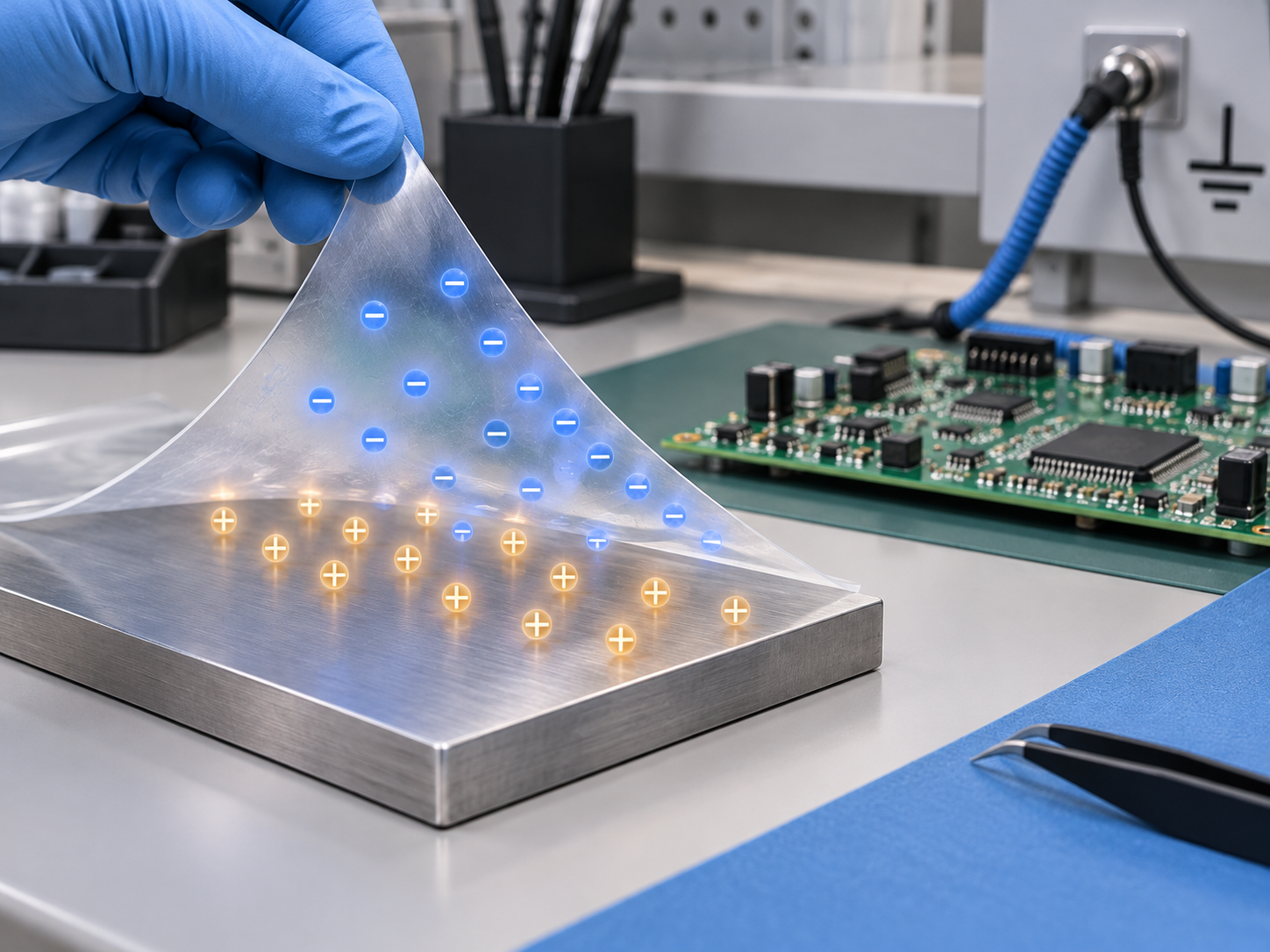
Objects are normally close to electrically balanced. When electrons move from one surface to another, one object can become relatively negative and the other relatively positive. The charge may remain in place because the material and surrounding path do not allow it to equalize quickly.
This is why static electricity is different from the continuous current in a powered circuit. It can be quiet and invisible until the electric field or potential difference creates a discharge path.
The charge does not need to look dramatic to matter. A surface can hold an imbalance while an object is being moved, stored, or prepared for the next operation. The surrounding materials, humidity, geometry, and available ground path influence how long the condition remains.
Contact and separation create common charge events
Rubbing is one visible example, but contact and separation can happen without obvious friction. A board sliding into a tray, film peeling from a surface, a package opening, footwear moving across a floor, or a tool leaving a fixture can all change the charge state of the materials involved.
The result depends on the materials, surface condition, motion, humidity, geometry, and available path to ground. That is why a single label such as “static-safe” cannot explain the behavior of a complete process.
For example, a package can become charged when a film is removed, a board can acquire charge when it slides into a tray, and a tool can become part of the discharge path when it approaches a conductor. The practical control question is where the charge can go next.
Why a discharge can affect electronics
When a charged body approaches or touches a different potential, the charge can transfer rapidly. An ESD event may alter a device, upset a system, or create damage that is discovered later. The risk depends on the device, discharge path, process, and control measures.
That is why ESD control combines several actions instead of relying on a single material. The operator, work surface, fixture, package, and item should be reviewed as one route. A change in one element can change the discharge path even when the rest of the workstation looks unchanged.
The sequence also explains why packaging and workstation controls are connected. The package may protect the item during transport, but the operator still needs a controlled method when the package is opened. A grounded surface may control one step, while a suitable tray or bag controls the next.
A practical review asks where charge is generated, where it can accumulate, and what happens when the item reaches a conductor. Those questions are more useful than treating static electricity as a mysterious spark or assuming that every antistatic label describes the same function.
Keep the answer tied to the actual device and route. A change in packaging, tooling, surface, or operator procedure should trigger a new check of the charge path and the available ESD controls.
The same mechanism can be harmless in one step and risky in another. A charge that remains on an isolated package may become a problem when the package is opened beside an exposed circuit. The control plan must follow the item through that change in state instead of judging only the package or the workstation by itself.
Static electricity examples are useful when they show the route: contact or separation creates an imbalance, the imbalance remains because the path is limited, and a later approach or touch provides a transfer path. This sequence helps an operator locate where a process change needs review.
In practice, an ESD control review records the material, motion, operator contact, grounding method, and package state for each sensitive step. If one of those inputs changes, repeat the review with the same device and route. That keeps a general explanation of static charge connected to a real production decision.
- Reduce generation: review materials, motion, packaging, surfaces, and process steps that create charge.
- Control the path: use the approved grounding, dissipation, and workstation method.
- Protect the item: use packaging and handling formats matched to the item and route.
- Verify changes: recheck substitutions, openings, and material claims against the process evidence.
The CH-ESD product catalog and ESD Box category can help review storage and handling routes, but they do not replace device-specific ESD evidence.
FAQ
How does static electricity work?
Charge can move between surfaces during contact and separation, leaving an imbalance that remains until a conductive or discharge path equalizes it. The visible shock is the final transfer, not the entire charge-generation process.
Why does static electricity damage electronics?
A rapid discharge can pass through or influence sensitive device structures. Whether damage occurs depends on the item, discharge path, energy, and the ESD controls around the process.
References
- EOS/ESD Fundamentals Part 3: Basic ESD Control Procedures and Materials — charge imbalance and everyday examples.
- IEEE Technology Navigator: Static Electricity — static charge and electronics context.
- EOS/ESD Fundamentals Part 1 — static electricity, ESD events, and electronics risk.