

What are antistatic materials? They are materials or material systems intended to reduce the risk of unwanted electrostatic charge during a defined handling task. In electronics, the useful decision is not whether a product carries the word antistatic, but what the material must do when it touches, stores, supports, or moves an ESD-sensitive item.
A material can reduce charge generation, allow controlled dissipation, provide a conductive path, or contribute to shielding. Those roles overlap in everyday marketing language, but they are not interchangeable engineering claims.
Antistatic, dissipative, conductive, and shielding are different tasks
Antistatic usually describes a lower tendency to build up triboelectric charge during contact and separation. A static-dissipative material is selected when charge must move away in a controlled manner. A conductive material provides a stronger electrical path when the system is designed to use that path. Shielding is a separate question about reducing an external electrostatic or electromagnetic influence around an item.
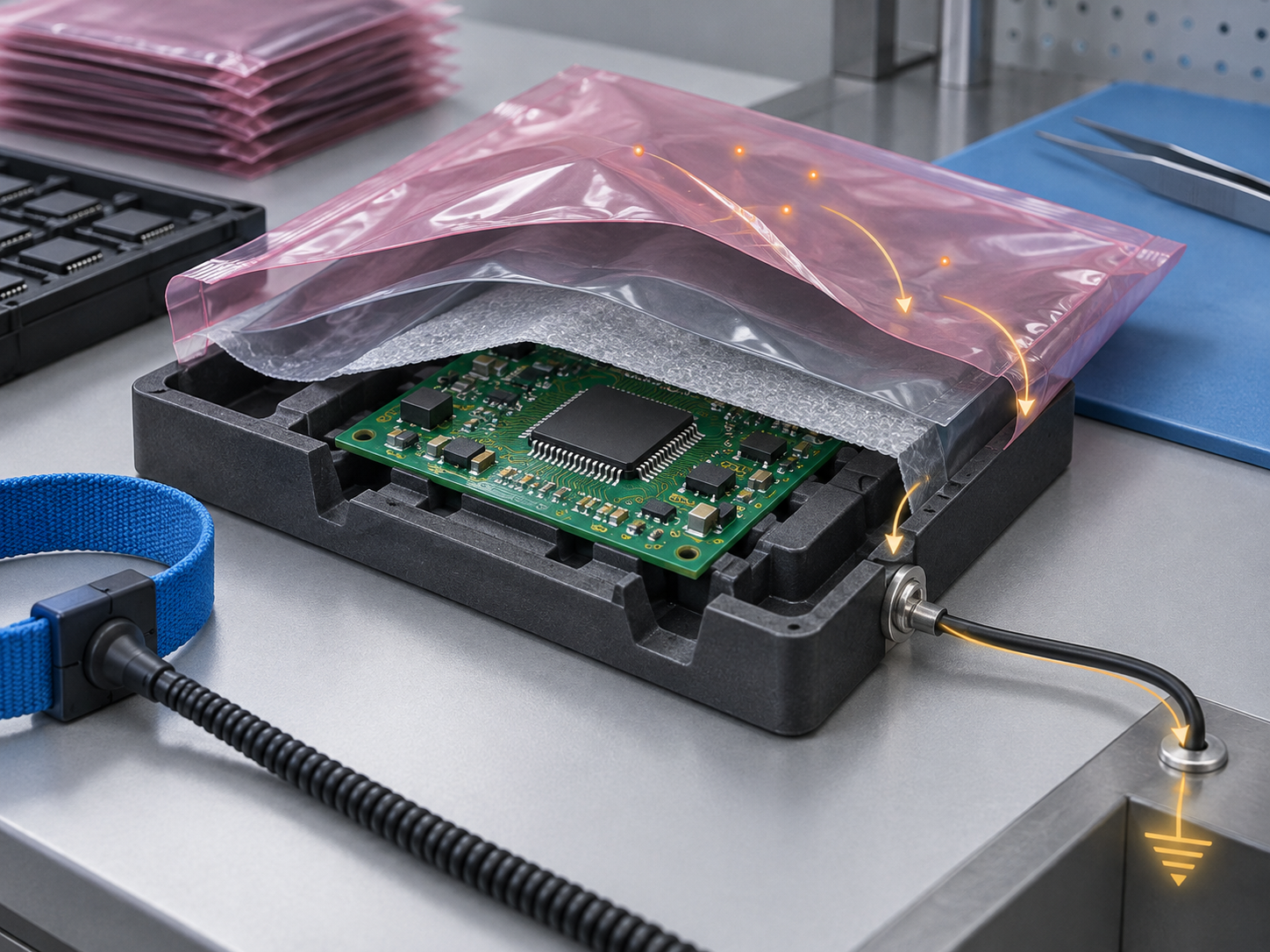
The same package may use several material functions. An inner layer can protect the component from contact, an outer layer can reduce handling charge, and a grounded workstation can provide the discharge path. The material name alone does not tell you how those layers work together.
A useful specification starts with the failure or handling concern. If the item must remain isolated during transport, the package and closure matter. If it sits on a work surface, the contact and grounding arrangement matter. If a tool touches a lead or connector, the tool and fixture material matter. The same word cannot answer all three questions.
How to choose an antistatic material for electronics
- Define the item: record the component envelope, exposed contacts, sensitivity information, and whether the item is loose, bagged, boxed, or assembled.
- Define the contact: identify whether the material touches leads, housings, boards, labels, tools, trays, or a work surface.
- Define the path: state whether the material is grounded, isolated, dissipative, or used inside a larger ESD-control system.
- Define the environment: include movement, storage time, humidity, cleaning, friction, stacking, and repeated opening.
- Request evidence: ask for the material classification, test method, configuration, revision, and limits that apply to the supplied item.
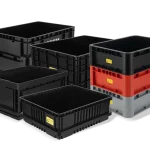
The CH-ESD product catalog helps separate product families, while the ESD Box category provides a storage route. These pages are starting points for configuration review and do not prove a universal material result.
Antistatic material selection needs process evidence
A substitution can change the charge path even when the color, shape, or product name looks similar. Review the new material with the work surface, grounding method, package closure, handling route, and device requirements. Keep the evidence with the approved configuration and revision record.
The selection record should identify the largest part, the contact surfaces, the storage and movement route, the opening frequency, and the cleaning or environmental conditions. It should also state which claim is being verified: lower charge generation, controlled dissipation, conductivity, shielding, or physical protection. That distinction keeps a useful material comparison from becoming a vague product promise.
When evidence is incomplete, keep the material as a candidate rather than marking the whole process protected. Ask the supplier for the test method, configuration, revision, and conditions that apply to the exact item. Recheck the decision whenever packaging, tooling, grounding, or the exposed device changes.
Pay attention to the interface between materials. A tray, liner, divider, label, adhesive, or fastener may change the contact path even when the main material is unchanged. The approved configuration should therefore record the parts that touch the item and the way the package is opened, closed, grounded, and moved.
For repeat purchasing, keep the supplier document with the material revision and incoming inspection record. This makes it easier to detect a formulation, thickness, surface, or accessory change before it enters the electronics process.
For a workbench, the key question is whether the material supports the approved grounding and handling method. For storage, the key question is whether the container, divider, closure, and label keep the item in the intended condition during movement and replenishment. Those are different decisions even when both formats are described as antistatic.
A procurement comparison should therefore place the material claim beside the configuration, test basis, revision, and use conditions. Ask the supplier to identify what was tested and how the result applies to the supplied part. A color, additive name, or marketing term is not a substitute for that record. The same record also makes later material substitutions easier to compare without losing the original use conditions.
FAQ
What is antistatic material?
It is a material or treatment intended to reduce unwanted electrostatic charge generation or accumulation in a defined use. The exact role and evidence depend on the material, contact, grounding, and process.
What is the difference between antistatic and conductive material?
Antistatic describes charge-generation behavior, while conductive describes an electrical path. A complete ESD decision may require dissipation, grounding, shielding, packaging, or several functions together.
References
- EOS/ESD Fundamentals Part 3 — grounding, materials, ionization, packaging, and handling controls.
- Newark ESD mitigation guidance — practical material and workstation considerations.
- Electronics Notes: ESD Basics — electronics handling and ESD work-surface context.