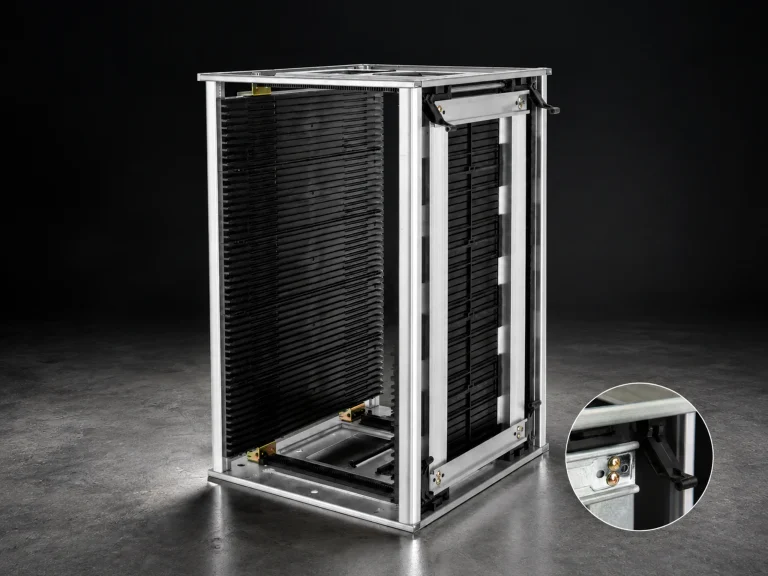


The best ESD compliant electronics containers for shipping are selected as a complete package: electrical protection, cushioning, rigid containment, closure, labeling, and the outer carton must match the route. A rigid tote can control handling and stacking, but it does not automatically provide cushioning, moisture control, or electrostatic-field shielding.
Start with the sensitivity of the shipped item and the hazards on its route. Then define the protective bag or wrap, cushioning, rigid container, closure, labels, outer carton, and supplier evidence as one configuration. This makes the shipment repeatable and prevents “ESD container” from becoming an unsupported compliance claim.
1. Separate the protection functions
Electrical and mechanical risks need separate answers. Low-charging material reduces charge generation during contact and separation. A dissipative path controls how charge moves when the package is used as designed. Shielding packaging limits exposure to an external electrostatic field. Cushioning manages shock, vibration, and contact pressure. A durable box controls handling, stack geometry, and part containment.
| Function | Question to answer | Possible package element |
|---|---|---|
| Charge generation | Which surfaces contact the device, and what happens during loading and removal? | Verified low-charging or dissipative inner material |
| Electrostatic field | Will an exposed ESDS item leave a protected area or move through an uncontrolled route? | A shielding bag or other verified shielding enclosure |
| Mechanical load | What drop, vibration, compression, or abrasion risk exists on the real route? | Fitted foam, dividers, retention, and an outer carton |
| Handling | How will operators lift, identify, close, stack, and reopen the shipment? | Rigid tote or box with a documented closure and label position |
ANSI/ESD S541-2026 addresses packaging properties used to protect electrostatic-discharge-sensitive items through production, transport, and storage. That framework supports a layered decision. It does not make every black plastic container compliant, and it does not replace configuration-specific evidence from the supplier.
2. Choose the inner package before the rigid container
Decide whether the item can remain inside an existing qualified package. A bare board, a bagged board, and a sealed module create different contact and clearance conditions. Record exposed pins, connectors, fragile surfaces, battery or moisture requirements, and whether the item must be removed inside an ESD protected area.
For an uncontrolled shipping route, do not assume a low-charging liner or pink bag provides shielding. Select the electrical protection layer for the device and route, then add cushioning that holds the packaged item without crushing components or forcing sharp leads against the barrier. The cushion should support the packaged object rather than become the only ESD control.
3. Select the best ESD compliant electronics containers for shipping
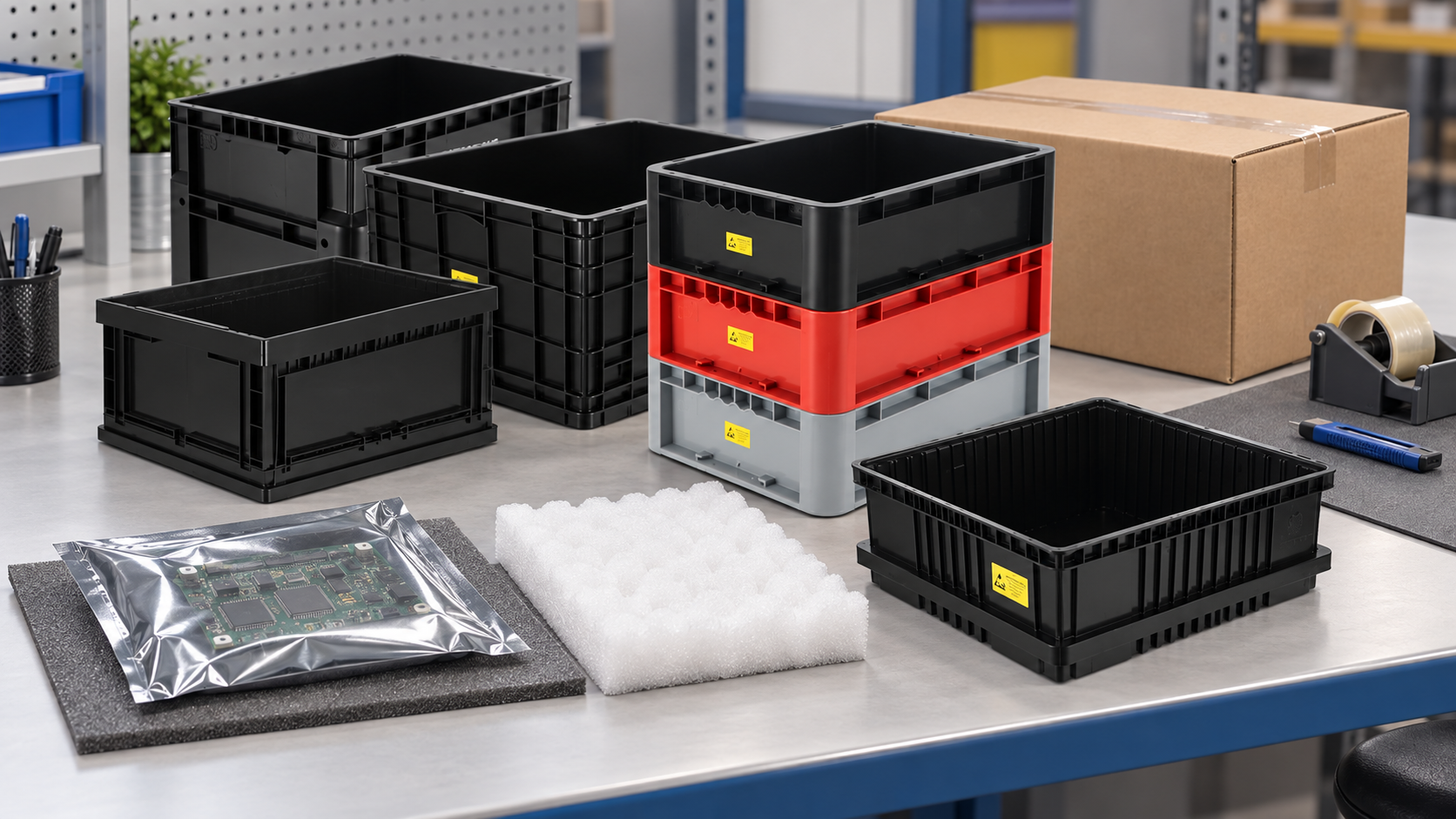
The rigid container is useful when it solves a route problem. Define usable internal space after cushioning, loaded mass, closure method, stacking direction, hand points, label face, seal or tamper requirement, and transfer points. A returnable plant tote and a one-way export pack may use different closures and outer packaging even when they carry the same device.
The CH-ESD ESD Box category is a product-family starting point for storage and transportation. Use it to identify candidate formats, then request the specific model, material, dimensions, closure, accessory list, and ESD test basis. If the part needs fixed cavities or direct visual count control, compare the ESD Tray family or the ESD Bin family before committing to a deep tote.
- Load a representative packaged device and verify clearance on every side.
- Close the container without pressing on the device or damaging the protective bag.
- Move the loaded sample through the actual handoff, cart, rack, and packing steps.
- Check the stack and label visibility in the shipping orientation.
- Record the accepted container, inner package, cushioning, quantity, and outer carton as one revision.
4. Build a supplier-ready shipping specification
Send the supplier the device envelope and packaged envelope, quantity per container, orientation, sensitive surfaces, route, reuse cycle, closure preference, stacking need, and outer-carton constraint. Ask for a drawing or data sheet that identifies the offered model and material. Request the relevant ESD property, test method, conditions, date or revision, and the exact configuration to which the result applies.
Keep compliance language precise. “Made from ESD material” does not establish that a complete pack protects a particular item during shipment. Define the applicable customer or control-program requirement, then compare the supplier evidence with it. If a sample, accessory, liner, or material changes, return the configuration to approval before repeat shipment.
The receiving check should compare the delivered pack with the approved record: model and revision, closure, liner or foam, bag type, label, quantity, and visible damage. Store that record with the packing instruction so production, warehouse, and quality teams use the same layers.
A pilot shipment should use the normal packing team, carrier handoff, and receiving method. Photograph the accepted layer sequence, note where seals and labels sit, and record any movement, abrasion, or closure problem after receipt. Correct the packaging instruction before scaling the quantity. This process tests the configuration without turning one undamaged shipment into a universal performance claim.
References
- EOS/ESD Association: ANSI/ESD S541-2026 — packaging properties and test-method context for ESDS items.
- NASA-STD-8739.6B — ESD control and protective-packaging context.
- NASA ESD Control Handbook overview — separation of dissipative packaging and electrostatic-field shielding roles.