
Cleanroom paper is documentation stock selected to limit contamination introduced by records, instructions and note-taking. Choosing it requires more than a familiar color or the word “cleanroom.” Match the exact material to the printing method, handling conditions and evidence required for the job.
Treated cellulose and synthetic sheets are both available. Their properties and supported uses depend on the particular product. A paper that works well for a laser-printed instruction sheet is not automatically the right choice for an inkjet form, a handwritten log or a differently packaged supply route.
By ZiroSip
Cleanroom paper materials: cellulose and synthetic options
Start with the manufacturer’s material description. Texwipe’s documentation range separates cellulose and synthetic sheets, along with loose sheets, notebooks and other recordkeeping formats. These are product choices with different specifications, not interchangeable names for one universal material.
| Material route | What the description establishes | What still needs checking |
|---|---|---|
| Treated or reinforced cellulose | Cellulose remains part of the sheet, with product-specific processing or reinforcement | The actual treatment, supported print method, contamination information and packaging |
| Synthetic sheet | The manufacturer identifies a synthetic substrate rather than ordinary cellulose stock | The exact product’s writing, printing and handling properties |
| Finished notebook or pad | The supplied documentation format includes more than loose sheets | Cover, binding, sheet identity and the intended recording task |
A broad description such as “latex-coated paper” should not replace the exact material statement. For example, the cited loose-leaf cellulose family identifies polymer reinforcement and states that it has no natural latex binders. That product detail is more useful than assuming that every treated paper uses the same binder.
The purchasing question is therefore not simply which material sounds cleaner. It is which exact sheet has the relevant evidence and practical behavior for the task. Appearance alone cannot establish particle performance, sterile status or suitability for a particular environment.
Confirm printing compatibility on the exact product
Cleanroom copy paper is not a universal printer setting. Read the supported printing methods in the product’s own information, then compare them with the printer and consumables actually used. Do not extend a statement about one family to another because both are sold for controlled environments.
The distinction is visible in manufacturer documents. Texwipe lists inkjet, laser and toner-based printer/copier compatibility for MP-10 TX5800. In contrast, the linked BCR Cleanroom Bond sheet dated March 2019 recommends laser/copier use but does not recommend inkjet printing. That dated sheet illustrates a product-specific restriction; request the current exact-product document before ordering.
This comparison is not a supplier ranking. It shows why a general purchasing description leaves a printing question unanswered. The relevant evidence is the statement attached to the candidate product and the outcome of a representative trial on your intended equipment.
Specify A4, letter or another format explicitly
When ordering cleanroom paper in A4, include the format in the product identity rather than treating it as an informal note. Confirm the required sheet size, orientation and any punching or binding. A quotation for another format may change the document layout even if its material description looks similar.
Use an actual form during the print check. A blank sheet passing through a printer does not show whether the approved document fits, whether both sides remain readable or whether handwriting fields are usable. These are proposed application checks, not a claim that any particular paper has already passed them.
Keep cleanliness data, packaging and record use separate
A useful specification distinguishes product information from the process owner’s acceptance decision. The cited BCR sheet labels its technical figures as typical values rather than product specifications. That distinction matters when numerical data from a brochure are copied into a purchase requirement.
| Evidence category | Useful question for the supplier or process owner |
|---|---|
| Material identity | Which substrate and exact product version are being supplied? |
| Contamination data | What was measured, under which method and conditions, and in what units? |
| Printer and writing use | Which methods are stated for this product, and what application trial remains? |
| Packaging | What pack format is supplied and how will the chosen supply route preserve its intended condition? |
| Identification | What product and available lot information will distinguish a replacement delivery? |
| Documentation format | Does the task need loose sheets, a bound log, a pad or another record format? |
This is a comparison record, not a universal test standard. A result in one reporting unit cannot simply be ranked against a number produced by another method. Ask for clarification where the comparison basis differs, and define the task’s acceptance criteria before using a sample outcome to justify a substitution.
Packaging also deserves its own line. A material description does not identify the supplied pack or the way sheets will be handled after opening. Record the candidate’s actual packaging and the intended route to its point of use; do not infer those details from a catalog photograph.
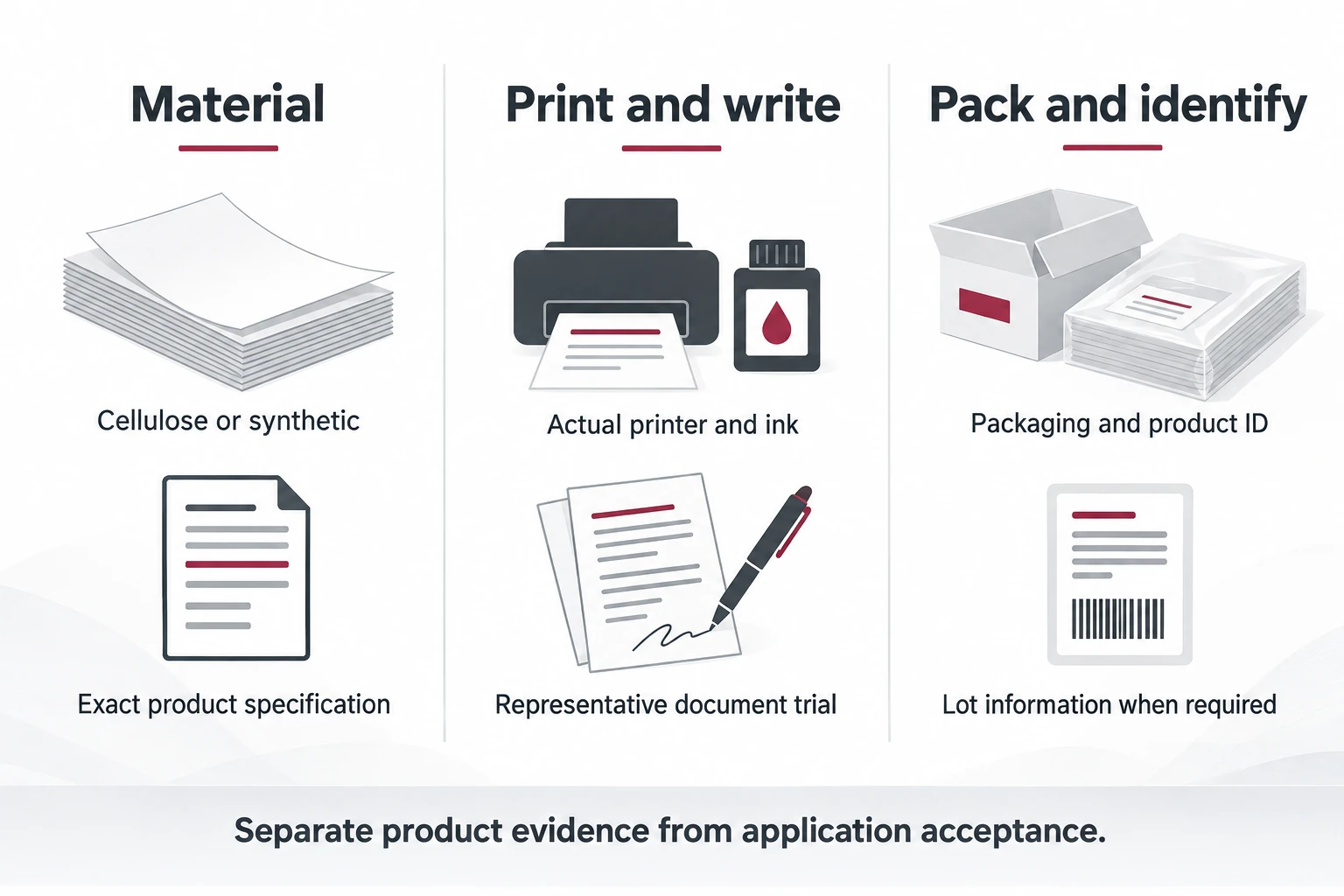
Run a representative document trial before approving a change
A sample trial should reproduce the intended documentation job closely enough to reveal a mismatch. The following is a proposed record for that evaluation. It does not replace the applicable product information or establish cleanliness merely because a printed page looks acceptable.
- Candidate identity: Record the exact product, material, sheet format and supplied pack.
- Output system: Identify the intended printer, ink or toner, and the representative document version.
- Document use: Note whether the page must be copied, printed on both sides, annotated, filed or kept at a workstation.
- Observations: Record feeding, print readability, visible transfer or smearing, handwriting usability and any other preselected task criteria.
- Decision: Identify which requirements are supported, which remain unanswered and who owns acceptance for the process.
For a hypothetical workstation instruction, the trial might use the actual approved layout and normal handling route. The question is whether the candidate supports readable instructions in that workflow. A successful print sample would still not supply missing contamination or packaging evidence.
For a second hypothetical job, an operator fills in a handwritten log throughout a shift. The writing instrument, available space and finished record format become part of the evaluation. A sheet selected solely because a different station prints on it would leave those needs unresolved.
Both jobs may ultimately use the same stock. The reason to record them separately is to prevent an unexplained assumption from becoming a purchasing rule. Keep the actual observations with the product identity so a future supply change can be reviewed against the same task.
Turn the sample decision into a clear purchase description
A request for cleanroom documentation paper should state the selected product or required evidence, material route, sheet format, printing/writing use and packaging. If a supplier proposes an alternative, compare those fields directly instead of accepting “equivalent clean room paper” as a complete answer.
Keep unresolved questions visible. A brochure’s typical data, a general family description and an application sample are different pieces of information. The order is ready when the required product evidence and the document-use decision are both clear enough for another buyer to repeat the selection.
References
- Texwipe: Cleanroom Paper and Labels — Material categories and documentation formats.
- Texwipe: Cleanroom Loose Leaf Sheets — Product-specific cellulose construction and printing statements.
- Texwipe: TexWrite MP-10 TX5800 — Product-specific synthetic-sheet and printing statements.
- Berkshire: BCR Cleanroom Bond Product Sheet — Dated March 2019 product sheet; printing restrictions and the distinction between typical data and specifications.