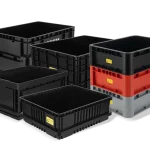


An ESD box with foam should be specified as a matched packaging assembly: the container, the insert and the component each need a defined fit and protection role. Ordering a black box and “anti-static foam” by name alone leaves the usable space, component support and required electrical protection unresolved.
For a useful quotation, start with the component drawing and the storage or transport route. Then request a proposed box model and a separate insert drawing. Quan Dun lists lidded ESD boxes and die-cut foam products separately; these listings do not establish a stocked, validated box-and-foam kit.
Define what the box and insert must do
The first decision is whether the assembly stays inside an ESD protected area or travels beyond it. EOS/ESD Association guidance distinguishes low-charging conductive or dissipative packaging within an EPA from the additional discharge-shielding protection needed outside it. A resistance description alone does not prove shielding.
ABB’s June 2018 supplier packaging manual provides a historical buyer-specific example: its static-dissipative carton-and-foam arrangement includes a shielding bag around the part. This illustrates separate packaging roles; it is not a universal instruction or evidence of today’s requirements for your shipment.
State your own required protection functions explicitly. The insert may be intended to locate a component, separate parts or provide cushioning. Those intentions still need an approved design and, where required, evidence from evaluation of the complete loaded package. A soft-feeling foam sample is not a cushioning test result.
Also describe who opens the box, where components are removed and whether the package will be reused. These are useful inputs for choosing the insert form and the acceptance checks. They do not establish waterproofing, a shipping rating or unlimited reuse.
Size an ESD box with foam from internal dimensions
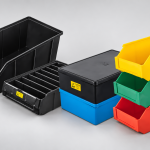
External box dimensions describe the outside envelope, not the space available to the component. Quan Dun’s lidded ESD box listing provides these nominal examples:
| Listed box model | External dimensions, L × W × H | Listed internal dimensions |
|---|---|---|
| QD-9805316 | 600 × 400 × 90 mm | 560 × 360 × 85 mm |
| QD-9805318 | 600 × 400 × 150 mm | 560 × 360 × 145 mm |
| QD-9805319 | 600 × 400 × 220 mm | 560 × 360 × 215 mm |
These are published nominal dimensions, not guaranteed clearances at every point inside a loaded, closed box. Confirm the selected model’s drawing, lid relationship and relevant tolerances before cutting the insert.
Hypothetical allowance example: Start with the listed 560 × 360 mm internal footprint. If a proposed design uses a 10 mm foam allowance on each opposing side, the simple remaining rectangle is 560 − 2 × 10 = 540 mm by 360 − 2 × 10 = 340 mm.
This calculation only explains how side allowances consume space. It does not approve a component of that size or recommend a foam thickness. Wall taper, local features, insert tolerances, loading clearance and the actual support design still need checking. Height must also account for lower support, component protrusions, any upper pad and the lid’s usable closed position.
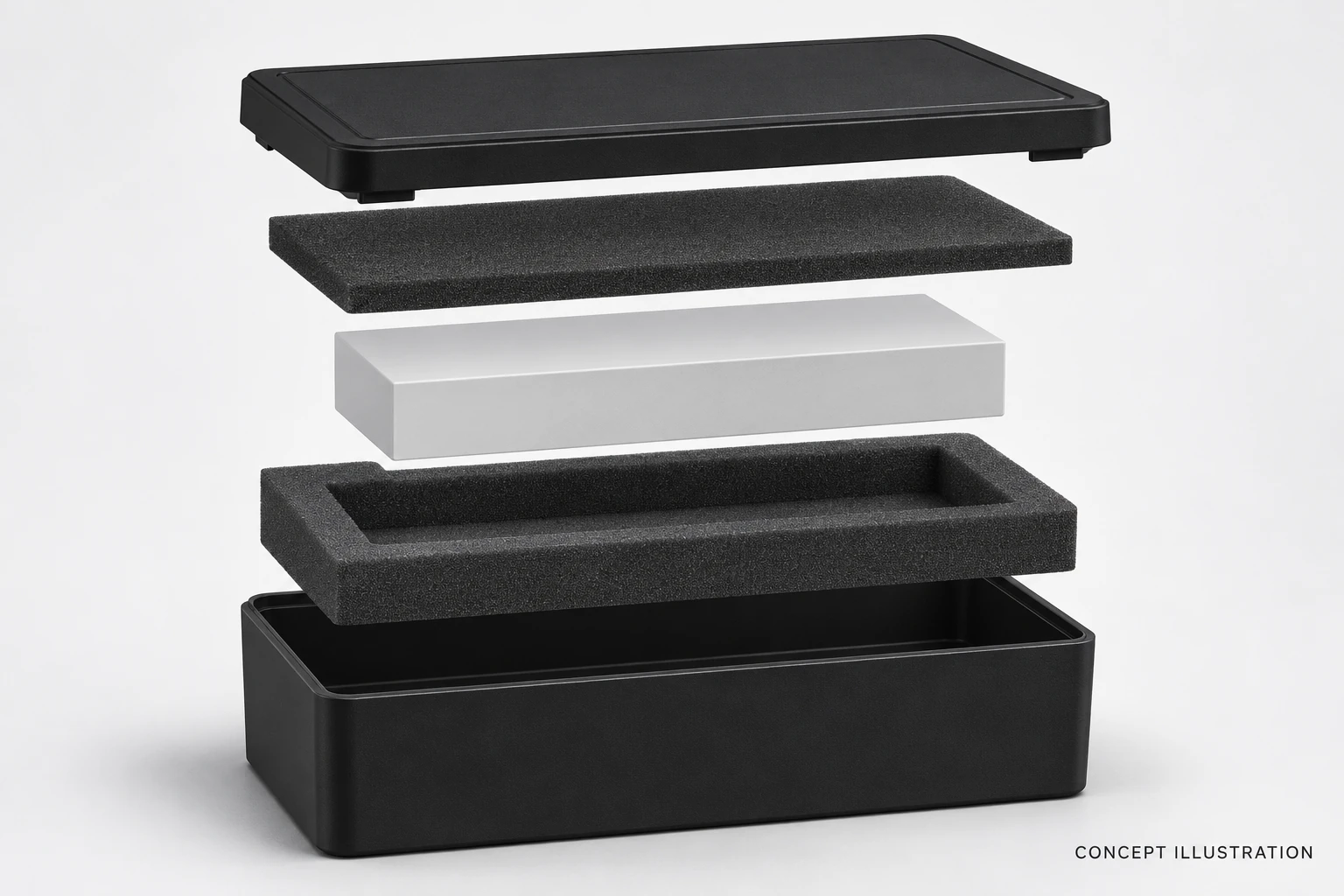
Specify the insert from component contact requirements
An insert drawing should identify where the part is supported and where it must remain clear. Send the supplier the full component envelope, including connectors, leads and protruding parts. Identify permitted support areas and any features that must not contact the foam.
Quan Dun’s separate anti-static foam sheet listing includes EVA, IXPE, PU and EPE material options and sheet, roll or die-cut forms. That establishes a range to discuss. It does not establish that every material is interchangeable or suitable for your exact component.
Request the proposed material grade, relevant electrical evidence and the design information needed for your handling or transport conditions. If density, hardness, cleanliness or chemical compatibility matters, put it in the specification and ask for model-specific support. Those properties cannot be inferred from foam color.
For an initial insert proposal, record the following fields on one drawing or accompanying sheet:
- Component: Envelope, mass, orientation and permitted contact areas.
- Box: Model, relevant internal drawing, cover and any partition requirement.
- Insert: Material proposal, outer profile, recess or separation geometry and loading/removal access.
- Protection: Required electrical, cleanliness and mechanical acceptance evidence, including any separate inner packaging.
Evaluate a complete sample before releasing the assembly
Evaluate the proposed insert in the selected box with a representative component or an agreed equivalent sample. Review whether it can be loaded and removed as intended, whether the support points match the drawing and whether the lid closes without unintended contact.
Use the buyer’s agreed acceptance plan for the actual route. If transport performance matters, define the required package evaluation with the responsible packaging or quality team. Do not treat a dimensional fit check as evidence of drop, vibration or electrostatic protection performance.
Keep the approved box model, insert drawing revision and material identity together. If the supplier proposes a different foam grade or box, review the affected requirements before accepting the change. This prevents a repeat order from becoming a different assembly under the same broad description.
Request a clearly separated box-and-foam quotation
Ask the quotation to identify the box, lid or accessories, foam material, insert drawing, quantity and sample scope separately. State whether assembly, labeling and any additional packaging are required. Ask the supplier to confirm what is included rather than assume the photograph represents the entire supplied set.
Send Quan Dun the component drawing and packaging requirements to request a proposed box and insert configuration. Include the route, quantity, support restrictions and acceptance documents needed. The next decision should be whether that defined proposal merits a sample, not whether an unspecified “ESD foam box” sounds suitable.
References
- EOS/ESD Association: ESD Fundamentals, Part 3 — packaging protection roles inside and outside an EPA.
- ABB: Packaging Manual for Suppliers, June 2018 — historical examples of separating cushioning and shielding functions.