


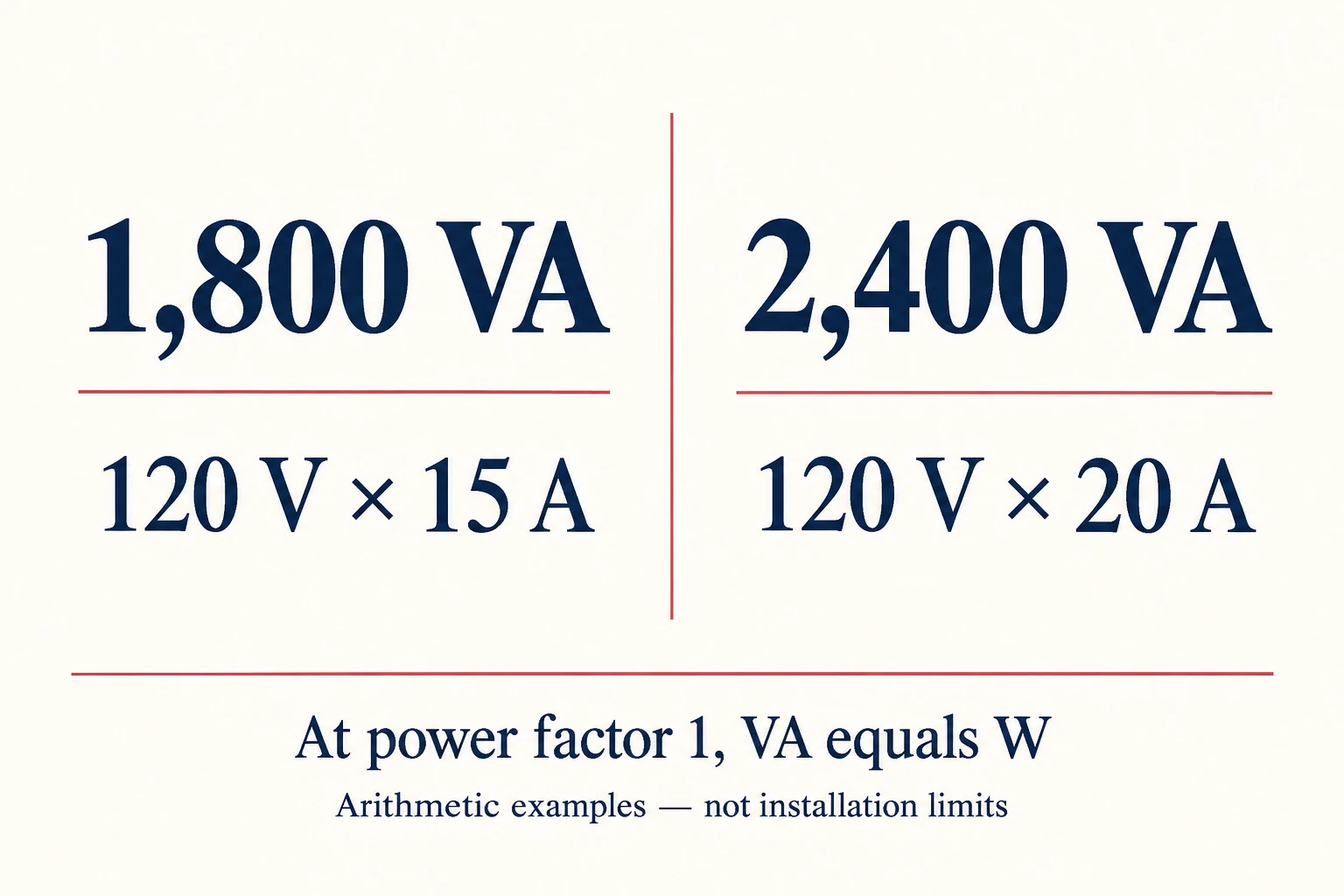
How many watts on a 20 amp circuit? At 120 volts and a power factor of 1, the arithmetic is 120 × 20 = 2,400 watts. At 240 volts, the corresponding result is 4,800 watts. Those are voltage-current calculations, not permission to connect that much equipment to an unknown circuit.
For a 15-amp example at 120 volts and power factor 1, the result is 1,800 watts. The missing detail in many “amps to watts” answers is the voltage; for AC equipment, power factor matters too.
Scope: US-oriented terminology and single-phase calculation examples, sources checked November 1, 2026. Actual circuit suitability requires the equipment instructions and applicable installation requirements.
How many watts on a 20 amp circuit at 120 V or 240 V?
For the examples below, voltage and current are RMS values. Their product is apparent power in volt-amperes (VA). Real power in watts equals that result multiplied by power factor. When power factor is 1, the numerical VA and watt values are equal.
| Voltage | Current | V × A | Real power at PF 1 |
|---|---|---|---|
| 120 V | 15 A | 1,800 VA | 1,800 W |
| 120 V | 20 A | 2,400 VA | 2,400 W |
| 240 V | 15 A | 3,600 VA | 3,600 W |
| 240 V | 20 A | 4,800 VA | 4,800 W |
Each row answers a mathematical question with stated assumptions. It does not verify the receptacle, wiring, protection, equipment connection or other loads. Do not change a connection or protective device to make an appliance match one of these rows.
Why 2,400 W and 1,920 W both appear in answers
The two numbers usually describe different assumptions. At 120 V,20 A gives 2,400 VA. Applying an 80% factor to 20 A gives 16 A, and 120 V × 16 A gives 1,920 VA, or 1,920 W at power factor 1. The corresponding 15 A arithmetic is 12 A and 1,440 W.
Schneider Electric distinguishes continuous application of standard 80%-rated breakers from appropriately applied 100%-rated versions. In the U.S. context described by Schneider, a continuous load is one whose maximum current is expected to continue for three hours or more. The 1,920 W example assumes 16 A at 120 V and a power factor of 1. It does not make “multiply every electrical value by 0.8” a universal rule.
Use 1,920 W only as a conditional example when discussing that particular assumption. Whether it applies to a real installation, and what other requirements remain, is a separate determination. This article does not approve a combination of loads or replace an installation assessment.
Power factor changes the watts, not the meaning of an amp
Fluke describes power factor as real power divided by apparent power. Consider a hypothetical 120 V load drawing 10 A with power factor 0.8: apparent power is 1,200 VA and real power is 960 W. The current is still 10 A in that example.
This is why dividing every appliance’s advertised watts by 120 can be misleading. An output-power claim, an input-power rating and an actual operating measurement are different records. Use the manufacturer’s electrical input information for the particular equipment rather than assuming an advertising number describes circuit demand.
A small worksheet prevents large assumptions
Record four items before comparing appliances: the model, rated supply voltage, electrical input rating and the source of that rating. If the document supplies current directly, preserve it rather than replacing it with a calculation based on an unrelated watt figure.
Add whether the numbers describe a particular operating mode. For several devices, keep separate rows instead of combining unlike data into one total. A list that mixes 120 V and 240 V equipment, peak output and input ratings, or unknown power factors does not become reliable merely because the arithmetic is correct.
The worksheet is a way to prepare information for a qualified assessment. It is not a recommendation to test circuit capacity by adding equipment until a breaker trips. No live measurement or panel access is needed to read existing product documentation.
Keep control ratings separate from circuit capacity
A control-device label also needs its context. An AC contactor has a switching role and associated ratings; its markings do not establish the capacity of the entire supply circuit. Likewise, an appliance’s watt rating does not certify the wiring that serves it.
The useful answer therefore keeps both parts: state the voltage-current calculation, then identify which real installation questions the calculation has not answered.