

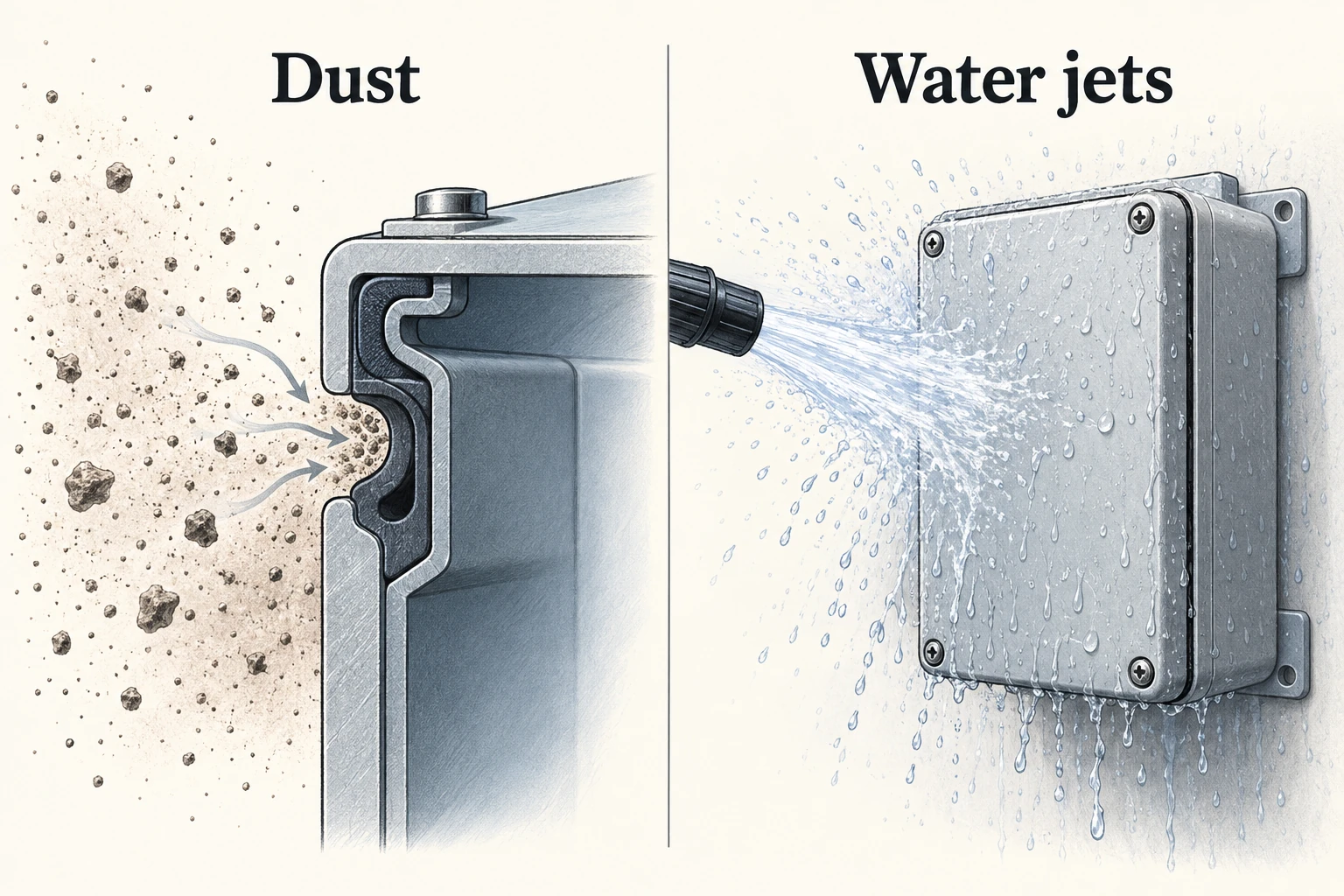
IP65 means the enclosure has a dust-tight classification and protection against water jets under the stated test conditions. The 6 describes solid-particle protection; the 5 describes water protection. It is not an immersion rating, an airtightness specification or a complete statement about outdoor durability.
That distinction matters when an electronics buyer compares cabinets, instruments or enclosed assemblies. IP65 can answer a defined dust-and-water question, but only for the configuration the claim covers. A useful selection starts with the exposure and ends with a matching product record.
What the two digits establish
Under the IEC enclosure classification, the first numeral 6 identifies dust-tight protection. The second numeral 5 identifies water jets. Reading them separately is more precise than calling the entire product “waterproof,” because the two parts address different challenges.
A product marked IPX5 states a water category without stating a solid-particle category in that marking. IP65 supplies both. Conversely, a dust-related claim alone does not establish jet protection. Buyers should retain the complete code in specifications instead of shortening it to a vague description such as sealed or rugged.
Is IP65 waterproof?
“Waterproof” is too broad unless its conditions are explained. IP65 addresses jets; it does not establish that the product can remain underwater. Nor does it automatically approve every hose, detergent, temperature or cleaning method used on a production floor.
Consider a closed instrument that normally receives occasional cleaning spray. Its documented water-jet category may be relevant to that exposure. If the same instrument can sit in a flooded tray, immersion becomes a separate question. The requirement changed even though the device and its label did not.
Compare IP65 with nearby ratings
| Marking | What differs from IP65 | Useful comparison question |
|---|---|---|
| IP55 | Different dust category; same water numeral | Is dust-tight performance part of the requirement? |
| IP66 | Same dust category; powerful-jet water category | Which jet exposure is actually documented and needed? |
| IP67 | Same dust category; temporary immersion category | Is immersion relevant, and is jet protection separately stated? |
| IP68 | Same dust category; specified immersion conditions | What depth, duration and assembly does the declaration cover? |
This is not a universal quality ladder. Immersion and jet categories describe different exposures. In particular, an immersion marking does not automatically settle the jet-protection question. A specification should identify the required combination rather than simply ask for the largest numeral available.
The assembly can matter more than the label
Compare the tested configuration with the item being purchased. Covers, cable entries, mating connectors and optional openings can change the enclosure boundary. A component’s own rating does not by itself prove the rating of the complete assembly after it is installed.
A practical example is an enclosure offered with either blank side walls or a cable-entry option. If the report describes only the blank version, the procurement question is whether the configured version is covered—not whether both versions use the same enclosure material. Ask the supplier to identify the applicable drawing and document revision.
For equipment that is opened during service, also obtain the manufacturer’s closure and maintenance instructions. The initial rating does not replace those instructions. Avoid inventing a tightening torque or gasket replacement interval from an unrelated product.
Keep the environmental requirement explicit
Before selecting a model, describe the dust, water exposure and any other relevant conditions in ordinary terms. Then connect each condition to the documentation that addresses it. A requirement for water jets differs from one for standing water; a corrosion concern is a different question again.
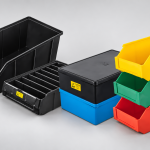
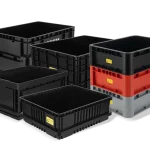
For electronics logistics, a storage tote and a finished equipment enclosure also serve different purposes. CH-ESD’s ESD box category covers component storage and transfer formats. Do not infer IP65 protection from a conductive material or a fitted lid. Request model-specific evidence if environmental sealing is part of the handling requirement.
The useful purchasing statement is therefore more complete than “IP65 required”: it names the enclosure configuration, the documented protection category and the exposure it is intended to address. That makes missing evidence visible before the order is placed.