

IPX5 means protection against water jets under the relevant test conditions. It does not establish protection during immersion, and the X leaves solid-particle protection unspecified. For electronics buyers, the useful question is whether the documented jet exposure matches the equipment’s actual environment—not whether “waterproof” appears in the listing.
A cabinet beside a cleaning area, a portable instrument and a storage container can encounter very different water conditions. The same short code cannot describe their entire service life. Understanding its boundary helps you ask for the right evidence without buying an unnecessary rating or relying on an unsuitable one.
Read the X and the 5 separately
The IP code separates protection against solid objects from protection against water. In IPX5, the water category is stated, while the solid-object category is not. X should not be read as “dust-tight,” nor does it mean the product necessarily has no dust protection. It means that this marking makes no claim for that part.
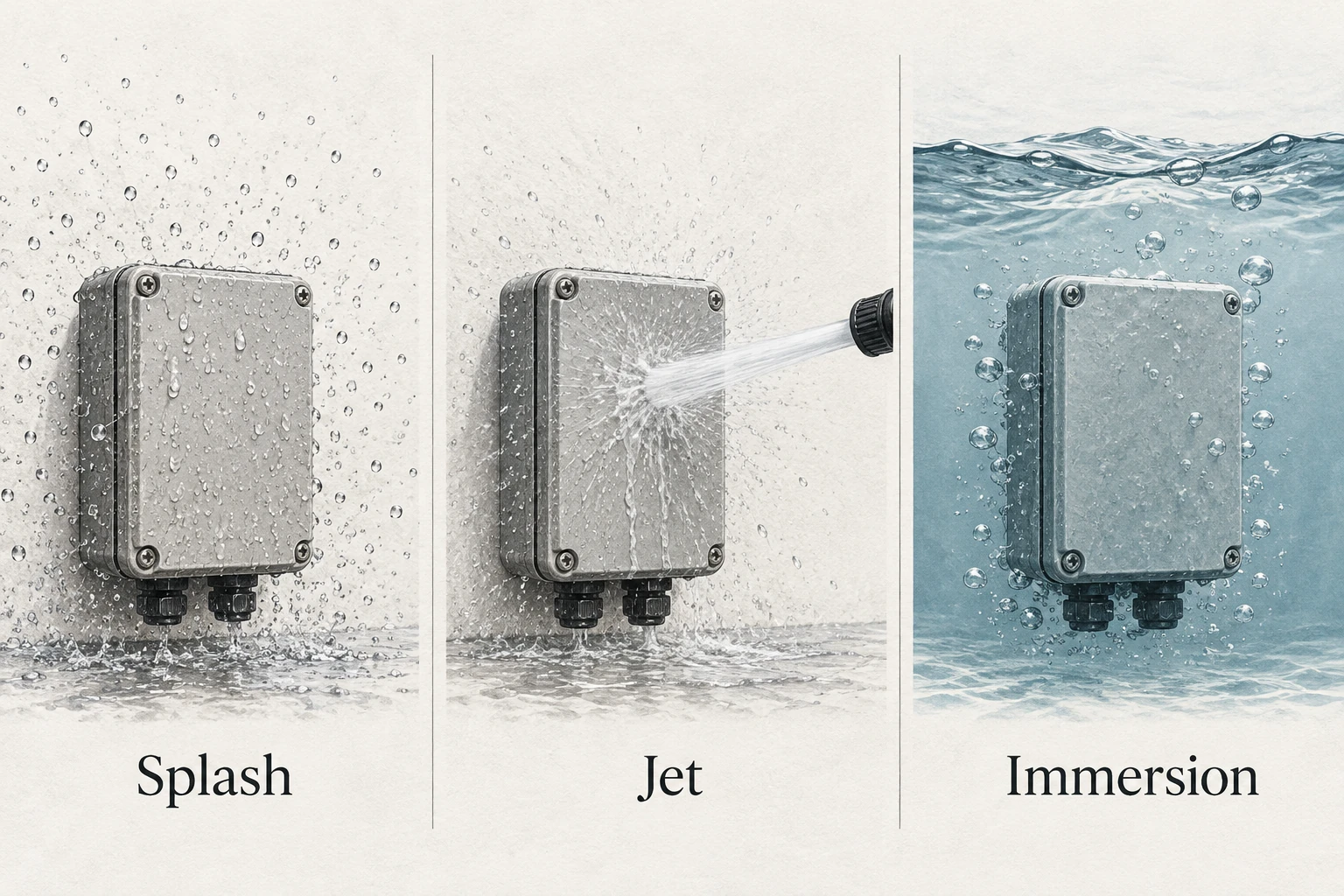
The final 5 identifies water jets. It is different from splash exposure and from temporary immersion. IEC 60529 provides the classification framework; the rating belongs to the described enclosure and configuration. A brand name, material description or lid photograph cannot replace that information.
What an IPX5 result establishes
A useful test record connects the result to a sample, a method and an assembled condition. When reviewing a supplier’s statement, identify the enclosure revision, fitted connectors, covers and other openings. Then check the reported exposure and acceptance result. A report for a sealed housing is not automatically evidence for a version with a newly added cable opening.
This is a document review, not a suggestion to recreate the test with a garden hose. A nozzle photograph alone does not establish flow, distance, duration or the acceptance assessment. Where exact test settings matter, the laboratory and applicable standard provide the procedure.
IPX5 does not answer every water question
| Question | What the code supports | What remains to check |
|---|---|---|
| Can it resist water jets? | The stated jet-protection category | The exact assembly and documented conditions |
| Can it stay underwater? | No immersion claim from IPX5 alone | A separate immersion rating and its conditions |
| Can it be pressure-washed? | No blanket cleaning approval | Pressure, temperature, chemicals and the manufacturer’s instructions |
| Is it dust-tight? | No solid-particle claim from X | A separately declared first numeral |
A larger final numeral is not an unrestricted upgrade for every kind of water exposure. ABB’s guidance specifically distinguishes immersion from jet protection. If the equipment encounters both, request evidence for both rather than treating an immersion label as a substitute for the jet result.
A practical enclosure comparison
Consider two candidate instrument housings for a transfer area. One has an IPX5 statement for the fully assembled instrument, including its cable entry. The other advertises “waterproof construction,” but the available document covers only an empty shell. The first statement is more useful for this comparison because its scope is identifiable. That does not prove it suits every part of the transfer route.
The next question is what happens during cleaning and downtime. If an operator may leave the instrument in standing water, the jet category has not answered the immersion question. If cleaning introduces a hot detergent solution, the liquid and temperature conditions also need a separate review. Record these as distinct exposures instead of trying to stretch one rating across all of them.
Keep enclosure protection separate from ESD handling
Electronics can need both environmental protection and electrostatic-discharge controls. Those properties are assessed separately. A conductive container may help with a defined handling task without providing a sealed water barrier; a water-resistant enclosure does not by itself establish ESD packaging performance.
CH-ESD’s ESD box range lists storage and transfer formats. When evaluating those containers, specify the part envelope, closure and handling route, then request any required environmental evidence for the exact configuration. A lid should not be treated as an IPX5 claim.
For an IPX5 purchasing decision, keep three items together: the rating, the configuration it covers, and the real exposure you need it to withstand. Any mismatch becomes a clear question for the supplier rather than an assumption hidden behind the word “waterproof.”