

Viscose vs polyester is mainly a comparison between a moisture-absorbing regenerated cellulose fiber and a synthetic fiber that takes up much less moisture. Viscose can be attractive when absorbency and a soft handle matter. Polyester can suit designs that prioritize resilience and managing moisture without storing much inside the fiber. Neither name alone tells you whether a finished garment will feel cool, dry quickly or meet a workplace requirement.
The useful choice is between specified fabrics, not labels in isolation. Blend ratio, yarn, fabric construction, finish and garment design all belong in the comparison. For workwear, the question also includes what happens after the intended cleaning process.
Viscose vs polyester: the differences worth comparing
Viscose is a manufactured cellulose fiber, commonly made from wood pulp through the viscose process. It is not polyester, and calling both materials “man-made” does not make their behavior the same. Polyester belongs to a different polymer family. Their different interactions with moisture are central to how they are used.
| Decision | Viscose | Polyester |
|---|---|---|
| Moisture inside the fiber | Relatively absorbent | Much lower moisture uptake |
| Moisture movement through cloth | Absorbency alone does not establish wicking speed | Low fiber uptake does not prevent a fabric from wicking |
| Shape and handling | Evaluate wet handling and the finished fabric’s recovery | Resilience is useful, but construction still matters |
| Choice for a particular garment | Check the actual sample and care instructions | Check the actual sample and care instructions |
| ESD or cleanroom suitability | Cannot be established from the fiber name | Cannot be established from the fiber name |
These are starting points for selection. They do not establish a ranking for every blouse, lining, uniform or wipe. A comparison that treats all viscose fabrics as one product and all polyester fabrics as another hides the variables that a buyer can actually specify.
Absorbing moisture is different from moving it
Absorption describes moisture entering a material. Wicking describes liquid moving through a structure, including the spaces between fibers and yarns. Drying adds another question: how the retained moisture leaves under the surrounding conditions. Those processes interact, but they are not interchangeable.
Daiwabo Rayon describes viscose as more moisture-absorbent than synthetic fibers such as polyester. That supports an absorbency comparison. It does not establish that every viscose garment removes sweat from the skin faster than every polyester garment.
A study by Das and colleagues examined eight polyester-viscose fabrics. In those samples, increasing the viscose proportion improved absorbency but reduced vertical and horizontal wicking. The result is useful because it separates two properties that are often grouped together as “moisture management.” It is not a universal ranking of all blends or garment designs.
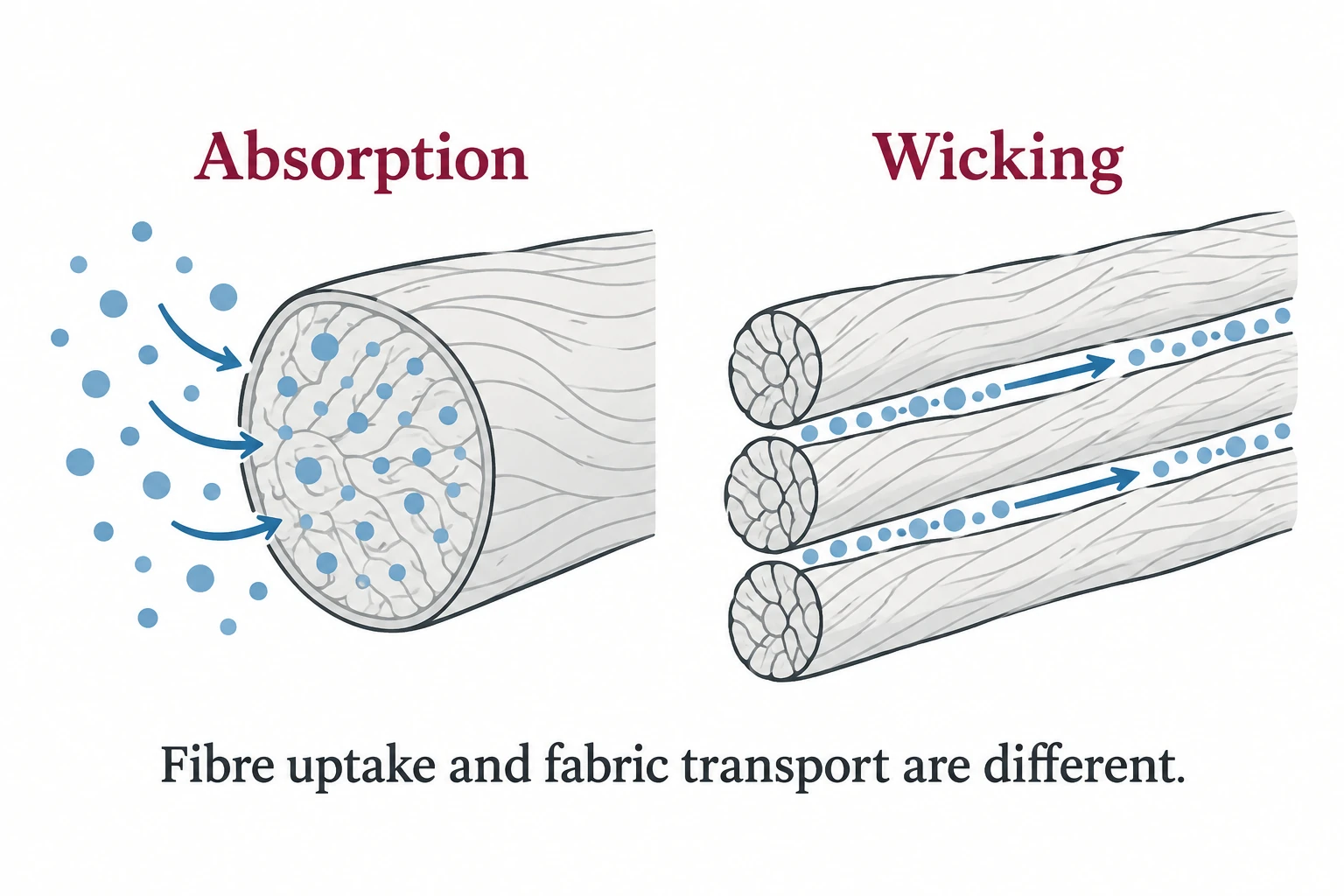
When a supplier describes a fabric as moisture-wicking, ask what was evaluated: water uptake, liquid spreading, transport from one face to the other, or drying. A broad adjective is less useful than a result tied to the exact material and method.
Which feels cooler, dries faster or keeps its shape?
A fiber label is insufficient to answer those questions for a finished garment. A thin, open fabric and a thick, dense fabric can serve different purposes even with the same composition. Compare the actual weight, construction, finish and fit before attributing the entire wearing experience to viscose or polyester.
Polyester’s low moisture uptake is relevant to drying, but it does not by itself specify how much liquid a complete fabric holds between its yarns. Likewise, viscose’s absorbency does not define a garment’s insulation. A useful sample assessment records comfort and drying separately rather than treating one as proof of the other.
Care instructions deserve the same attention. Coats distinguishes the properties of regular rayon, stronger rayon types and polyester in its fiber guide. Avoid transferring the behavior of one fiber grade to every garment carrying a related name. Use the finished item’s care instructions and compare the sample after its intended cleaning process.
Choose a sample against the job it must do
For everyday apparel, start with the required feel, drape, care routine and fit. For a work uniform, add movement, closures, pocket layout and the environment in which it will be worn. The same preference for a soft fabric does not establish suitability for both uses.
A compact comparison record can contain four entries: the exact composition; the construction and finish; the care conditions; and the property that matters to the job. Keep the supplier’s data beside the sample identification so a change in fabric does not silently inherit another sample’s result.
If drying matters, ask for comparable evidence under stated conditions. If dimensional stability matters, compare the intended cleaning process and measurement method. If contamination control or ESD performance matters, request the relevant garment evidence separately. An absorbency result cannot answer an electrical-performance question.
What this means for anti-static clothing
Quan Dun lists a two-piece anti-static cleanroom suit with conductive striped fabric. That is a relevant garment option to investigate, but the listing does not establish a viscose/polyester blend ratio. Obtain the actual composition and applicable product documentation before specifying it.
For such a purchase, separate the comfort decision from the protective-function decision. Ask what fabric is supplied, what garment configuration the evidence covers, and which cleaning conditions apply. Choose viscose, polyester or a blend because the finished material meets the stated task—not because one fiber has been declared the universal winner.