

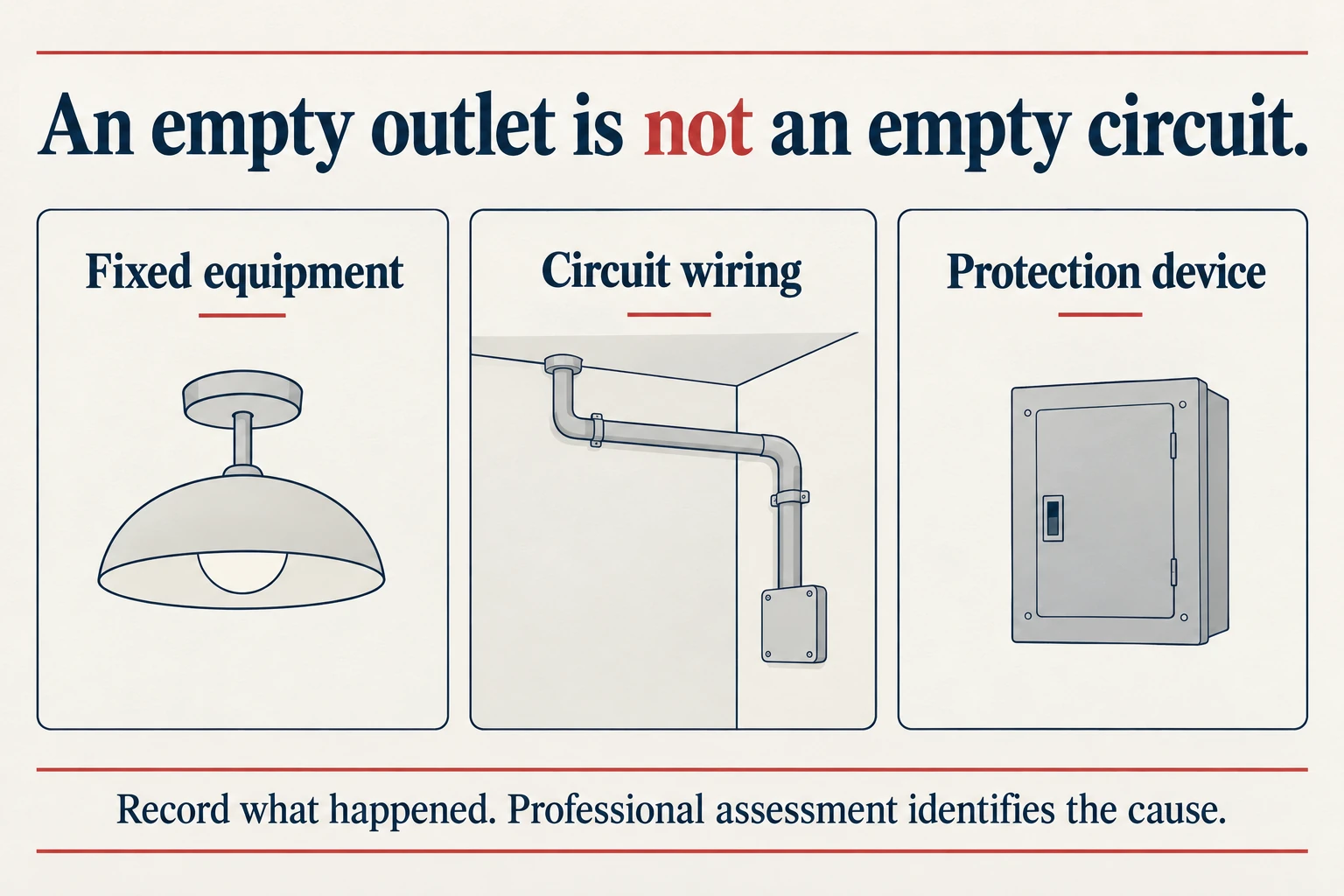
Why does my breaker keep tripping with nothing plugged in? Empty visible outlets do not prove that the entire circuit has no load or no fault. Fixed equipment, outlets elsewhere, a wiring or connection problem, or the protection device itself may still be involved. The symptom alone does not identify which one is responsible.
Do not keep resetting a breaker that repeatedly trips. Arrange a qualified electrical assessment. If there is smoke, active sparking or an immediate fire hazard, move away and contact emergency services. Do not open the panel, touch suspect equipment or attempt a repair.
Scope: US-oriented symptom explanation and non-invasive information gathering, sources checked November 1, 2026. No live testing, wiring, panel removal or breaker-replacement procedure is provided.
Why does my breaker keep tripping with nothing plugged in: what is still connected?
“Nothing plugged in” usually describes what you can see at accessible receptacles. It does not necessarily describe the complete circuit. Lighting or other fixed equipment may not use a visible plug, and an existing circuit label may not identify every supplied location.
Record the areas and devices already known to lose power when the event occurs. That observation is useful; deliberately creating repeated trips to map the circuit is not. Keep unknown connections marked as unknown instead of assuming that an empty room means an unloaded circuit.
| Possible category | What the observation can suggest | What it cannot prove |
|---|---|---|
| Fixed or overlooked equipment | The visible outlets do not describe every connection | Which device caused the event |
| Wiring or connection fault | The circuit itself may need assessment | A safe location to open or test |
| Protection-device issue | The breaker may be part of the investigation | That replacement is the correct first action |
| Model-specific protection event | An existing visible indicator may help a professional | A universal meaning for every LED or handle position |
A trip is a symptom, not a component diagnosis
Schneider Electric’s thermal-magnetic breaker guidance identifies several possibilities, including overcurrent, circuit faults, connection problems and internal breaker issues. Its professional troubleshooting material should not be converted into a do-it-yourself instruction to expose connections or adjust protection.
Timing is useful background: did the event happen when something started, after equipment had operated for a while, or with no obvious change? But timing alone cannot safely distinguish every fault or every type of protective device. Report the sequence without assigning a definite cause.
Indicator meanings belong to the particular breaker
Some breakers provide visible diagnostic information. Leviton, for example, describes LEDs and handle indications on its products. Interpret such information only with the matching manufacturer documentation. A color or flashing pattern from one product family should not be applied to a different device.
If a label or indicator is already safely visible, note its exact wording or appearance. Do not remove a cover to find it. Do not reset the device repeatedly to recreate an indication that has disappeared; describe what you previously observed and let the professional determine the next step.
Useful information to give the electrician
Prepare a short timeline: when the problem began, which known areas lost power, and whether any equipment change, building work or water event preceded it. Separate an observed fact from a guess. “The hallway light went out” is more useful than an unsupported statement that the hallway wiring is defective.
Include any already-visible device identification and the existing circuit-directory wording. Explain what you mean by “nothing plugged in”: which accessible portable appliances were absent, and which fixed or inaccessible connections remain unknown. No dismantling or electrical measurement is needed to make that distinction.
The CPSC’s home-wiring guide treats recurring protective-device operation as a warning and explains that finding specific defects and repairing them are jobs for qualified electrical professionals. A symptom list helps that handoff; it is not a substitute for it.
Keep switching and protection functions separate
A switch or contactor being off does not establish that every part of an electrical system is safe to access. For background on a different device role, see our AC contactor explanation. It does not provide a workaround for a tripping breaker.
The next useful result is an identified cause and an appropriate professional remedy, not simply making the breaker stay on. Do not bypass protection, install a larger breaker or open the panel to investigate this symptom yourself.