

Resistivity units describe a material property, not simply a resistance reading. Volume resistivity is commonly expressed in ohm-metres (Ω·m) or ohm-centimetres (Ω·cm). Resistance is expressed in ohms (Ω). Surface measurements need their own method and geometry, and cannot be converted into volume resistivity by changing the unit label.
For electronics buyers, the practical problem is comparing reports that appear to describe the same conductive or dissipative material. One supplier may show a resistance range, another a volume resistivity, and another a surface result. Before comparing the numbers, identify the quantity, test conditions and specimen. This guide provides conversions, hypothetical calculations and a report worksheet for that decision.
Identify the electrical quantity before converting it
A material report should name the property next to the result. A column headed only “electrical value” leaves too much unresolved. Resistance describes the opposition associated with a particular path and geometry. Volume resistivity accounts for geometry within an appropriate material model. Conductivity expresses the reciprocal bulk property. Surface resistivity addresses a surface measurement rather than automatically describing conduction through the material thickness.
| Quantity | Common notation and unit | Question it helps answer |
|---|---|---|
| Resistance | R, Ω | What resistance is associated with this defined path? |
| Volume resistivity | ρ, Ω·m or Ω·cm | What bulk material property was derived under the stated conditions? |
| Conductivity | σ, S/m | How conductive is the material within the applicable model? |
| Surface resistivity or sheet-related result | Often Ω or Ω/□, depending on method | What does the defined surface geometry represent? |
The unit is a useful warning signal, but it is not a substitute for the property name. A result written in Ω may be a directly measured resistance or a method-defined surface quantity. Read the report definition before assigning it to a purchasing specification. Ask the supplier to preserve the original label when providing a converted summary.
This matters especially when a catalog table has been shortened for marketing. Dropping the specimen description can turn a valid laboratory result into an ambiguous product claim. Keep the original report reference attached to the summary so another engineer can reconstruct what was measured without relying on the appearance of the number.
Why Ω·m is different from Ω
For a uniform ohmic specimen represented by length L and cross-sectional area A, the relationship is R = ρL/A. Rearranging gives ρ = RA/L. If R is in ohms, A in square metres and L in metres, the resulting unit is Ω·m. The length in that unit is part of the dimensional relationship; it is not decorative punctuation.
This model explains why resistance alone is not an intrinsic comparison between differently shaped specimens. A longer path or a different cross section changes the resistance associated with the same resistivity. Conversely, different resistivities can produce the same resistance when the geometries differ. Neither observation establishes the performance of a finished container with an unspecified test path.
Treat the geometry as evidence, not an afterthought. Record which direction was measured, what area was used and how the specimen was defined. A molded part may not be represented by the simple uniform block in the equation. The model must fit the actual measurement before its arithmetic is useful.
OpenStax provides the underlying uniform-specimen relationship. The report-comparison decisions here apply that relationship without assuming that every plastic article behaves as an ideal homogeneous block. Where a laboratory uses a particular electrode geometry or correction factor, retain that method rather than replacing it with an improvised calculation from external part dimensions.
Convert the units without changing the quantity
The basic length conversion gives 1 Ω·cm = 0.01 Ω·m. In the opposite direction, 1 Ω·m = 100 Ω·cm. The numerical value therefore becomes smaller when converting the same resistivity from Ω·cm to Ω·m. This direction is easy to reverse accidentally when a report contains large powers of ten.
| Starting value | Same resistivity in another unit | Conversion used |
|---|---|---|
| 1 Ω·cm | 0.01 Ω·m | Multiply by 0.01 |
| 3 Ω·m | 300 Ω·cm | Multiply by 100 |
| 10⁸ Ω·cm | 10⁶ Ω·m | Multiply by 0.01 |
| 1 Ω·mm²/m | 10⁻⁶ Ω·m | Convert square millimetres to square metres |
| 0.25 Ω·mm²/m | 2.5 × 10⁻⁷ Ω·m | Multiply by 10⁻⁶ |
These are dimensional conversions, not material test results. The area-based expression Ω·mm²/m belongs to the same resistivity dimension because its square millimetres must be converted as area. Applying a single length factor instead would produce an incorrect value. Preserve the superscript two when copying the unit into a spreadsheet.
For a controlled purchasing record, keep three fields: original value and unit, converted value and unit, and conversion factor. Do not overwrite the laboratory result with the normalized number. A reviewer should be able to check both the arithmetic and whether the two reports were measuring the same property before accepting a comparison.
Keep surface and volume results separate
A surface result and a volume result address different measurement arrangements. Surface-related values may be expressed using Ω or Ω/□ according to the method and model. The square symbol does not describe a square metre of surface area. It identifies a sheet-related convention and must be interpreted with the associated geometry.
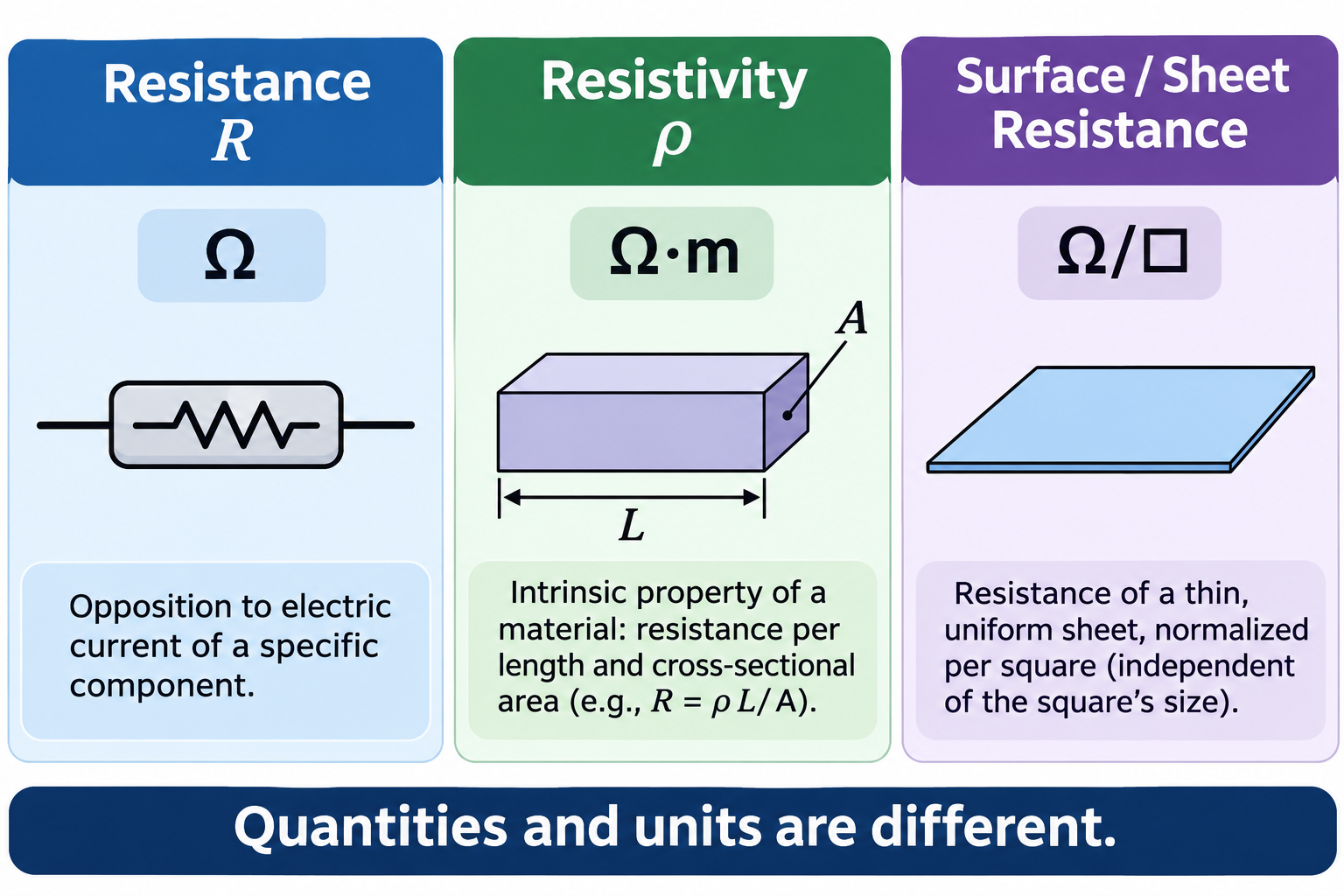
There is no general conversion that turns an unspecified Ω/□ result into Ω·m. A suitable material model, thickness and measurement definition may connect certain sheet and bulk properties, but those inputs cannot be inferred from a catalog label. Surface coatings, bulk composition and the particular test path must not be silently treated as equivalent.
For a supplier comparison, place surface and volume results in separate columns. If only one is available, leave the other unknown and ask whether the missing property matters to the handling task. This is more useful than estimating a missing value simply to complete a comparison table. Intertek’s surface and volume resistivity overview supports this separation and the importance of stated measurement conditions.
A further distinction is between material data and the resistance of a finished assembly. Interfaces, supports and the intended path are part of an assembly question. A material coupon report can be relevant evidence without answering the whole assembly question. Label that difference explicitly in the selection record.
Work through geometry and conductivity examples
Consider a hypothetical uniform specimen with resistivity 2 Ω·m, length 0.01 m and cross-sectional area 0.0001 m². Applying R = ρL/A gives 2 × 0.01 ÷ 0.0001 = 200 Ω. The calculation demonstrates the model only. It is not a measured value for an ESD box, a recommended acceptance limit or a predicted value for a molded corner.
If the same hypothetical model doubles L while keeping ρ and A unchanged, R doubles. If A doubles instead, R halves. This is why a direct resistance number cannot be compared fairly without knowing the represented path. It also explains why normalizing the unit alone does not normalize specimen geometry or test conditions.
Conductivity uses the reciprocal relationship σ = 1/ρ in the applicable scalar material model. A hypothetical resistivity of 0.02 Ω·m corresponds to 50 S/m. The unit changes as well as the number. Writing “50 Ω·m” after taking the reciprocal would describe a different and incorrect result. EPA’s reference explains the reciprocal quantities and their units; no geological material assumptions are needed for this arithmetic.
Keep reciprocal calculations separate from resistance conversion. The reciprocal of a resistance is conductance, not automatically conductivity. Before using a calculator, write the property name beside the symbol. That small step makes it much easier to spot a spreadsheet formula that has turned a path measurement into a claimed bulk property without the required geometry.
Compare two supplier reports fairly
Suppose report A lists 10⁸ Ω·cm and report B lists 10⁶ Ω·m. Their numerical values represent the same resistivity after conversion. That establishes unit equivalence only. It does not establish equal materials, equal conditioning, equivalent uncertainty or compliance with a particular ESD handling requirement.
| Report field | What to retain | Why the comparison needs it |
|---|---|---|
| Property | Exact measured or derived quantity | Prevents surface, bulk and path values being mixed |
| Method | Document name, revision and stated deviations | Identifies the basis of the result |
| Specimen | Material identity, form, thickness and geometry | Connects the evidence to what was tested |
| Conditions | Reported conditioning and measurement conditions | Keeps unlike test situations visible |
| Result | Original units, individual values or stated range | Preserves the laboratory record |
| Applicability | Relation to the supplied part and intended task | Separates material evidence from product approval |
When one report lacks a field, state the gap instead of selecting the more attractive number. A useful follow-up request is specific: ask whether the result concerns surface or volume, which specimen was tested, and whether the proposed supplied material is covered by that report. This gives the supplier a concrete evidence task rather than a vague demand for “better conductivity.”
For recurring purchases, retain a report identifier with the material or product revision. A later change in material, construction or supplier documentation may require the comparison to be revisited. The worksheet supports traceability; it does not prescribe a universal retest interval or imply that every change has the same electrical consequence.
Apply the comparison to ESD material selection
The useful property depends on the handling system and the item being protected. A large or small resistivity value is not automatically a complete ESD specification. Determine the required function, then request evidence for the relevant material and finished-product behavior. EOS/ESD Association guidance places materials within a broader control approach rather than treating one unqualified number as the entire program.
When considering ESD boxes and conductive storage containers, connect the electrical evidence to the proposed configuration. Provide the component envelope, access pattern and handling route alongside the documentation request. Keep material-property confirmation distinct from dimensions, divider arrangements and physical fit, which answer separate purchasing questions.
Ask for the exact property required by your approved handling specification. If the supplier provides a different quantity, identify the mismatch before ordering. A response with a resistance result may still be useful, but it should not be relabeled volume resistivity merely because that is the column your comparison sheet expects.
Questions about resistivity units
Does a smaller resistivity number always mean a better ESD material?
No single direction determines suitability. Lower resistivity indicates greater bulk conductivity within the model, but the handling requirement must identify the intended electrical behavior. Selection also needs the applicable material evidence, physical configuration and system requirements. Ranking suppliers only by the smallest number can discard those distinctions.
Can I compare two reports if one only shows a range?
You can preserve the range in a preliminary comparison, but do not manufacture a midpoint or treat it as an individual test result. Ask what the range represents, which conditions apply and whether the supporting report covers the supplied configuration. Unit conversion can normalize notation; it cannot recover missing test evidence.
References
- OpenStax: Resistivity and Resistance — For a uniform ohmic specimen R=ρL/A; resistivity SI unit Ω·m; conductivity is reciprocal resistivity under the stated model.
- US EPA: Electrical Conductivity and Resistivity — Resistivity in Ω·m, conductivity in S/m and the reciprocal relationship between those properties.
- Intertek: Surface and Volume Resistivity — Bulk and surface measurements are distinct; conditioning, geometry and test method matter.
- EOS/ESD Association: Control Procedures and Materials — ESD handling selection is a system/property task, not proof from one unqualified resistivity number.