

Magazine rack loader compatibility It is a critical factor for the electronic industry, SMT experts, and everyone involved in automated PCB assembly production lines. In case your magazine rack does not go into loader, the work will be stuck and some precious time and money will be lost. This article presents the most frequent causes that break magazine rack loader compatibility, suggests ways of solving them, and provides a checklist. It does not matter if you have currently encountered an issue or you are simply making sure that everything works properly and smoothly.
Understanding Magazine Rack Loader Compatibility
PCBs are usually transported and handled by means of magazine racks and loaders in an SMT production setup. The loader serves as a connection between the magazine rack and conveyor. To facilitate usage and ensure effective performance, the magazine rack and the loader must be compatible with each other in terms of size, mechanical connection, and operating parameters.
Problems arising from poor magazine rack loader compatibility can be caused by differences in design, manufacturing tolerances, erroneous specification, or poor communication between suppliers and engineers. Therefore, the recommended first step in solving or preventing the problem is to determine the particular requirements of the loader and racks to guarantee solid magazine rack loader compatibility.
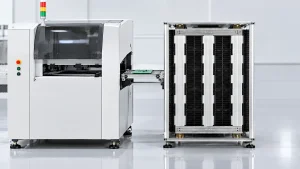
Key Physical Dimensions: Magazine Rack and Loader Alignment
To ensure magazine rack loader compatibility, the physical specifications are required to be identical. This means matching all measurements of the magazine rack with respect to the loader’s entry. The dimensions of the magazine rack may even include reference designations such as “Position A,” “Position B,” or some other designation that will assist in ensuring the proper positioning of the magazine rack. Thus, if the rack is set to Position A and the loader accepts Position B, a misalignment will occur and ruin magazine rack loader compatibility.
Another important factor is the height of the conveyor. SMT assembly conveyors are usually at a standard height such as 900mm but still have some variations. If ever the conveyor height used by the loader differs from the height designed for the magazine rack, the signal transfer can either jam or fail completely. Make sure to take the right measures and make sure the technical specifications of the magazine rack and loader match before purchasing the equipment to secure magazine rack loader compatibility. There also may be a mismatch between magazine racks designed for other types of conveyors and old equipment with new loaders.
Mechanical Connections and Rack Types
Various structures may employ different methods to keep and move magazine racks. Common types of racks include metal, plastic or alloy racks, which come with their own design characteristics. It is essential that the mechanical locking points (such as side brackets, bottom pins, and clamp slots) conform to the requirements of the loader reliable magazine rack loader compatibility. For instance, certain loaders have racks with side guide slots to make the movement smooth while the others are designed to rely on bottom rails or pins for stability.
Due to the fact that the standards for racks and loaders are so diverse, designing them to be able to work together is a rarity. It’s important to ensure that you consult specifications on the size and mechanical engagement of both items before buying. Try to get drawings for the components and superimpose them visually to check if they fit together. Always contact the loader suppliers if feasible and ask for samples that can be fitted to test magazine rack loader compatibility.
Material and Weight: Load Limitations
In addition to simple size, the type of material of the magazine rack affects magazine rack loader compatibility. Metal racks tend to be heavier and typically surpass the maximum weight limit of the loader– especially when they are filled with heavy PCBs. On the contrary, lightweight racks made out of plastic may not offer the sufficient rigidity for some loaders, which results in malfunction or malfunctioning movement.
Find out the maximum allowable load as per the manufacturer specifications of your loader and see whether this matches the weight of a loaded rack. An overloaded loader can result in mechanical failure or alarms going off or poor performance. On the contrary, a light rack can cause the loader sensors fail to operate timely. Make it a point to find out the material and its weight before choosing any new magazine rack for your loader equipment and protect magazine rack loader compatibility.
Rack Orientation and PCB Positioning
It is important to have the right direction: magazine racks are made to accommodate printed circuit boards either horizontally or vertically and they have specific position markers. Some loaders only work with magazine racks with PCB slots that match perfectly with their feeding device. If the rack’s PCB layout is different than the loader configuration, the feeding arm may not pick the PCBs or the PCBs will be fed incorrectly.
Furthermore, the orientation affects downstream processes, including wave soldering, inspection, and pick-and-place. Magazine racks with unusual slot angles may not be compatible with loaders intended for standard slot designs. When changing rack types or introducing new board sizes, it’s imperative to check the compatibility of orientation.
Checking Rack Against Loader: A Practical Guide
Manufacturers and engineers ask the popular question, “How can I verify that my rack matches my loader?” The process is mechanical and requires more than just visual scanning. First, retrieve data sheets of both the loader and the rack to ensure compatibility in spacing, dimension instructions, base placement, and maximum weight.
If possible, place the rack physically on the loader. Confirm that:
·The rack fits securely and does not wobble.
·All mechanical engagement points align.
·The PCB slots line up with the loader’s feeding mechanisms.
·The rack does not exceed the loader’s height, width, or weight constraints.
·Sensors or guiding systems trigger correctly.
If it is not possible to carry out a real-world fit, use Computer-Aided Design or technical overlapping tools in order to show compatibility. If some parameter is not clear, contact the technical support of the supplier. Some loading systems can have adjustable devices, therefore you must seek confirmation if your loading equipment can adapt to slightly different configurations of magazine racks.
Vendor-Specific Standards and Custom Magazine Racks
A magazine rack is not always made to universal specifications; sometimes companies design their own models in order to build consumer loyalty or to meet special needs. In case your loader was made by A, but your rack was made by B, pay close attention to possible small principle differences which may distinguish them.
Custom racks can cater to unique PCB handling requirements that make custom loader adaptations necessary. When possible, try to obtain racks and loaders from the same manufacturer or find one that offers cross-brand compatibility. Always ask for custom rack samples and tryouts prior to bulk purchase.
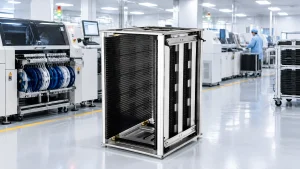
Height Settings for SMT Conveyor and Loader Integration
The height of the magazine rack in SMT assembly lines is varied according to both loader and conveyor side requirements. In the absence of the correct height adjustment, the boards might be misfed or damaged. The standard conveyor height is between 900 mm and 950 mm. However, specialized lines might differ from these measurements.
The first step to correct height discrepancies is the determination of the loader’s changing possibilities. Many of the modern loaders have the opportunity of height adjustment. In difficult cases, receipts and pieces of advice may be received from technical workers related to the use of loader adaptations and modifications. One should remember that the heights that do not correspond may lead to breakdowns as well as to hostile effects on the printed circuit board and equipment.
Other Factors Affecting Compatibility
Along with the operations machinery like racks and loaders, compatibility may also be affected by certain other factors. For instance, depending on temperature and humidity, the expansion or contraction of material may cause racks to fit improperly with loaders. At any location that needs high throughput, wear and tear may result in deformation of racks and hence lead to fitment problems.
Regularly check racks and loaders for any signs of wear and tear. Change out any old racks proactively. Create and carry out a maintenance program for loaders. If your loader is unable to accept any racks that were previously working, check for whether the machine has any kind of physical deformity or the sensor is out of calibration.
Consulting Technical Support and Supplier Services
When compatibility issues cannot be solved internally, a request for supplier technical assistance should be submitted. Many manufacturers offer the services of engineering consultations, fitting tests, and even custom design for loaders best suited to a problematic set of magazine racks. Working with supplier cooperation can hasten the process of finding a solution to the problem and reducing downtime.
Record compatibility requirements in technical procurement contracts. Ask your suppliers to provide compatibility guarantees with regard to base positions, mechanical fastening points, maximum board/weight specs, and height settings. Maintain full records of compatibility data for future possible troubleshooting and audits.
Ensuring effective communication prevents any misunderstandings. Try to involve the procurement and engineering departments while selecting the racks and loaders. Discuss any special specifications like static-free shelves or racks that serve the purpose of humidity control; such specifications can also dictate the selection of features in loaders.