

Polyamide fabric is a textile made wholly or partly from polyamide fibers. In ordinary fabric descriptions, this usually means nylon, including familiar textile materials such as nylon 6 and nylon 6,6. The label identifies a fiber family; the weave, knit, blend and finishing determine what the finished fabric is like.
Polyamide and polyester are different synthetic material families. Neither name provides a complete answer to “Which fabric should I choose?” A useful comparison keeps the intended job constant and examines composition, construction, moisture behavior, handling and the evidence available for the actual item.
What polyamide fabric means
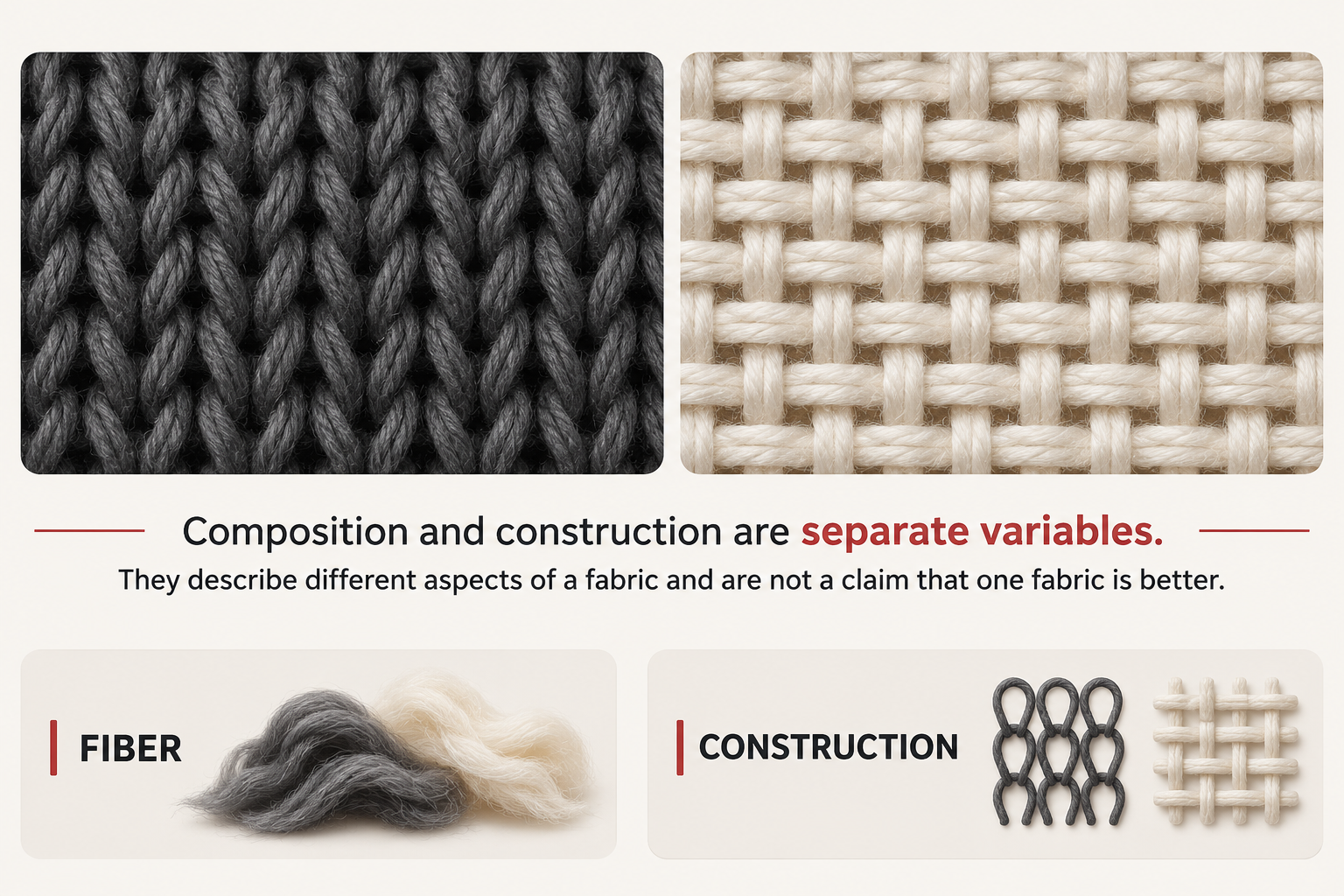
Read a fabric description in layers. “Polyamide” describes material content. “Knitted” or “woven” describes construction. A blend declaration identifies other fibers present. A coating or finish adds another part of the finished-product description.
These layers answer different questions. Knowing the fiber does not tell you whether a swatch is an open knit or a dense weave. Knowing the construction does not tell you the declared composition. A buyer who records only one of those details may receive quotations that look comparable while describing different textiles.
For example, a soft, stretchy sample and a firmer woven sample can both be described as polyamide fabric. The difference is not evidence that one supplier has mislabeled the material. It is a reason to ask for the construction and blend information before drawing a conclusion about performance.
On a quotation or technical sheet, look for the complete finished-material description. If “PA” is used as an abbreviation, ask the supplier to identify what it refers to in that document. An abbreviation is useful shorthand once both parties share the same material definition.
Is polyamide the same as nylon?
For familiar synthetic textile fibers, nylon is the common name encountered within the polyamide family. Fulgar’s textile comparison identifies polyamide 6 and 6,6 as examples. The broader family name should not be read as a guarantee that every polyamide grade or finished textile is identical.
In everyday shopping, nylon and polyamide labels can therefore point to closely related descriptions. In technical purchasing, the more useful question is whether two offered items have the same declared material, construction and acceptance requirements.
A fabric replacement request should not stop at “nylon or equivalent.” Explain what equivalence needs to cover. If the requirement concerns feel, agree on a sample comparison. If it concerns an electrical or cleanliness property, specify the evidence needed for that property. The material nickname cannot carry all of those requirements.
This also avoids confusing a polymer family with a supplier’s product name. A commercial name may identify a particular offering, while “polyamide” remains a general material description. Keep both identities in the purchasing record when both are relevant.
Polyamide versus polyester: compare the right variables
Polyamide and polyester differ in moisture interaction and elasticity at the fiber level. Coats’ comparison places nylon above polyester in moisture regain under its stated reference conditions. Fulgar describes textile polyamide as more elastic than polyester. These are useful material tendencies, not a ranking of every finished fabric.
For selection, greater moisture regain means that more moisture is taken into the fiber under the comparison conditions; it does not prove faster drying. Greater fiber elasticity can be relevant when flexibility or recovery matters, but a finished fabric also depends on construction and blends. In particular, a stretch-fabric result cannot be assigned to PA alone when the sample contains another stretch fiber.
To compare two real samples, put their specifications next to the intended use. A lightweight knit and a heavier woven fabric should not be presented as a controlled comparison of polymer alone. Their construction and finished form differ as well.
| Comparison level | What to identify | Question for the offered fabric |
|---|---|---|
| Material | PA or polyester and declared blend | What fibers are actually present? |
| Construction | Weave, knit and relevant finished structure | Are the samples structurally comparable? |
| Handling | Feel, flexibility and recovery requirements | Does the finished sample suit the task? |
| Service conditions | Care, contact and use conditions | Does the evidence cover those conditions? |
| Special function | The specific claimed property | What item-specific evidence supports it? |
A fair comparison may still favor one offered product. The important point is to state why. “This sample meets the required handling and documented performance” is a more useful conclusion than “polyamide is always better than polyester.” It gives the next buyer something specific to verify.
Moisture absorption is not the same as drying or comfort
Moisture regain describes moisture taken up by a fiber relative to its dry weight under defined conditions. The Coats comparison uses a common temperature and relative humidity for its nylon and polyester entries, supporting the relative comparison above. Moving liquid through a fabric and losing it by evaporation are different questions.
Consequently, the lower moisture regain of polyester does not mean every polyester fabric has the same surface-wetting behavior. Nor does nylon’s higher regain prove that every PA garment will feel more comfortable. Compare the finished materials against the actual requirement after using the fiber facts to identify relevant questions.
When a product description says a fabric manages moisture, ask what that means for the intended task. Does the user need liquid uptake, a particular surface feel, or a finished material that behaves consistently after care? Those are different requirements and may call for different comparisons.
A general fiber table also cannot describe every blend or finish. If a quotation changes composition and construction at the same time, a difference in the sample cannot be assigned confidently to the polymer alone.
For a practical evaluation, write down the condition that matters before reviewing a claim. A workwear buyer might focus on handling and the intended wearing environment. A wipe buyer needs to define the liquid and contact surface. The same broad phrase, such as “moisture management,” should not be used to stand in for both decisions.
Avoid converting a relative material tendency into a numerical result for a product that has not been evaluated. A supplier should be able to explain which information concerns the fiber and which concerns the finished item.
Fabric construction and blends change the result
A blend declaration tells a buyer that more than one fiber contributes to the textile. It does not explain how those fibers are arranged, how the fabric has been finished, or how the finished article behaves in use.
Keep three records together when evaluating a blend: the declared composition, the construction and the sample identity. That makes it easier to recognize whether a later quotation is offering the same item or a different material under a similar description.
Suppose a supplier proposes a different blend to address a handling complaint. Ask which requirement the proposed change is intended to improve, then compare the relevant samples and documentation. A new composition is a design choice to evaluate, not proof that the problem has been solved.
The same logic applies when a finish is introduced. Record the finish as part of the offered item, together with any relevant limitations. Do not attribute the finished function automatically to the underlying polyamide fiber.
For repeat orders, agree how changes will be communicated. A stable product code is helpful only if it refers to a stable, documented specification or clearly identifies approved revisions.
Care and service conditions belong to the finished item
The care information for a finished fabric or garment should be treated as item-specific guidance. A general statement about nylon cannot account for every blend, finish, seam or component in the finished article.
During selection, request the supplier’s care instructions and ask whether the supporting performance information refers to a new item or an item after the relevant care process. This is especially useful when repeated use is part of the purchasing requirement.
Keep the question tied to the actual objective. If the concern is appearance, compare the appearance criteria. If it is dimensional consistency or a special functional property, ask for information addressing that property. A description such as “washable” does not specify every acceptable outcome after washing.
Do not replace missing product guidance with a generic temperature or chemical recommendation taken from another fabric. The correct next step is to obtain the information for the offered item and make the acceptance conditions explicit.
What changes in controlled manufacturing environments
In controlled manufacturing, material identity is only one part of the decision. A textile may also need to meet requirements involving contamination, electrical behavior or contact with a particular surface. Those requirements should be considered separately.
A soft fabric is not automatically a low-particle fabric. A synthetic fiber is not automatically an ESD-qualified finished item. A general material description cannot establish either conclusion without the relevant item-specific evidence.
For a cleaning consumable, identify the surface, cleaning medium, construction, edge and packaging requirements. For workwear, define the intended use and the finished-garment properties that matter. These are different reader tasks even when both products contain textile fibers.
Quan Dun’s clean-wiper listing provides a concrete polyester product family for comparison with a material requirement. It should not be interpreted as evidence that a particular polyamide fabric is supplied. The appropriate item still needs its own material and performance information.
A practical fabric comparison worksheet
Use a short comparison record when several quotations use similar material language. The purpose is to identify differences and missing information, not to create a universal score for every fabric.
- Reader task: State what the textile must help a person do.
- Item identity: Record the offered product, sample and specification revision.
- Material description: Copy the declared fibers and blend information accurately.
- Construction and finish: Identify what the material name leaves out.
- Relevant evidence: Link each important requirement to information covering that item.
- Decision: Record the accepted differences and unresolved questions.
For example, two fabrics may both suit an appearance requirement while only one has documentation for an additional functional requirement. The appropriate choice then depends on whether that extra function is necessary. The worksheet makes the reason visible rather than hiding it behind a general material preference.
If essential information is missing, the result is an unanswered question. Keeping it visible is more useful than assigning a reassuring score based on the fiber name.
How to avoid a misleading sample comparison
Suppose the available PA sample is a light knit and the polyester sample is a dense woven fabric. A person may prefer the feel of one sample, but the comparison changes both material and construction. Record the preference as a result for those finished samples rather than proof of a universal fiber advantage.
A more focused comparison starts with the property that matters. If the objective is a particular handling feel, choose the offered samples against that requirement. If the objective is to understand the effect of a material substitution, identify which other variables differ and ask whether more comparable information is available.
Also preserve the difference between a user preference and a technical requirement. A sample can be preferred for appearance while lacking information for another necessary function. The purchasing decision should show both observations instead of allowing the preferred feel to answer every question.
This approach helps a supplier propose a useful alternative. The enquiry can explain the feature to preserve and the feature to change. “Keep the current finished dimensions and required documentation, but address this handling issue” gives a clearer task than “replace polyester with something better.” No result is assumed until the proposed item has been compared.
Common questions about polyamide fabric
Is polyamide a natural fiber?
The familiar nylon textile polyamides discussed here are synthetic fibers. They should not be confused with regenerated cellulosic materials such as viscose, whose feedstock and manufacturing route form a different classification.
Can I choose between PA and polyester by touch?
Touch is useful for assessing a sample’s feel. It does not establish the declared composition or a special performance property. Use it alongside the specification, not as a replacement for the specification.
What is the most useful question to ask a supplier?
Ask for the complete description and supporting information for the offered finished item, matched to its intended use. That request connects the material discussion to an actual purchasing decision.
References
- Fulgar: Polyamide versus polyester — textile material comparison.
- Coats: Know About Textile Fibres — fiber properties and measurement context.
- Lenzing: Fiber Technologies — regenerated-cellulose production context.