

Dielectric strength describes the electric field associated with breakdown of an insulating material under specified test conditions. It is commonly reported as voltage per thickness, such as kV/mm or V/mil. A higher reported value does not, by itself, establish the safe working voltage of equipment or the suitability of an ESD handling product.
The practical selection task is to understand what a report actually demonstrates. Breakdown voltage, dielectric strength, insulation resistance and dielectric constant answer different questions. This guide separates those quantities, shows bounded calculations and provides a comparison record for discussing materials with a supplier. It concerns data interpretation, not instructions for performing high-voltage tests.
What dielectric strength tells you
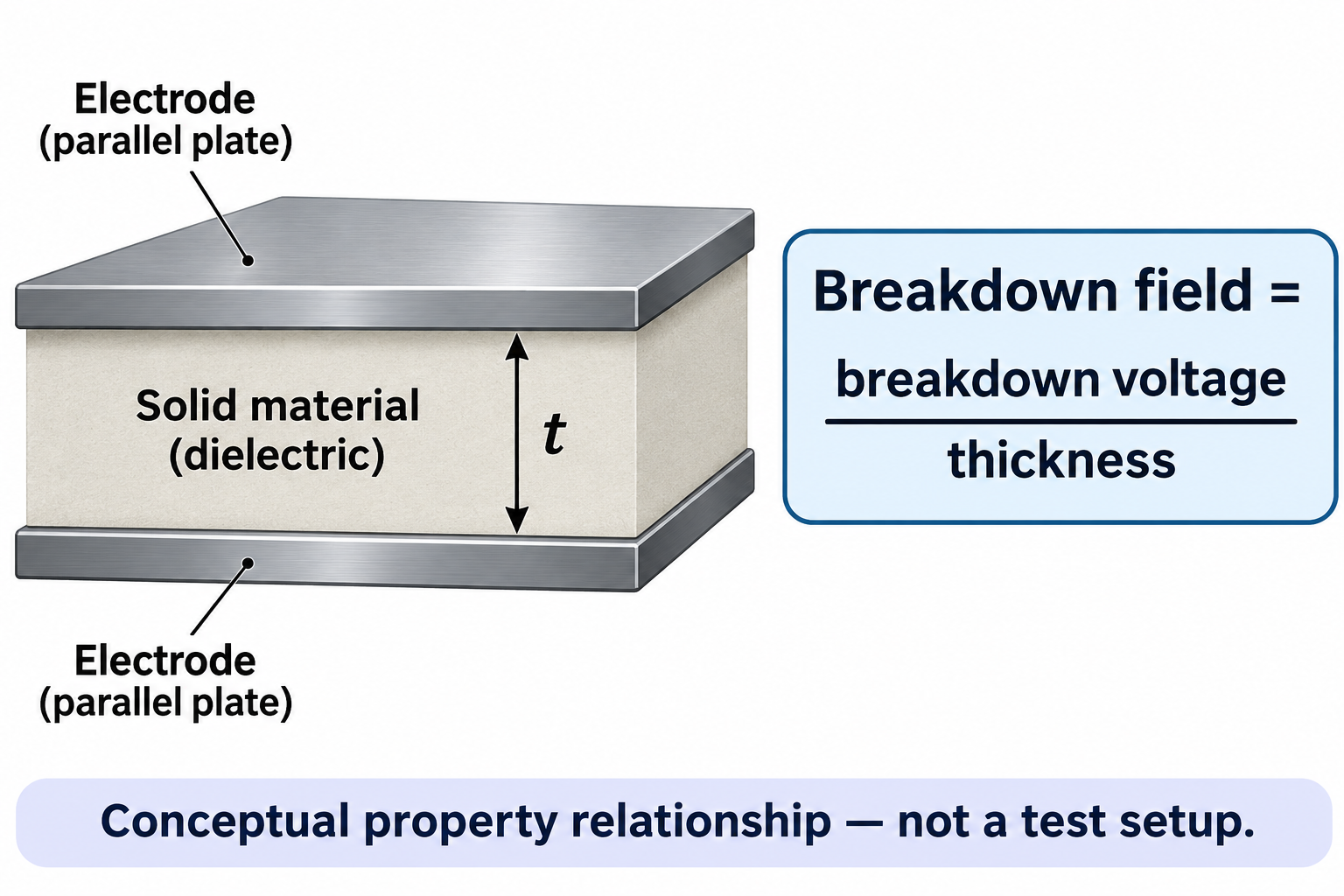
A dielectric-strength result relates a breakdown observation to the specimen and test method. It describes a property under those conditions, rather than giving a universal voltage that every part made from that material can withstand. Material form, specimen thickness and the measurement arrangement belong with the result.
The distinction becomes important when a purchasing table reduces an entire report to one number. A value can be correctly transcribed while its meaning is lost. Before accepting the table, locate the original report, identify the tested material and read how the result was expressed. A molded article, a film and a laboratory specimen should not be treated as the same test object without supporting evidence.
Intertek’s ASTM D149 overview explains the relationship between breakdown voltage and specimen thickness. The current ASTM D149-25 public scope addresses solid electrical insulating materials at commercial power frequencies and cautions against directly treating test results as actual application behavior. Neither source makes a general component working-voltage assignment from a material number alone.
Use the result as one input to a defined selection decision. State whether the question concerns comparing material data, reviewing a supplied insulation component or qualifying a complete assembly. Those are different levels of evidence. A material report may support the first while leaving much of the second and third unresolved.
Breakdown voltage and field units
Breakdown voltage is a voltage associated with the test observation. Dielectric strength is commonly calculated by dividing that voltage by specimen thickness. A result written only in kV therefore does not express the same quantity as one written in kV/mm. The denominator matters as much as the size of the number.
| Report notation | What it expresses | What must remain attached |
|---|---|---|
| kV or V | Breakdown voltage | Specimen thickness and test conditions |
| kV/mm or MV/m | Voltage divided by thickness | Method, specimen and calculation basis |
| V/mil | Voltage per thousandth of an inch | The same conditions, with the thickness unit made explicit |
| Ω | A resistance quantity | The measurement type; this is not breakdown field |
A mil is 0.001 inch, or 0.0254 mm. It is not a millimetre. Confusing those two thickness units creates a large conversion error even when the original voltage is copied correctly. Write the full unit name in an internal review when the audience includes people unfamiliar with imperial thickness notation.
Do not compare voltage and field columns by their numerical magnitudes. A specimen that reaches a larger breakdown voltage can still have a smaller voltage-per-thickness result. The unit tells you which comparison you are making; the specimen and method tell you whether that comparison is technically meaningful.
A hypothetical calculation, with a clear boundary
Imagine a report example with breakdown at 6 kV and specimen thickness 0.5 mm. The arithmetic gives 6 ÷ 0.5 = 12 kV/mm, which is also 12 MV/m. These are invented teaching inputs. They are not test data for a particular polymer or an allowable voltage for a CH-ESD product.
Converting that illustrative field to V/mil gives 12,000 V/mm × 0.0254 mm/mil = 304.8 V/mil. The material property has not changed; only its notation has. Keeping the original voltage and thickness beside the converted field lets a reviewer verify both the division and the unit conversion.
Now consider a second hypothetical specimen with breakdown at 8 kV and thickness 1 mm. Its calculated field is 8 kV/mm. The second specimen has the larger absolute voltage but the smaller normalized field. This example shows why “withstood more kilovolts” and “has a higher dielectric-strength result” are not interchangeable statements.
The calculation does not justify scaling a real part’s voltage rating in direct proportion to thickness. Actual thickness effects and test conditions must be considered through the applicable qualification process. Likewise, dividing by thickness does not remove every difference between two reports. It produces the stated quantity, not automatic equivalence between materials or assemblies.
Why specimen and test conditions change the comparison
A useful report identifies the specimen and the conditions under which breakdown was evaluated. Thickness, electrode arrangement, test route, surrounding medium and conditioning can affect interpretation. Without those details, two identical-looking field values may represent different test situations. A comparison should preserve those differences rather than conceal them behind a normalized unit.
For example, if report A concerns a conditioned film and report B concerns a different specimen form, matching the units does not make the results directly interchangeable. Ask whether the reports cover the same material identity, construction and intended comparison. Do not fill missing conditions using assumptions drawn from a product photograph.
The test-method identifier also needs its revision. “ASTM tested” is too broad to explain which result is being offered. The reference used here is the public scope of D149-25; it is not a claim that any particular CH-ESD material was tested to that standard. If a supplier submits a report using another edition, preserve that actual edition and have its relevance assessed for the purchasing requirement.
Avoid asking suppliers to choose whichever condition gives the highest number. A more useful request asks for comparable evidence tied to the supplied material. That changes the discussion from a numerical contest to a traceable explanation of what the evidence supports.
Dielectric strength versus other electrical properties
Insulation data sheets often place several electrical properties close together. Their proximity does not make them substitutes. Dielectric constant describes a different material response from breakdown. Dissipation factor concerns losses under specified conditions. Insulation resistance describes a resistance measurement. Each requires its own units and conditions.
| Property | Main question in a data review | Incorrect shortcut to avoid |
|---|---|---|
| Dielectric strength | What breakdown field was reported under these conditions? | Treating it as the equipment working voltage |
| Breakdown voltage | At what voltage was breakdown observed for this specimen? | Comparing it without thickness or method |
| Insulation resistance | What resistance was measured in the defined arrangement? | Relabeling it as a breakdown result |
| Dielectric constant | What relative dielectric response was reported? | Treating a larger value as universally better insulation |
| Dissipation factor | What loss-related property was reported under the stated conditions? | Assuming it measures the same failure condition as breakdown |
This matrix is a reading aid, not a full material qualification procedure. Its purpose is to prevent a supplier response from answering a different question than the specification asks. Intertek’s D150 overview addresses dielectric constant and dissipation factor separately from its D149 breakdown overview, reinforcing the need to keep those categories distinct.
In a comparison spreadsheet, give every property its own column and retain the relevant frequency, temperature or other reported condition where applicable. A blank field is more honest than moving an available number into a similarly named category. If a value is needed for the actual decision, request it explicitly rather than inferring it from another property.
Read the report before comparing materials
Start a review by identifying the proposed supplied material and the report specimen. Then connect the reported result to the application question. The following record is useful for a technical purchasing discussion because it makes the gaps visible without inventing a universal pass threshold.
| Review field | Information to request | Decision it supports |
|---|---|---|
| Material identity | Grade, construction and relevant revision | Whether the evidence concerns the supplied material |
| Specimen | Form, thickness and preparation recorded in the report | Whether the comparison uses equivalent test objects |
| Method | Full method identifier, edition and stated deviations | Whether results share an interpretable basis |
| Conditions | Reported conditioning, medium and measurement conditions | Whether differences need further review |
| Result | Original breakdown voltage, field calculation and reported result format | Whether units and arithmetic were transcribed correctly |
| Application | Component geometry and intended duty for separate qualification | Whether material evidence answers enough of the design question |
Keep the laboratory’s original result format. A reported minimum, average, range or individual observation should not be silently converted into another type of statistic. If the report format is unclear, ask what the number represents. There is no need to invent a midpoint just to rank two suppliers in a spreadsheet.
The review should end with a specific disposition: comparable for the defined material question, useful but incomplete, or not comparable without additional evidence. Record the reason. That produces a better handoff than marking one material “stronger” based solely on the largest catalog number and leaving the next person to discover the missing conditions.
Separate electrical insulation from ESD handling
Electrical insulation and static-control handling have different objectives. A material that resists breakdown under a stated test condition is not thereby proven suitable for controlling electrostatic charge around sensitive electronics. Conversely, a material selected for charge dissipation should not be assumed to provide electrical protective insulation.
EOS/ESD Association guidance treats materials as part of a broader control approach. For a purchasing team, the useful action is to keep the evidence requests separate. Ask for the properties required by the approved ESD handling specification and, when relevant, the independently defined insulation requirements. Do not let a favorable number in one category substitute for missing evidence in the other.
For ESD trays used in component handling, begin with the component envelope, support arrangement, access needs and applicable handling controls. Then request evidence for the selected material and configuration. A tray category is not a declaration that the product is certified electrical protective equipment, and this article assigns no high-voltage rating to it.
Separating the questions also improves a supplier conversation. A request for “the best insulating ESD tray” may combine conflicting or undefined priorities. State the actual handling job and the electrical property that must be documented. The supplier can then identify which configuration and evidence apply, and which requirements still need specialist evaluation.
Questions about dielectric-strength data
Can a higher kV/mm result justify replacing an existing material?
Not by itself. Check that the results are comparable, that the evidence concerns the proposed supplied material and that the full application requirements remain satisfied. A replacement decision can involve geometry, environmental conditions, manufacturing and other electrical properties. The breakdown-field number addresses one part of that assessment.
What should I do when a catalog lists dielectric strength without a method?
Treat it as preliminary information and request the supporting report or method details. Preserve the catalog value as originally stated, but do not present it as a verified working-voltage rating or a completed qualification. The missing method is a concrete evidence gap that the supplier can answer before the material is approved.
References
- Intertek: Dielectric Strength — Breakdown voltage divided by specimen thickness; conditions and test route affect comparability. No test procedure is reproduced.
- ASTM: D149-25 public scope — Public scope of D149-25 for solid electrical insulating materials at commercial power frequencies; limits on applying test results to actual service.
- Intertek: Dielectric Constant and Dissipation Factor — Dielectric constant and dissipation describe different properties from breakdown field.
- EOS/ESD Association: Control Procedures and Materials — Handling requirements for sensitive electronics are separate from electrical-insulation qualification.