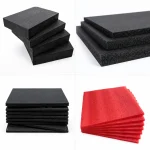


High density anti-static ESD foam is a material-selection question with two separate axes. Density describes a mechanical choice such as firmness, support, or handling feel. Antistatic, dissipative, or shielding language describes an electrical protection role. One label cannot prove the other, and a high-density foam is not automatically the right foam for an electronic part.
Start with the part, the contact surface, and the route. Define whether the foam cushions a part in a package, separates components in a tray, supports a workstation position, or fills a custom profile. Then request the grade, fabrication method, electrical evidence, and finished-part dimensions for the exact application.
1. Separate high density anti-static ESD foam from the ESD role
A dense foam can support a load or resist compression in a way that a softer foam cannot, but that mechanical behavior does not establish charge generation, dissipation, shielding, or compatibility with the handled part. NASA ESD guidance separates protective packaging functions from the mechanical design of the package. Use that distinction when writing the requirement: name the electrical role and the cushioning task independently.
The CH-ESD ESD foam product page lists EVA, IXPE, PU, and EPE families, along with sheets, rolls, die-cut shapes, and custom profiles. Treat these as supplier-stated material and fabrication options. The exact grade, density, surface, dimensions, and ESD evidence still need confirmation for the finished part.
| Decision axis | Questions to answer | Evidence to request |
|---|---|---|
| Electrical role | Is the requirement low charging, dissipative behavior, shielding, or another defined function? | Material designation, test method, conditions, and applicable specification |
| Mechanical task | Is the foam cushioning, separating, lining, blocking, or workstation support? | Finished dimensions, contact surface, compression or handling requirement |
| Structure and fabrication | Is the part a sheet, roll, die-cut shape, or custom profile? | Drawing, tolerance, cut method, revision, and edge condition |
| Cleanliness and contact | Will the foam touch a surface, connector, finish, or clean process? | Cleaning, packaging, surface compatibility, and handling requirements |
| Route | Will it stay in a package, move between stations, or ship externally? | Outer package, movement instruction, label, and final inspection criteria |
2. Compare foam construction with the finished use
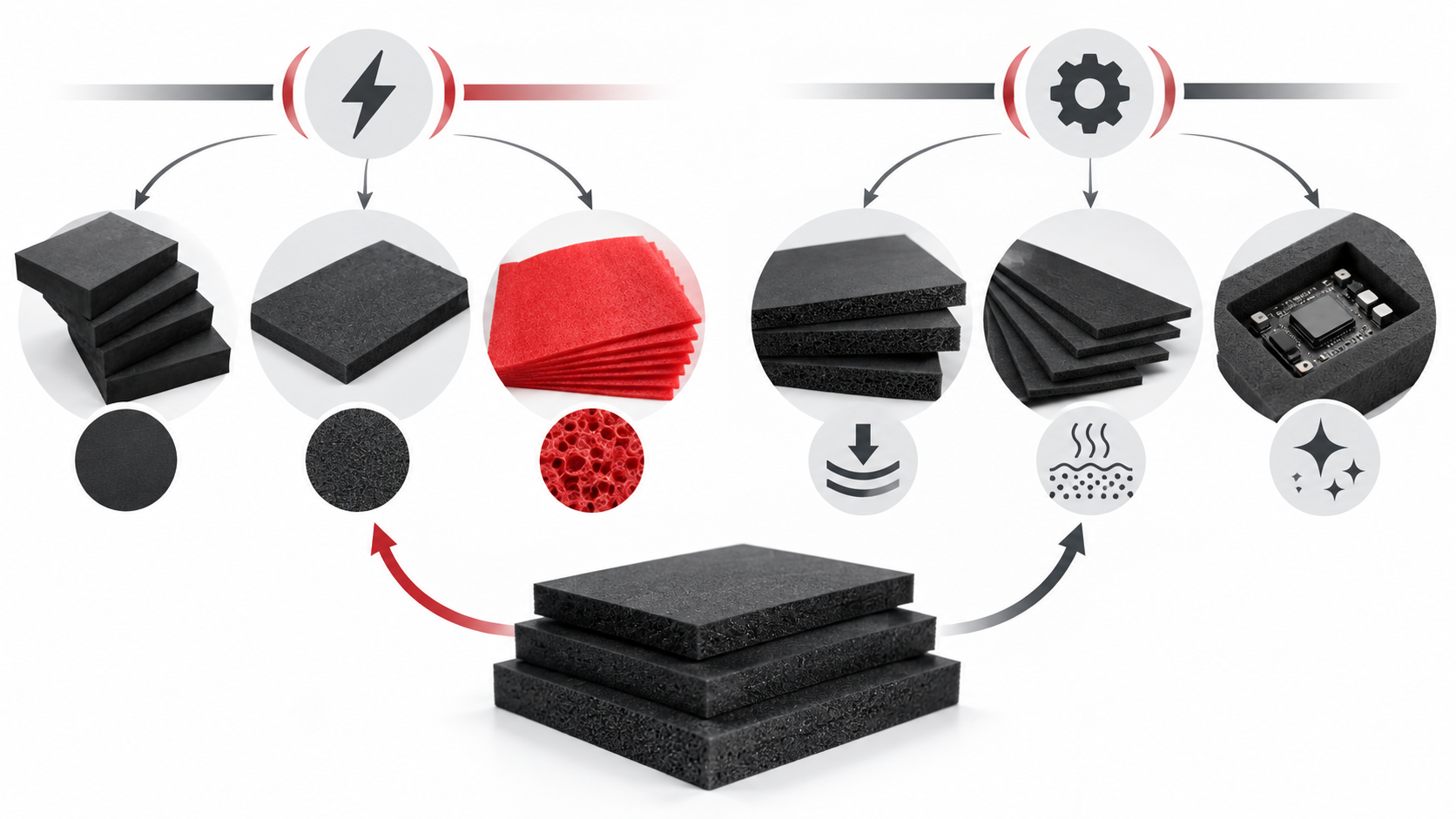
EVA, IXPE, PU, and EPE can represent different construction choices, but the material name alone does not answer whether the foam suits the part. Consider cell structure, resilience, surface texture, cut accuracy, edge stability, and how the foam contacts the component. A material that works as a flat separator may need a different conversion or surface treatment when it becomes a shaped insert.
For cushioning, define the part’s supported surfaces and the movement or shock exposure that the package must manage. For a tray liner, define the cavity, edge support, retrieval motion, and label or divider relationship. For a workstation pad, define the contact surface, cleaning routine, and route. Keep the electrical requirement visible in the same specification so the mechanical decision does not silently replace it.
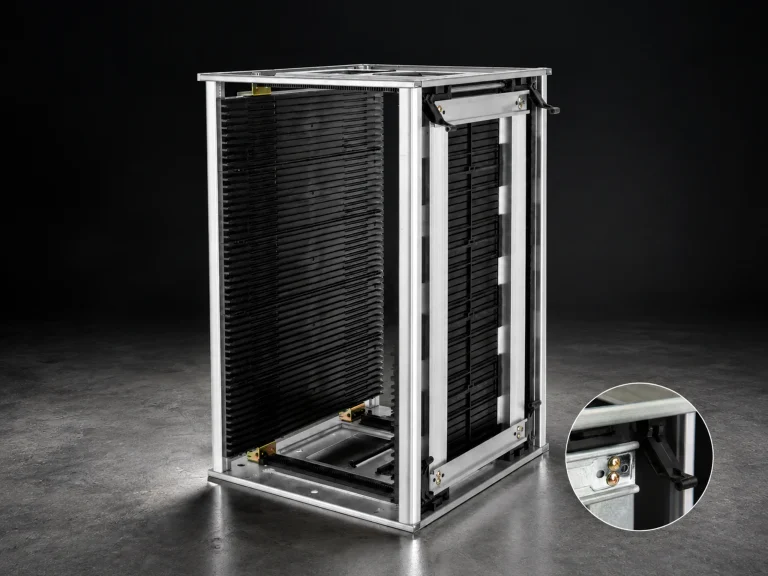
The CH-ESD ESD tray category provides a route for tray-based organization and transfer. If foam is added to a tray or box, approve the combined assembly: foam fit, tray geometry, part contact, removal method, and ESD evidence. Do not transfer a result from a sheet, another grade, or an unassembled sample.
3. Choose the fabrication form and inspection method
Sheets and rolls can support prototyping or repeated cutting, while die-cut or custom profiles can match a defined part envelope. The correct choice depends on repeatability, tolerance, volume, tool access, and whether the finished edge could interfere with a connector or sensitive surface. Ask for a drawing before production and retain the revision with the sample approval.
Define inspection at the finished-part level. Check dimensions, cut edges, surface condition, part fit, removal force, label or orientation marks, and packaging. If the supplier provides an electrical value or test report, record the method, condition, date, material grade, and sample configuration. NASA packaging guidance and ESD Association fundamentals support evidence discipline, but they do not certify a particular CH-ESD foam part.
4. Verify the actual foam part
Send the supplier the part envelope, contact surfaces, mechanical task, intended route, cleanliness constraints, required electrical role, fabrication form, quantity, and inspection evidence. Ask for the exact material family and grade, drawing revision, finished dimensions, surface description, test basis, and packaging for shipment. Approve a representative sample before releasing the full lot.
- Check the finished dimensions, cut edges, cavities, and contact surfaces against the approved drawing.
- Load the real part and run the insertion, removal, closure, and handling steps used in production.
- Confirm that the foam does not hide labels, trap loose parts, block connectors, or change the intended orientation.
- Match the supplier’s electrical evidence to the exact grade, sample, test method, and stated conditions.
- Freeze the material grade, fabrication method, drawing revision, packaging route, and inspection record.
Revalidate when the foam family, grade, density, surface, cut profile, part package, tray, outer box, route, or cleaning method changes. High density can be a useful mechanical attribute, but the approved ESD foam is the finished configuration whose electrical and mechanical evidence match the actual job.
References
- NASA NEPP ESD handbook overview — general ESD control and packaging context.
- NASA-STD-8739.6B — ESD protective-packaging and handling context.
- EOS/ESD Association: ESD Fundamentals, Part 3 — general ESD-control procedures and material-category context.