
Polyester cleanroom wipes should be compared by their specific fabric construction, edge finish, contamination evidence and packaging—not by the word polyester alone. Before a recurring supply order, identify the cleaning task, shortlist exact models and approve samples against a written acceptance plan.
A quotation for “9-inch polyester wipes” leaves important questions unanswered. Which construction is offered? How is the edge finished? How many wipes are in the bag? What evidence supports the required cleanliness? Answering those questions makes both sample evaluation and price comparison more useful.
Specify polyester cleanroom wipes by fabric, edge and cleanliness
A material label does not describe the whole wipe. Fisher Scientific’s cleanroom wipe guide distinguishes construction, edge processing, cleanliness and packaging considerations. MicroCare also discusses the differences between wipe constructions and their compatibility with cleaning applications.
For procurement, separate what the supplier calls the product from what your process needs it to demonstrate. A low-lint description is not a quantified particle-release result. A product-family title containing “laser edge” does not establish the edge treatment of every model in a mixed table.
| Specification | Ask the supplier | Record for acceptance |
|---|---|---|
| Fabric | What is the exact model’s material and construction? | Product code and controlled description |
| Edge finish | Which finish applies to this size and model? | Model-specific finish, supported by the supplied information |
| Contamination | Which particle, residue or extractables data is available and how was it measured? | Relevant method, result and scope |
| Cleaning use | What evidence is available for the intended substrate and cleaning fluid? | Buyer-defined sample trial and compatibility decision |
| Packaging | How many wipes per bag, and what packaging configuration is supplied? | Bag count, handling needs and repeat-order pack specification |
Keep sterile status, controlled-environment suitability and electrical requirements separate as well. None follows automatically from a white wipe, a sealed-looking pack or an ESD-related product title. Request the evidence that your particular application requires.
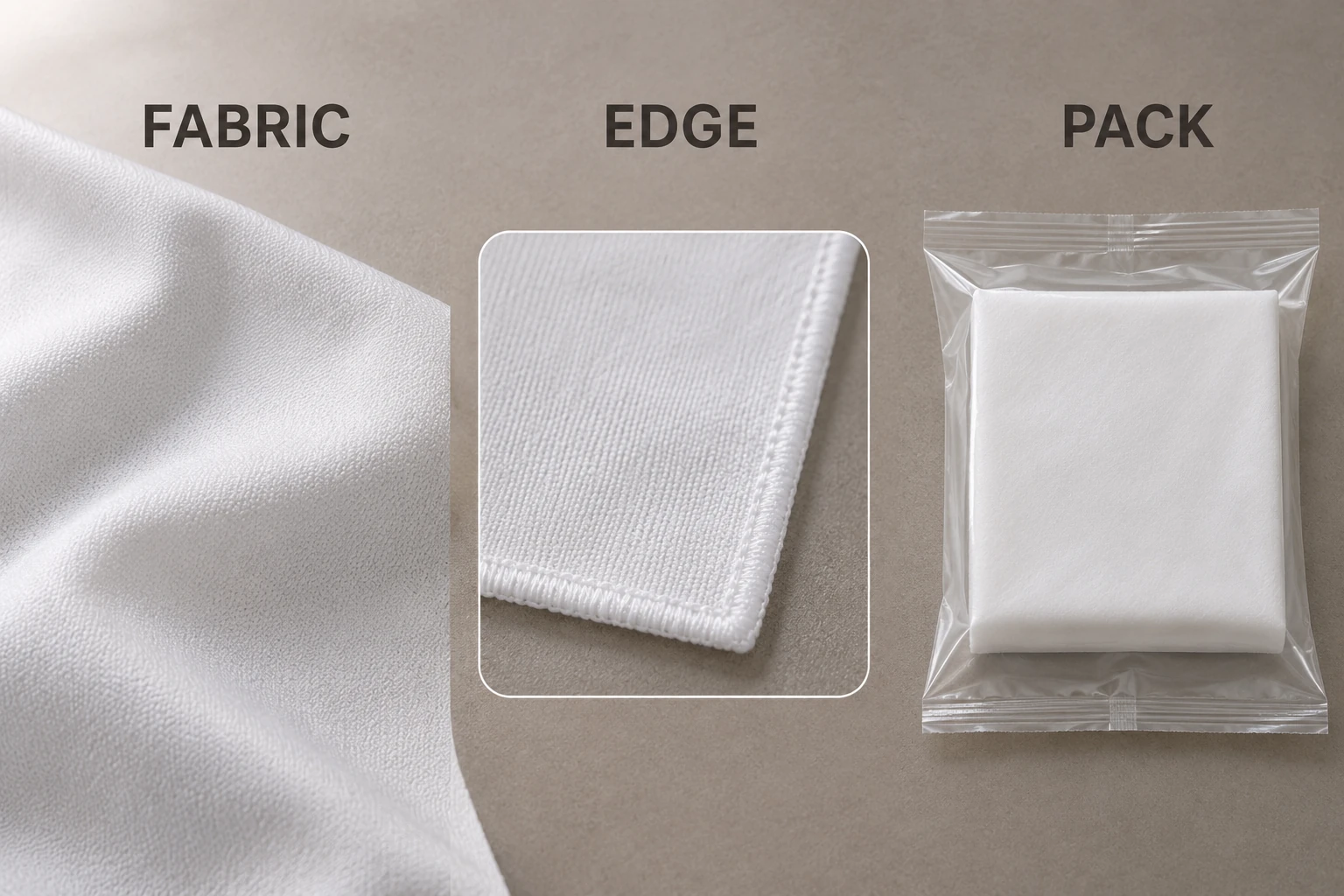
Compare actual model and pack combinations
Quan Dun’s clean wiper product table contains normal polyester, micro-denier woven and micro-denier knitted entries. The examples below retain the listed construction labels, sizes and bag counts. They identify products to discuss, not an established performance ranking.
| Listed construction | Model | Listed size | Listed quantity per bag |
|---|---|---|---|
| Normal polyester | QD81009-6 | 9 × 9 in. | 150 |
| Normal polyester | QD81006-6 | 6 × 6 in. | 150 |
| Normal polyester | QD81004-6 | 4 × 4 in. | 600 |
| Micro-denier woven | QD82209-6 | 9 × 9 in. | 100 |
| Micro-denier knitted | QD84209-6 | 9 × 9 in. | 100 |
A buyer can use these codes to ask for samples with a defined size and pack configuration. Do not substitute one construction for another just because both are offered in a 9 × 9-inch format. Ask which material and construction description applies to the exact quoted model.
The public listing does not establish model-specific particle-release limits, extractables, sterile status, electrical resistance or universal solvent compatibility. Its cleanliness labels are not, by themselves, a complete qualification record. Where your process requires such evidence, request the relevant report and its scope before approval.
Normalize the quotation before comparing bag prices
Compare like-for-like models and packs first. For the same cleaning task, bag price alone can conceal a different wipe size or count. A transparent comparison records the quoted bag price, wipes per bag, size, construction and the quantity actually used for the task.
Hypothetical arithmetic: A bag priced at $15 containing 150 wipes costs $0.10 per wipe. A bag priced at $12 containing 100 wipes costs $0.12 per wipe. These are invented calculation inputs, not Quan Dun prices. The lower bag price is not the lower unit price in this example.
Unit price is still only one part of the decision. Do not assume that a larger wipe or a different fabric will complete the same task with the same consumption. Record task usage during the sample trial, then compare the proposed supply options on that common basis.
If your team calculates cost per task, use the accepted sample’s observed consumption and your actual quotation. Keep rejected wipes, rework or other process consequences visible where your evaluation measures them. Do not insert estimated savings that the trial has not established.
Evaluate samples under the intended cleaning conditions
A useful sample trial holds the task and evaluation method steady while comparing the shortlisted models. Identify the substrate, residue to remove, cleaning fluid, handling method and acceptance criteria before the trial. Use the process owner’s approved compatibility and safety requirements.
MicroCare’s guidance is a reason to check the complete cleaning application rather than assume all wipe materials behave alike. It is not evidence that a particular Quan Dun wipe is suitable for every cleaning chemical. Request model-specific guidance and verify the proposed combination for the actual use.
- Identify: Record model, size, sample reference, bag count and supplied documentation.
- Observe: Record handling, wet or dry use, visible residues, wipe integrity and consumption for the defined task.
- Measure: Use the relevant agreed contamination or process checks where required; visual cleanliness does not replace them.
- Decide: Record the approved model, restrictions and any information still needed before a repeat order.
Turn the accepted sample into a repeatable order
The final purchase specification should name the model, size, construction, edge finish, packaging configuration and the agreed documentation. Keep the accepted sample reference and request notice of proposed changes to characteristics that matter to the process.
For an initial inquiry, send your cleaning task, substrate, fluid, preferred size, expected consumption and any required contamination evidence. Indicate whether the order is for sample evaluation or an established repeat requirement. Ask the supplier to identify what it can support and which model it proposes.
Request a model-specific wipe sample and quotation from Quan Dun using those details. A clear model-and-pack comparison gives your team a practical basis for approval and repeat supply.
References
- Fisher Scientific: Fisherbrand Cleanroom Wipes Guide, 2022 — construction, edge processing, cleanliness and packaging considerations.
- MicroCare: All Electronics Cleaning Wipes Are Not Created Equal — wipe construction and cleaning-application compatibility.