

How many amps does a dryer use? The answer depends on the model and on whether you mean operating current or the required circuit rating. GE’s published examples include electric dryers with operating ratings around 22–25 A while specifying a 30 A circuit. A 30 A breaker requirement does not mean a dryer continuously draws 30 A.
Gas dryers and some compact 120 V electric models have different electrical requirements. Start with the full model number and its manufacturer instructions; “dryer” alone is not a complete electrical specification.
Scope: US manufacturer examples, sources checked November 1, 2026. This article explains ratings; it does not select wiring, breakers, receptacles or adapters for an installation.
How many amps does a dryer use versus its circuit rating?
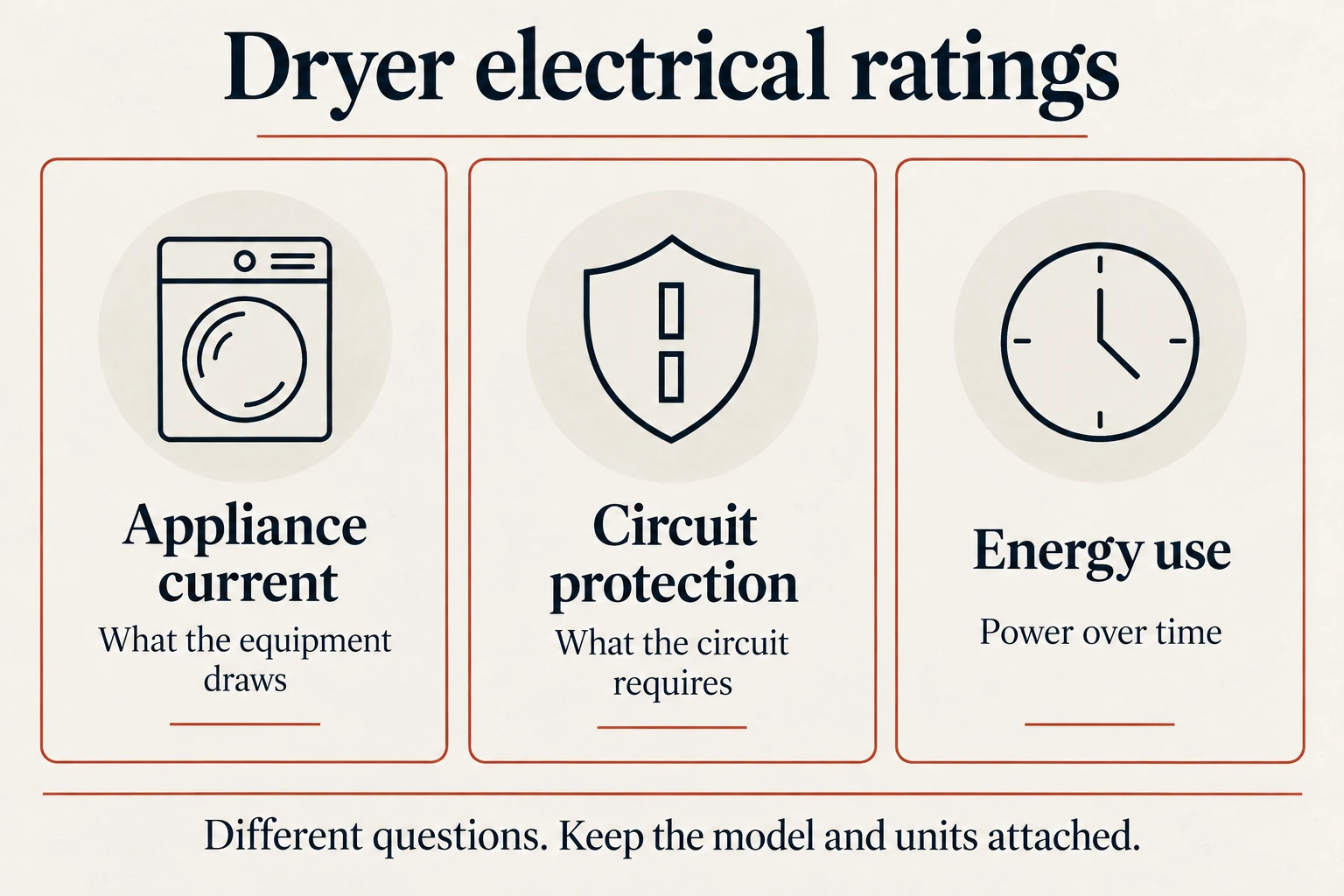
GE’s table for certain 6.1/6.2-cubic-foot top-load electric dryers at 208 V lists 22 A alongside a 30 A breaker requirement. The same manufacturer publishes other values for different capacities and voltages. Those entries illustrate why the operating-amperage column and breaker column should not be combined.
Keep the equipment category and voltage attached to the example. A number from a 208 V table is not automatically the correct value for a 240 V configuration. It is also not a measurement of your dryer during a particular cycle.
| GE/Hotpoint category in the cited guidance | Supply described | Typical circuit protection listed | What still needs model confirmation |
|---|---|---|---|
| Electric dryer | 208/240 V | 30 A | Actual operating rating and installation details |
| Gas dryer | 120 V | 15 A or 20 A | Specific appliance instructions |
| Certain space-saving electric dryers | 120 V | 15 A or 20 A | Whether the particular model belongs to this category |
These are manufacturer-scoped examples, not a universal chart for every brand, heat-pump design or combination appliance. The model documentation resolves which entry, if any, applies.
Gas, electric and compact are starting points
A fuel-type description helps identify the right documentation, but it does not replace it. A gas dryer still has electrical requirements. Likewise, the word “compact” does not by itself establish a 120 V supply or a particular circuit rating.
When comparing two listings, record the exact model and electrical specification beside each price. Otherwise, an attractive comparison can accidentally place unlike appliances in the same category. A photograph of the front of the machine rarely supplies enough information to resolve that difference.
Why watts divided by volts is not a complete installation answer
A calculation can help interpret a stated rating when its assumptions are known. It cannot replace a missing model-specific requirement. Do not calculate a new breaker size from a sales-page watt figure, or change a protective device to accommodate an appliance that has not been assessed.
The practical issue is often the source of the number. Was it copied from the nameplate, a manufacturer table, an energy label or an unrelated model’s listing? Write that source down. Two figures can both be valid while describing different things.
Current draw is not the electricity cost per load
Amps describe current. Watts describe power, while kilowatt-hours describe energy accumulated over time. For a purely illustrative constant 1 kW load operating for half an hour, the energy is 0.5 kWh. This example explains the units; it does not estimate a dryer cycle.
A breaker’s amp rating cannot tell you how much energy a load of laundry uses. For a meaningful operating-cost comparison, use suitable manufacturer energy information or an appropriate energy-use record, together with your tariff. Keep those results separate from the installation specifications.
Prepare the useful questions before buying
A concise record should contain the model identifier, fuel or heating type as described by the maker, rated supply, electrical input information, and the exact installation document. Include whether the appliance is standalone or part of a combined unit.
Then ask two separate questions: “What does this model require?” and “Has this location been assessed for those requirements?” The first is answered by equipment documentation; the second needs an assessment of the actual installation. Do not move equipment or open covers merely to complete a worksheet.
Other electrical components have similarly distinct roles. Our AC contactor explanation discusses switching-device ratings; those also should not be substituted for a dryer’s supply requirements.