

Corona discharge is localized ionization of gas around a conductor where the electric field is sufficiently concentrated. It can occur without an arc bridging the entire gap. That distinction explains why a high-voltage system may show discharge activity without the dramatic spark that people often associate with electrical breakdown.
Understanding the term helps interpret an engineering report. It does not enable someone to diagnose energized equipment by sight, sound or smell. High-voltage inspection and maintenance belong to qualified personnel using the site’s approved procedures.
Why corona discharge starts in a local region
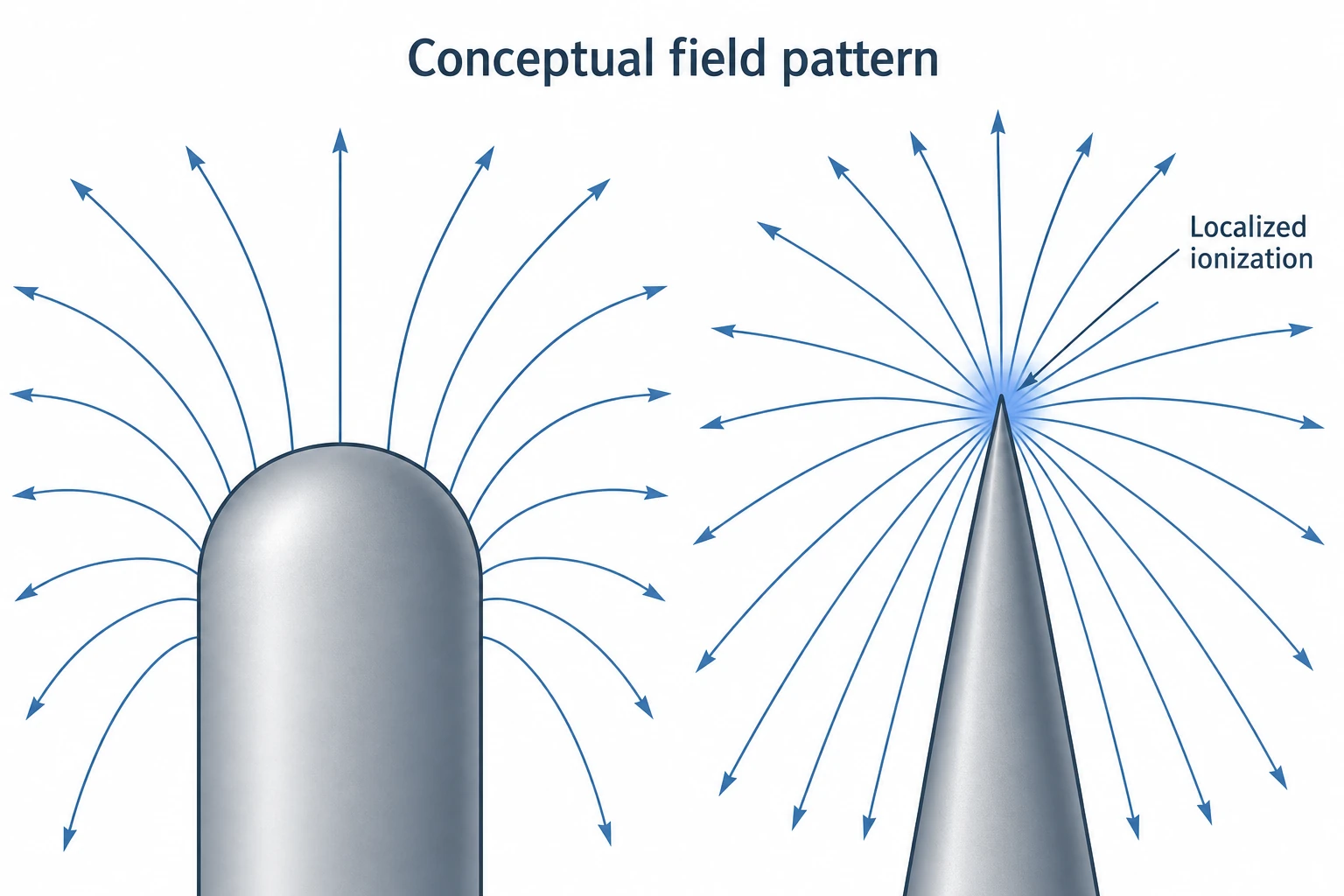
The field around a conductor is not necessarily uniform. When the local electric field is strong enough, the air near the conductor can ionize. A small region may therefore become electrically active even though the surrounding gas has not broken down across the whole separation.
Exosens identifies conductor shape and surface condition among the influencing factors. A point or sharp corner can concentrate the field relative to a smoother region. Gas conditions also matter, so one voltage number cannot define corona onset for every geometry and environment. Treat a quoted onset value as a result for a stated configuration.
Distinguish corona, partial discharge and an arc
| Term | What it describes | What the term alone does not prove |
|---|---|---|
| Corona | Localized gaseous discharge near a high-field region | The severity or remaining life of the equipment |
| Partial discharge | A broader class that can include corona and other localized insulation discharges | That the activity is specifically external corona |
| Arc | A discharge in which current sustains an ionized channel across a gap after breakdown | That every earlier indication was an arc |
The terminology matters when comparing reports. An observation labelled “partial discharge” should not automatically be rewritten as “visible corona.” Retain the measurement method, location and equipment context with the observation.
Why repeated activity matters
Persistent corona can contribute to deterioration of nearby materials. Spellman discusses ozone formation and its adverse effects on certain insulating materials. Exosens notes that the impact depends on intensity, exposure time, material and environment. A detected signal is therefore a reason for assessment, not a universal remaining-life estimate.
Consider a fictional report that marks a localized indication near one termination. It would be inappropriate to conclude from the label alone that the whole cable must be replaced, or that the equipment can remain in service. The responsible engineering team needs the operating conditions, measurement evidence, history and equipment-specific criteria.
Different observations answer different questions
Ultraviolet imaging can help locate external corona activity. Thermal imaging addresses surface temperature patterns; the absence of a thermal anomaly does not by itself exclude corona. Exosens describes the two techniques as providing different types of information. A report should name the technique instead of presenting every image as interchangeable proof.
A practical review asks which asset and location were observed, how the observation was obtained, which operating conditions were recorded and whether comparable earlier records exist. If two reports concern different configurations or methods, explain that difference before comparing their conclusions.
Do not approach equipment to reproduce a glow, noise or odour. Record information already available through authorised operations and refer the issue to the site’s electrical team. A general explanation cannot establish a safe approach distance, repair method or permission to energize.
How this differs from ESD handling
A static discharge during component handling and corona in a high-voltage assembly are different engineering problems. A handling spark briefly transfers accumulated charge across a gap. Corona can stay localized in the gas next to a conductor for as long as the strong local field persists. A storage container selected for electronic parts is not an insulation design remedy or a protective measure for personnel around high-voltage equipment.
CH-ESD’s ESD storage boxes address the separate task of storing and transferring components. Keep documentation for that handling system distinct from the high-voltage equipment’s inspection and design records. The useful takeaway from a corona report is the identified phenomenon, its location and the evidence for professional assessment—not a conclusion borrowed from an unrelated static-control product label.