
Your handheld speaker has an IPX5 mark. After a muddy outing, can you rinse it under the tap and put it straight on charge? The mark answers only part of that question. IPX5 describes protection against water jets under a defined enclosure test. It does not specify how to clean this model, whether its connector may be wet when used, or what to do after an accidental dunk. For this speaker owner, the practical IPX5 waterproof meaning depends on the exposure and the state of the port cover.
IPX5 waterproof meaning on a portable device
Read the X as “no solids rating specified here.” It does not mean dust-tight and it does not mean the product failed a dust test. The 5 is the water-jet category. It is distinct from the immersion categories. A photo of a device covered in droplets adds no information about whether its ports, charger or detachable accessories have the same protection.
Find the exact model in the care guide. Look for the condition of its covers during exposure and instructions that distinguish wiping, rinsing and immersion. If a family includes several sizes or connector designs, make sure the instructions show the device in your hand.
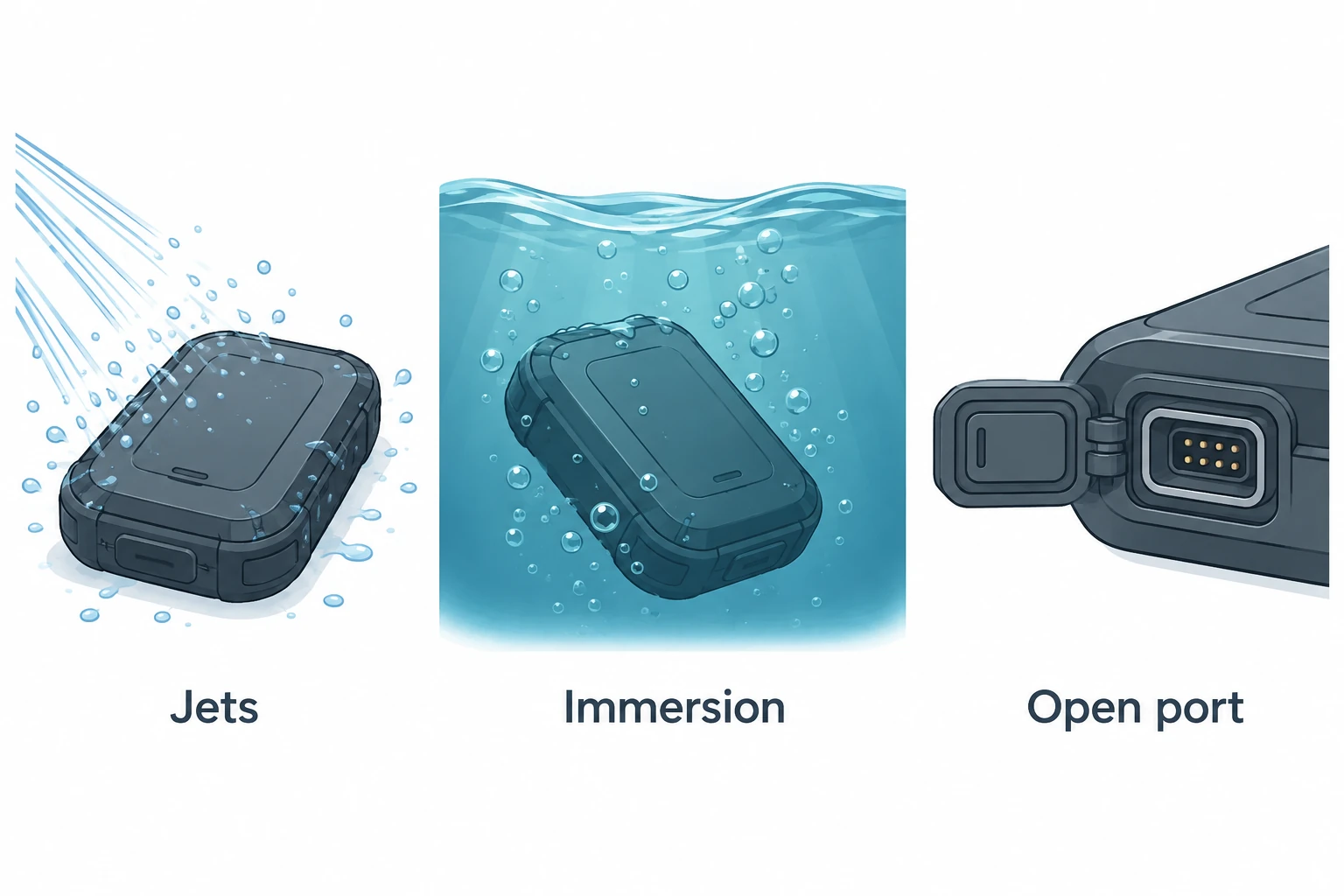
Read a care instruction before deciding to rinse
Consider a fictional speaker manual that says the rating applies with its port cover fully closed and directs owners to clean the case with a damp cloth. The rating describes an enclosure test. The care instruction gives the supported method for this product. A rinse is not necessary to follow the instruction, and there is no reason to substitute a jet for the cloth.
Now consider a different manual that explicitly permits a fresh-water rinse with the supplied cover closed. That permission belongs to the model and conditions named. Do not extend it to detergent, a pressure washer or a device with a missing cover. Evidence for a jet category is not evidence of chemical compatibility.
Three situations after water exposure
| What happened | What IPX5 establishes | Decision |
|---|---|---|
| The closed case was splashed | There is a water-jet rating for the specified enclosure | Use the maker’s care and drying instructions |
| The connector was exposed or remains wet | The marking does not establish permission to charge wet | Leave charging until the maker’s stated conditions are met |
| The device fell into a sink | Jet testing does not establish immersion protection | Use the model-specific accidental-immersion guidance or contact support |
If the guide cannot be found, record the model and what happened before contacting the manufacturer. “The cover was open for part of the exposure” is more useful than “it is supposed to be waterproof.” Do not treat a device that still turns on as proof that every internal part and connector is unaffected.
Keep accessories and stored parts separate
A charging dock or removable cable may have its own care limits. A rating printed on the handheld unit cannot be assigned to its accessories. Likewise, a workshop’s ESD handling containers are intended for component handling; their static-control description does not establish water protection. For the speaker owner, the deciding document is the care guide for that exact device and its condition at the time of exposure.