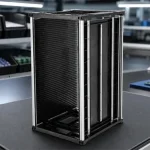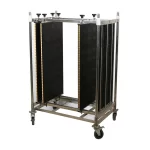


The way you approach and organize PCB magazine racks is of utmost importance in the operation and safety of your electronics manufacturing plant. The primary purpose of the PCB magazine rack is to store and transport printed circuit boards. They not only help maximize space but also keep printed circuit board assemblies safe from ESD and mechanical damage while transporting and storing them. This detailed tutorial aims to explore the proper use of PCB magazine racks, provide possible safety elements to be taken into account in the operation, and give recommendations regarding the best number of magazine racks to use in the process.

Safe Use for Stacking Anti-Static Racks
I.Safe Stacking Height for PCB Magazine Racks
A major issue faced by managers and supervisors on the production floor is knowing the safe height of PCB magazine racks. More often than not, people tend to stack the magazine higher than necessary. Safe height is dependent upon the design of the stack, weight of the load on the rack, and type of the PCB.
With most standard racks, designers advise erecting more than three to five racks. Certain specialized ESD racks, made out of plastic and or aluminum are capable of supporting stacks of up to six racks. However, it is critical to verify according to the manufacturer’s recommendation. The weight in each rack, as well as the loaded multilayer PCBs, affects the stacking capability. The heavier the racks, the lower the stacks should be. Also, special concern should be shown to the height of the racks with regard to the transport carts that are used when moving them.
Furthermore, as an important consideration, attempts must be made to avoid stacking in areas with a risk of vibration (i.e. near SMT lines or transportation areas). The floor must be dry and flat since an uneven flooring can cause the rack to topple over.
II.Loading Capacity and Rack Durability
Every PCB magazine stand has its own defined loading capability depending on the material used in its construction. Respecting this loading capacity is crucial for the strength of the PCB rack since loading which exceeds the capacity can lead to structural deformation of the rack making the stack unstable, thus risking damage to PCBs.
Most types of racks can hold up to 8-12 kg of weight, while the heavy-duty units can take up to 20 kg or more. Before stacking, remember to measure the total weight of loaded racks. Documentation with details of the loading capabilities should be provided by the manufacturer and used as a guideline for operations.
Heavy-duty racks or those made of metal or ESD-resistant materials are generally far more durable and better suited to stacking than others. Nonetheless, it is essential to inspect them regularly for any signs of damage, including cracks and loose connectors. The above-mentioned characteristics could lead to stacking safety issues, so it is extremely important to inspect the racks before reusing them.
III.Stacking Considerations
Static electricity is among the most dangerous elements in PCB treatment. The application of ESD racks made of carbon or conductive polymers minimizes this danger significantly. ESD racks are mandatory in places where PCBs are kept before use in sensitive situations, particularly in advanced production where PCBs get used for making devices for the automotive, medical, and aerospace industries.
When arranging ESD racks, it is essential to prevent friction from occurring between the racks since this would otherwise lead to the generation of static electricity. To avoid buildup of static, manufacturers usually recommend utilization of ESD gloves and grounding the racks with the aid of ESD mats/floors in the process. Unlike traditional racks, ESD PCB magazine racks often feature anti-slip feet or stacking guides, thereby enhancing the level of stability while stacking racks.
The stacking rules for ESD racks follow the same principles as for the standard racks: as a general rule of thumb, stacking something higher than five racks is not recommended. In the case of sensitive board, it would be best to keep the limit low at three for the ease of access and the reduced exposure to static. Overstacking even the durable ESD racks may affect the effectiveness of their anti-static performance and reduce the safety of moving them.
Frequently Asked Questions About PCB Magazine Rack Stacking
To address common concerns and clarify best practices around PCB magazine rack stacking, here are some frequently asked questions:
How can I prevent static discharge when stacking?
Use ESD PCB magazine racks and ESD gloves, ensure racks are properly grounded and avoid excess friction. Consider conductive flooring or anti-static mats in stacking zones.
Does high temperature or humidity affect stacking safety and ESD function?
High humidity helps reduce static buildup, yet excessive moisture may accelerate material aging of plastic ESD racks. High-temperature zones such as near reflow ovens are not suitable for long-term stacked storage, as thermal deformation weakens stacking stability.
Can PCB magazine racks loaded with bare PCBs and assembled PCBA be stacked together?
It is not recommended. Bare circuit boards and soldered PCBA differ in weight, rigidity and static sensitivity. PCBA with protruding components are easier to suffer mechanical collision damage when mixed-stacked. Separate stacking zones are preferred.
For any additional questions, consulting your rack supplier or technical documentation is always advisable.