

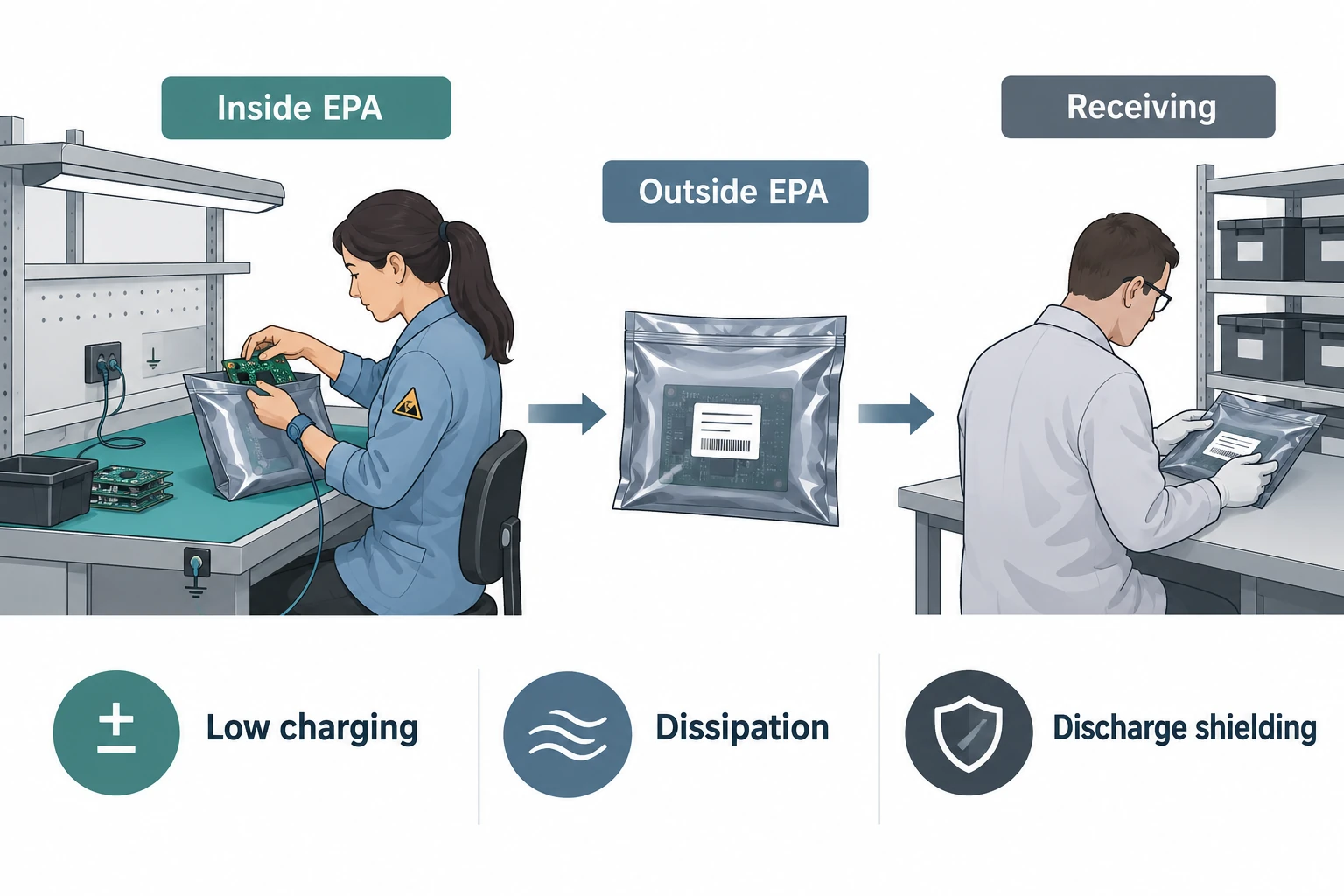
A board can leave an assembly bench in a bag that behaves well during packing yet lacks evidence of protection against a discharge during transit. Choose the bag for the route. Low charging describes what happens as materials contact and separate. Dissipative behaviour concerns how charge moves. Discharge shielding concerns protection of the contents from an external discharge. Those claims are not interchangeable. When a purchase request says “anti static bag,” ask where the board will travel.
Which anti static bag does this transfer need?
Start with two locations: where the board is first enclosed and where the next person will open it. At a controlled bench, personnel and surfaces are part of the site’s ESD control programme. A corridor, carrier depot or customer’s receiving area can have quite different controls. EOS/ESD Association distinguishes packaging properties for use inside an ESD protected area from protection needed outside it.
Consider a board moving between adjacent benches within the same controlled area. The team needs compatible contact materials and a handling arrangement that keeps the board protected. Now imagine the same board travelling by courier. Evidence for low charging at the bench does not demonstrate that the package shields the board during outside handling. Record each leg rather than putting “antistatic” on the entire shipment specification.
What to request from the bag supplier
| Property or feature | A useful request | What does not establish it |
|---|---|---|
| Low charging | Identify the intended contact surface and relevant evidence | A pink or metallic appearance |
| Discharge shielding | Identify the tested bag construction, method and closure condition | A resistance value for the film alone |
| Fit and closure | Give usable dimensions and closure instructions for the selected bag | Nominal width without allowance for a populated board |
Ask for results that identify the supplier part number and construction being offered. EOS/ESD Association identifies ANSI/ESD S541 as a packaging standard. A reference to a standard on a family brochure is a starting point; a purchaser still needs to know which property the evidence addresses and whether it applies to the ordered variant.
Walk a sample through the packing route
In a trial pack, a tall connector might fit inside the nominal bag dimensions but sit directly under the closure. Folding the top may then put pressure on the connector or prevent the bag from closing as instructed. Resolve that mechanical issue separately: choose a suitable size or protective arrangement rather than assuming electrical performance makes the fit acceptable.
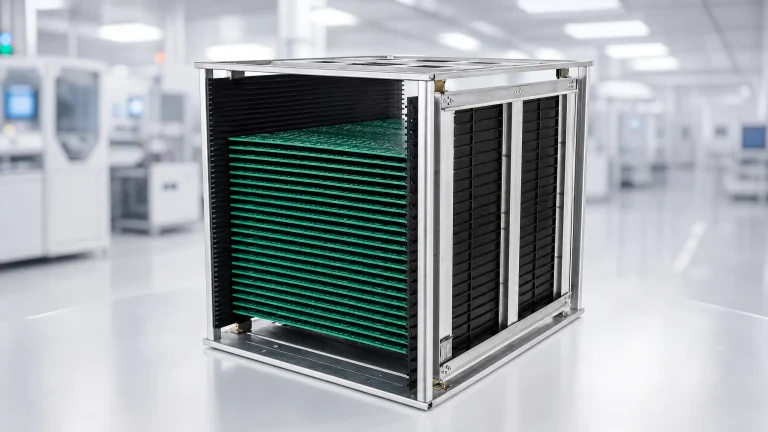
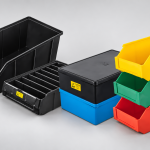
An outer ESD storage box can organize protected boards and reduce handling. A rigid outer box does not automatically supply missing discharge-shielding evidence for the inner package. Nor does an electrical shielding claim establish cushioning, puncture resistance or moisture-barrier performance. Ask for each property the shipping route actually needs.
Write a release note the next buyer can use
Record the board revision, packed dimensions, bag model and closure, route, and where opening is allowed. Keep the supplier evidence alongside that record. If an alternate bag arrives with the same colour but a different construction or part number, purchasing can identify the missing comparison immediately instead of relying on appearance at the packing bench.