

Two handheld instruments are advertised for wet environments. One says “water resistant”; the other says “waterproof.” Which should you buy for an inspection route where the instrument may get splashed, then be wiped clean before docking? Neither adjective answers that question. Ask what exposure was evaluated, in which configuration, and what the maker permits the operator to do afterward. The water resistant vs waterproof comparison becomes useful once you identify the exposure.
Water resistant vs waterproof: compare the evidence behind the words
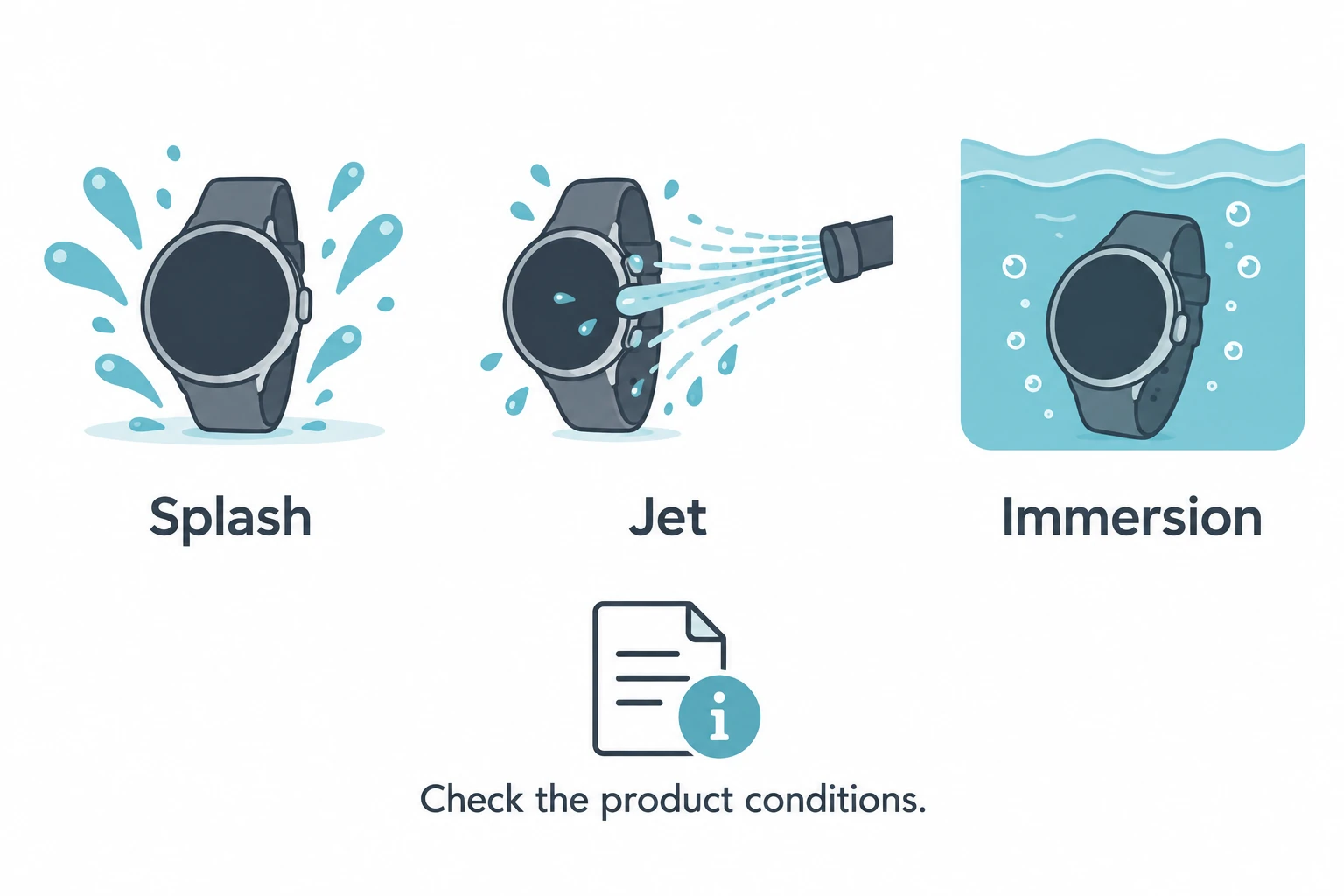
An enclosure classification under IEC 60529 describes particular test conditions. Water splashes, jets and immersion are different challenges. A resistance claim without a method may still be useful when the manual gives specific care instructions, but it is not equivalent to a documented enclosure rating. Likewise, the word waterproof does not identify a depth, duration, liquid or operating state.
An immersion claim is particularly easy to misread. A device tested while closed for a stated immersion condition has not necessarily been assessed against a cleaning jet. ABB’s guide explains why jet and immersion categories must be interpreted separately. If your route includes both, look for evidence covering both exposures.
Translate three advertisements into purchasing questions
| Advertised statement | What is still missing? | Question for the supplier |
|---|---|---|
| Water-resistant display | The claim may concern the front face only | Which surfaces and connectors are covered in the assembled instrument? |
| Waterproof with cap fitted | The liquid, duration and cap identity are not stated | Which document specifies the exposure and replacement cap? |
| Immersion-tested model | A wash jet is a separate exposure | Is the intended cleaning method expressly supported? |
Suppose one supplier supplies a care guide allowing a damp wipe but ruling out rinsing. Another supplies an immersion report for the main housing only; its docking connector is excluded. The first guide supports damp wiping. For the inspection route described above, neither reply establishes splash protection for the complete instrument, including its docking connector.
Record the use case in a sentence
Write down when the water exposure occurs. “The operator uses the instrument under cover; it may receive splashes during transfer; it is dry before docking” is far more useful than “outdoor use.” Include which caps and accessories are installed at each stage. Check chemical or saltwater compatibility separately if the liquid is not clean water. A housing material description alone does not resolve the seal or connector question.
What to keep with the purchase
File the model-specific rating or care document, its revision and the supplier’s answer about exclusions. If a sales claim and a manual appear to disagree, hold the disputed use open rather than silently choosing the more generous statement. Describe the permitted exposure to operators in the same plain language used in the purchasing decision.
For a facility also handling bare boards, an ESD storage box serves a different purpose. Static-control packaging should have its own specification; neither its name nor its lid supplies evidence of a water rating.