

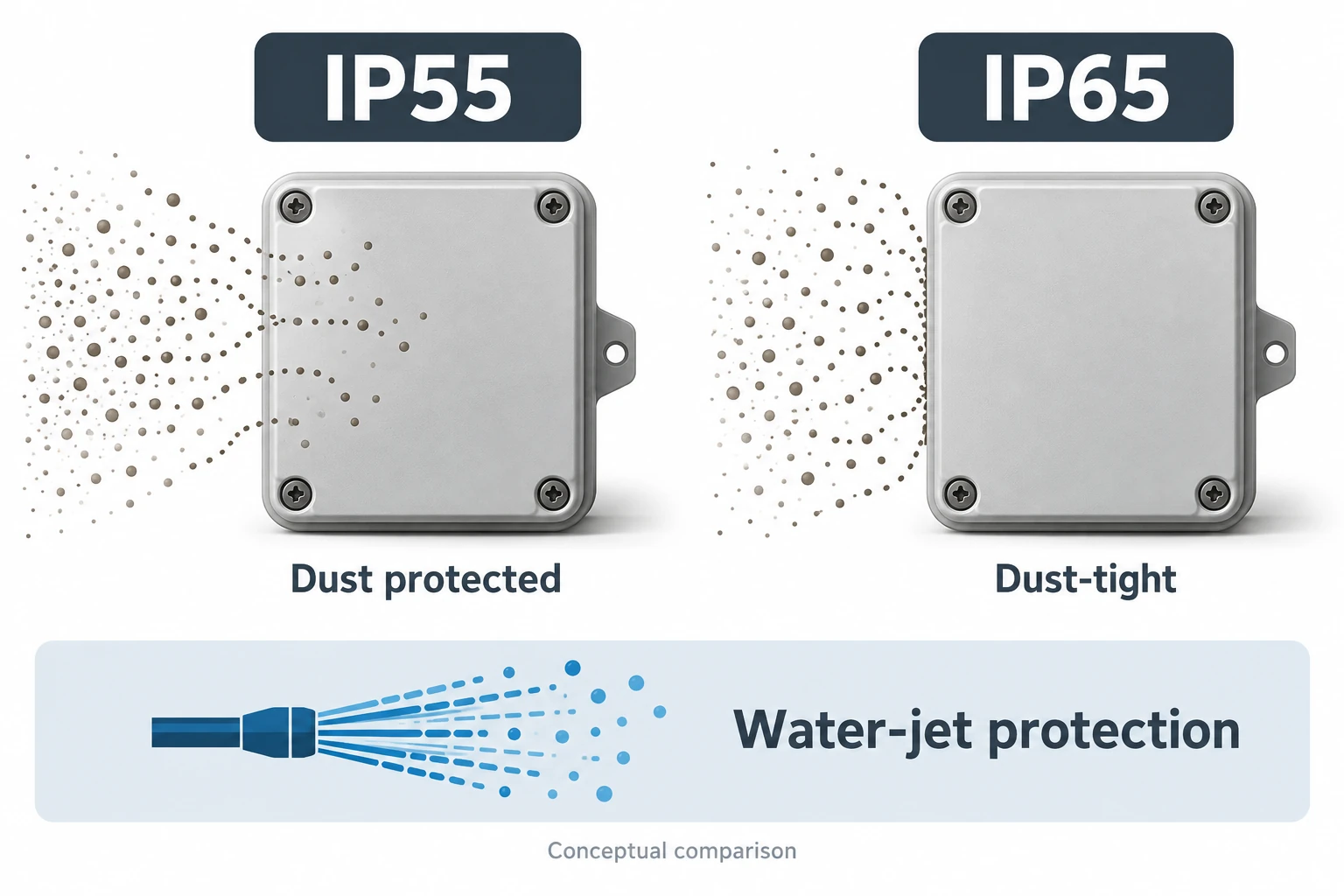
IP55 and IP65 share the same water-protection numeral: 5, for water jets. Their difference is the first digit. IP55 is dust protected, allowing limited dust ingress that does not impair satisfactory operation or safety under the applicable conditions; IP65 is dust-tight.
Changing from IP55 to IP65 therefore changes the stated dust classification. It does not, by itself, move the equipment into a stronger water-jet or immersion category.
Compare IP55 and IP65 one digit at a time
IEC 60529 classifies enclosure ingress protection. KEYENCE’s rating table explains the separate solid-particle and water categories. Keeping those categories separate prevents a common procurement mistake: treating a larger two-digit code as a single measure of every kind of environmental durability.
| Characteristic | IP55 | IP65 |
|---|---|---|
| Dust category | Dust protected | Dust-tight |
| Water category | Water jets | Water jets |
| Immersion established by this code? | No | No |
| Chemical compatibility established? | No | No |
“Dust protected” does not mean an unrestricted amount of dust may enter. It describes a bounded protection category. Conversely, “dust-tight” is an ingress classification, not a promise that every other property of the enclosure is suitable for the application.
A replacement enclosure needs more than the higher dust digit
Consider a hypothetical maintenance buyer replacing a cabinet in a dusty production area. The old drawing names one enclosure, while a proposed substitute advertises IP65 instead of IP55. The difference may be relevant to the dust requirement, but the rating does not resolve fit, cable entries, heat management or the installed configuration.
Ask for the complete assembly covered by the rating. Does it include the proposed door, gland plate, vents and connectors? An enclosure wall without penetrations is not necessarily the same configuration as the finished cabinet. Record the exact variant and installation conditions specified by its manufacturer.
This is a documentation comparison, not a direction to modify equipment. If the replacement changes the system design, the responsible designer must evaluate that change. The IP digits answer only part of the purchasing question.
Water jets are not immersion or unrestricted washdown
Both codes contain the same 5 in the water position. If the actual concern is powerful jets, temporary immersion or another exposure, ask for evidence covering that separate category. ABB’s guide makes clear that jet and immersion claims should not be treated as interchangeable.
A cleaning process also involves more than the presence of water. Its chemicals, temperature, direction, duration and the condition of the enclosure can matter to the product’s suitability. The IP55 or IP65 label alone does not define a universal cleaning recipe. Use the manufacturer’s instructions for the actual assembly.
Translate the environment into clear supplier questions
Describe where the enclosure sits, which particulate exposure is expected, how water reaches it and whether doors or connectors are opened during normal work. Include the configured assembly drawing. This allows the supplier to respond to a specific case instead of interpreting a broad request for “better waterproofing.”
Then ask which document supports each requirement. Keep the dust classification, water classification and any separate corrosion or material-compatibility evidence identifiable. A single marketing adjective should not replace those distinctions.
Component handling remains a separate requirement
Before electronics reach their final enclosure, they may need storage and transfer protection. CH-ESD’s ESD boxes serve that handling stage. Their electrostatic-control role does not automatically give them the environmental rating of the equipment being assembled.
For purchasing, the useful conclusion is precise: choose between IP55 and IP65 on the documented dust requirement, then evaluate the shared water-jet category and the remaining environmental conditions independently. That preserves the value of the code without asking it to answer questions it was never intended to answer.
For two otherwise similar quotations, put the manufacturer’s drawing revision beside each rating. If one quote covers the empty enclosure and the other covers a fitted assembly, mark that difference before comparing prices. This prevents a superficially equal specification from concealing a different product boundary.