
70% IPA wipes are wiping materials supplied with an isopropyl-alcohol solution at the stated concentration. Searches for 70 IPA wipes usually describe this product category, but the concentration alone does not identify the wipe material, solution grade, packaging or suitability for a particular surface.
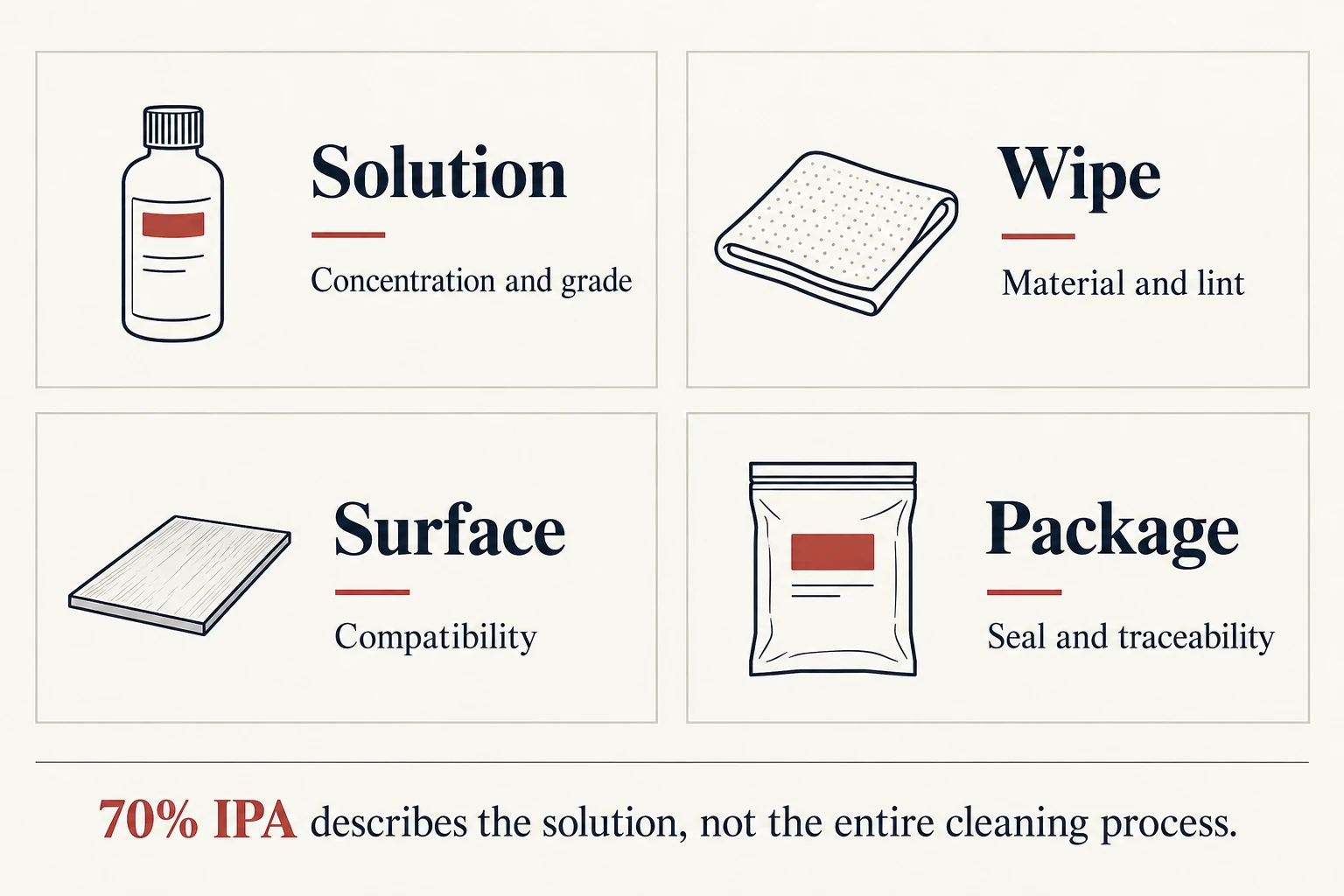
For an electronics or controlled-workspace purchase, compare the solution and the carrier together. Two packages carrying a 70% label can still be different cleaning products.
What 70 IPA wipes tell you—and what the label leaves open
IPA is isopropyl alcohol, also called isopropanol. Techspray explains 70% IPA as an alcohol-water mixture. Check the specific product documentation for the concentration basis and grade rather than treating every “alcohol wipe” as equivalent.
For a clearly defined example, Texwipe describes its TX 167 liquid as 70% by-volume USP-grade isopropanol with 30% USP Purified Water. It also explicitly calls that product non-sterile. This is a liquid-product example, not a specification for every pre-saturated wipe.
| Selection field | Evidence to request | Assumption to avoid |
|---|---|---|
| Solution | Concentration basis, grade and formulation | All 70% products are identical |
| Wipe carrier | Material, size and relevant contamination data | Concentration predicts lint or absorbency |
| Surface | Compatibility for the actual material and finish | Every plastic tolerates the same solvent |
| Packaging | Format, seal, lot and shelf-life information | A large tub and a sealed packet suit every workflow equally |
The wipe material is part of the product
Techspray’s 1608/1608 CP technical sheet distinguishes polyester and polyester-cellulose options, as well as individually wrapped and tub formats. This illustrates why a purchasing line should include the precise wipe variant rather than only “70% alcohol.”
Ask which characteristics matter for the job: dimensions, handling strength, absorbency, particle contribution or access to the surface. A general low-lint description does not replace a numerical test result where your process requires one. Likewise, a particular material name does not supply every performance value.
70% versus higher-concentration IPA is an application question
Techspray describes how water content affects drying behavior and surface wetting. More water can extend drying time; that may matter differently for different soils and processes. “Stronger percentage” is therefore not a complete description of better cleaning.
A useful comparison states the contaminant, the surface and the required outcome. Removing a particular residue from a robust fixture is a different task from working around a sensitive coating or optical surface. Choose against the documented process rather than selecting the highest concentration by default.
Material compatibility is more specific than “plastic-safe”
The Techspray wipe sheet includes a broad plastic-compatibility description, but its detailed instructions also warn that some sensitive plastics can be affected. Preserve that qualification. A short marketing phrase should not erase the limitations in the technical document.
Identify the actual material, finish and coating when requesting compatibility information. A transparent cover, a printed label and an exposed polymer body may present different questions even when they belong to one assembly. If the material is unknown, the compatibility decision remains unresolved.
Use the product’s current label, technical data and safety data sheet within your approved workplace procedure. This article compares specifications; it does not provide a solvent-mixing recipe, a powered-equipment cleaning procedure or a disinfection protocol.
Concentration does not prove sterility or ESD performance
The non-sterile Texwipe example shows why “70% IPA” cannot be read as a sterility claim. If a process requires a particular validated status, request evidence for the exact product. Do not infer medical suitability or a validated disinfecting result from the concentration alone.
The same evidence principle applies in an ESD-controlled workflow: the alcohol percentage does not provide an electrical-performance test for the complete wipe or cleaning process. Keep any required ESD criteria in the process specification instead of assuming that an electronics-cleaning label covers them.
Write a purchasing description that can be checked
Specify the manufacturer part number, solution details, wipe dimensions and material, pack format and required supporting documents. Add the target surface and the acceptance criteria your team actually uses. Keep lot and expiry information with the received material when the supplier provides them.
For the surrounding production workflow, our SMT supplies overview helps place cleaning consumables alongside other assembly materials. Confirm each consumable separately; a shared workstation does not make different material specifications interchangeable.