

ESD bags for electronics should be selected by protection role and route. The word antistatic, a pink color, or a metallic appearance does not by itself tell you whether a bag provides the function needed for storage, handling, or shipping. Start by defining what must be controlled, how the part moves, and what evidence is required for the exact bag configuration.
Separate low-charging, dissipative, shielding, moisture, and mechanical requirements. Then decide whether the bag is a primary package, a temporary handling layer, or one part of an outer shipping system. This keeps the bag choice connected to the route rather than to a color or a generic category label.
1. What ESD bags for electronics need to protect against
A low-charging or antistatic requirement addresses how the package behaves when handled. A dissipative requirement addresses how charge can move under defined conditions. A shielding requirement addresses protection from an external electrostatic field. These are related but different questions. NASA ESD guidance distinguishes packaging functions so the requirement can be matched to the actual exposure and handling process.
The CH-ESD ESD shielding bag product page describes a multi-layer bag family for electronic-component storage, handling, and transportation, with size, thickness, and opening options. Use that page to identify a candidate family, then request the construction and evidence for the exact offered size and configuration.
| Route question | Protection decision | Evidence to confirm |
|---|---|---|
| Bench or shelf storage | Low-charging, dissipative, shielding, or combined requirement | Material/construction, applicable test basis, and storage condition |
| Frequent handling | Opening, closure, visibility, and resealing method | Closure detail, handling instruction, and identification method |
| Moisture or contamination exposure | Whether a barrier or secondary package is required | Barrier claim, seal method, environment, and packaging configuration |
| Puncture or abrasion risk | Whether an outer box or additional protection is needed | Bag thickness, handling controls, and outer-package design |
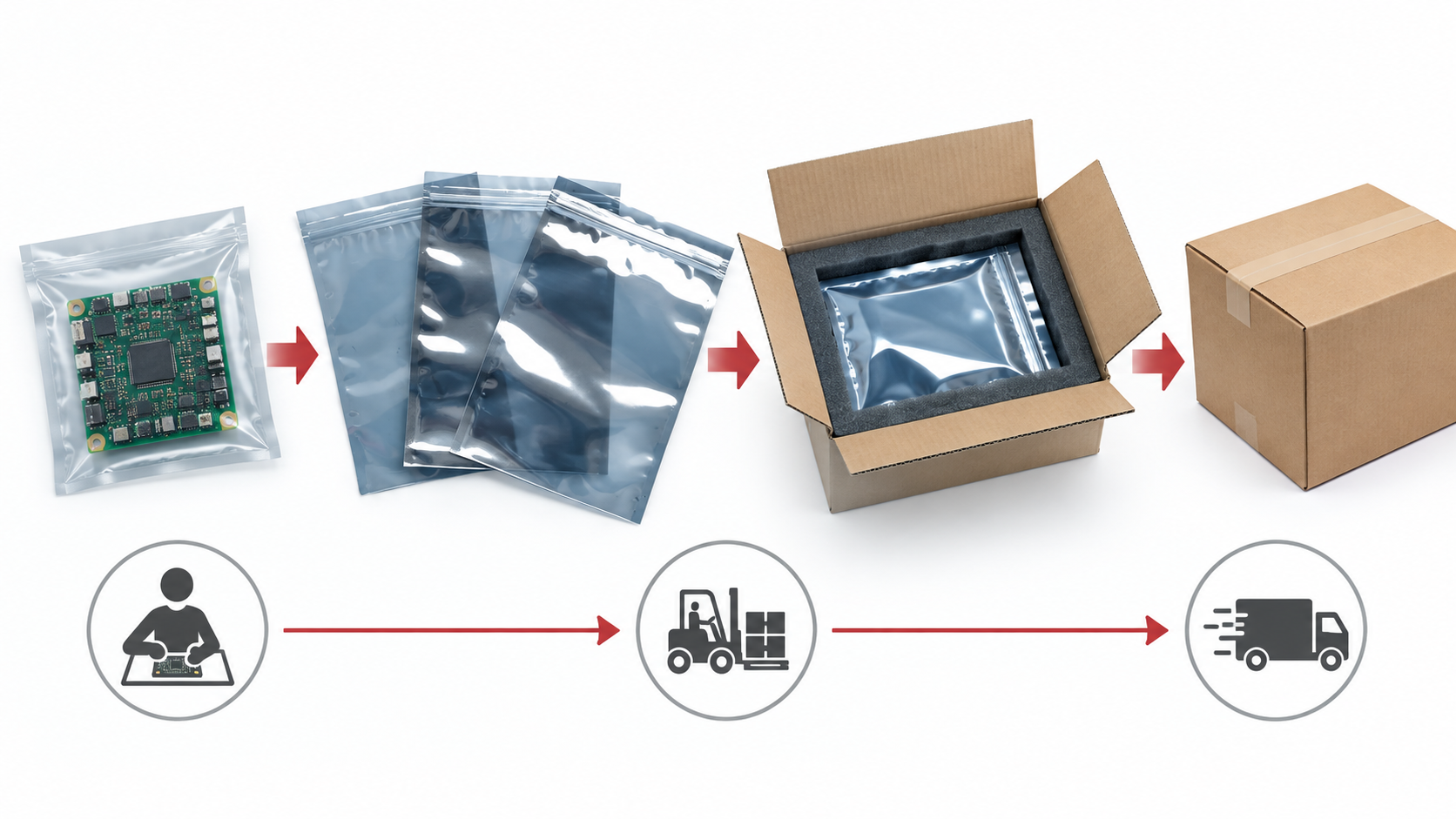
| External shipment | Primary bag plus approved secondary and outer package | Route, label, closure, inspection, and shipping evidence |
2. Separate antistatic, dissipative, and shielding functions
Do not use a color as a performance specification. A colored bag may identify a product family, but the required function must be stated and supported by the supplier’s evidence. If the part needs field protection, ask specifically for shielding performance and the test basis. If the process only needs a low-charging contact surface, state that role instead of assuming shielding is included.
The CH-ESD ESD Box category can be part of the same packaging route when a bag needs an outer container for movement or organization. Approve the bag and box together when the route includes a handoff, stacking, cart movement, or a shipping package. Check that the bag fits without excessive folding, the closure remains protected, and the label stays readable.
NASA packaging guidance supports matching evidence to the package and route, while EOS/ESD control fundamentals distinguish material and procedure roles. Those sources provide general guidance; they do not certify the CH-ESD bag. Keep the supplier’s configuration, test method, conditions, and revision with the approval record.
3. Match the bag to storage, handling, and shipping
For storage, define the part surface, exposure, label, reseal rule, and whether the bag remains in a cabinet, box, or tote. For handling, define how often the bag opens, whether operators need to see the part, and how a partial quantity is closed and identified. For shipping, define the inner package, cushioning, outer carton, moisture or puncture concerns, and the inspection point before dispatch.
The product page lists different sizes, thicknesses, and opening styles. Treat those as options to review, not as a universal specification. Measure the loaded part and allow room for the closure and any inner support. A bag that fits the component but strains the seal or hides the label may fail the route even if the nominal size looks correct.
4. Verify the exact bag and route
Send the supplier the component envelope, quantity, contact sensitivity, protection role, storage and handling route, closure preference, label method, outer package, and evidence requirement. Request the exact bag construction, size, thickness, opening style, drawing or specification, test method, conditions, and packaging revision. Approve a loaded sample through the route before placing a repeat order.
- Load the largest approved component and check fit, closure, label visibility, surface contact, and removal.
- Run the normal opening, resealing, handoff, and outer-package steps with the intended operator.
- Check whether the bag needs a secondary box, cushioning, moisture control, or puncture protection for the route.
- Match the supplier evidence to the exact construction, size, test method, sample, and stated conditions.
- Freeze the approved bag, closure, outer package, label, handling instruction, and inspection record.
FAQs
Are antistatic bags the same as shielding bags?
No. They answer different protection questions. Antistatic wording may describe a low-charging handling property, while shielding requires evidence for field protection under a defined method and condition. Select the function required by the route and confirm it for the exact bag construction.
Are ESD bags automatically enough for shipping?
No. Shipping adds movement, abrasion, closure, cushioning, labeling, and outer-package decisions. The bag may be one layer in a validated package. Approve the loaded bag, secondary protection, and outer shipping route together.
References
- NASA NEPP ESD handbook overview — general ESD control and packaging context.
- NASA-STD-8739.6B — ESD protective-packaging and handling context.
- EOS/ESD Association: ESD Fundamentals, Part 3 — general ESD-control procedures and material-category context.