

ESD foam is not one electrical category or one cushioning material. “Conductive,” “static-dissipative,” and “antistatic” describe different electrical roles, while EVA, IXPE, PU, and EPE describe foam families with different physical structures. A usable specification keeps those two decisions separate.
Choose the electrical behavior required by the item and handling route. Then choose the foam construction for support, compression, cleanliness, fabrication, and cost. Ask the supplier to confirm both properties for the exact grade and finished insert.
1. Understand the three ESD foam electrical labels
Antistatic usually refers to low-charging behavior: the material is intended to reduce charge generation through contact and separation. Static-dissipative material controls the rate at which charge moves across or through it. Conductive material provides a lower-resistance path. These labels are related, but they are not interchangeable and should not be inferred from foam color.
A foam can also cushion a part without providing electrostatic-field shielding. If the handling route requires shielding, the complete package may need a separate shielding enclosure. Desco technical guidance distinguishes low charging from dissipative behavior, while ESD packaging guidance treats charge generation, discharge, and field exposure as separate risks.
| Decision | What to define | What to verify |
|---|---|---|
| Electrical role | Low charging, dissipation, conductive contact, or a combination | Property, test method, condition, sample orientation, and acceptance range |
| Mechanical role | Support, cushioning, retention, gap filling, or surface protection | Density or hardness, compression behavior, thickness, and recovery |
| Fabrication | Sheet, roll, die-cut cavity, laminated set, or custom profile | Drawing, tolerances, adhesive or lamination, and edge quality |
| Package system | Open workstation use or enclosed transport package | Contact surfaces, shielding layer, closure, and route |
2. Separate electrical function from foam construction
Do not select conductive ESD foam merely because the device has exposed leads, and do not select antistatic foam merely because it is pink. Start with the control program and item sensitivity. Determine whether the foam touches the device, whether it must drain charge, whether it sits inside a shielding bag, and whether operators remove the item at an ESD protected workstation.
Next, test the physical fit. The cavity should support the intended surfaces, provide clearance around fragile features, and prevent the item from migrating during the defined route. Sharp edges, compressed walls, loose crumbs, or an adhesive layer can change how the finished insert behaves even when the raw sheet data is acceptable.
3. Choose EVA, IXPE, PU, or EPE for the mechanical task
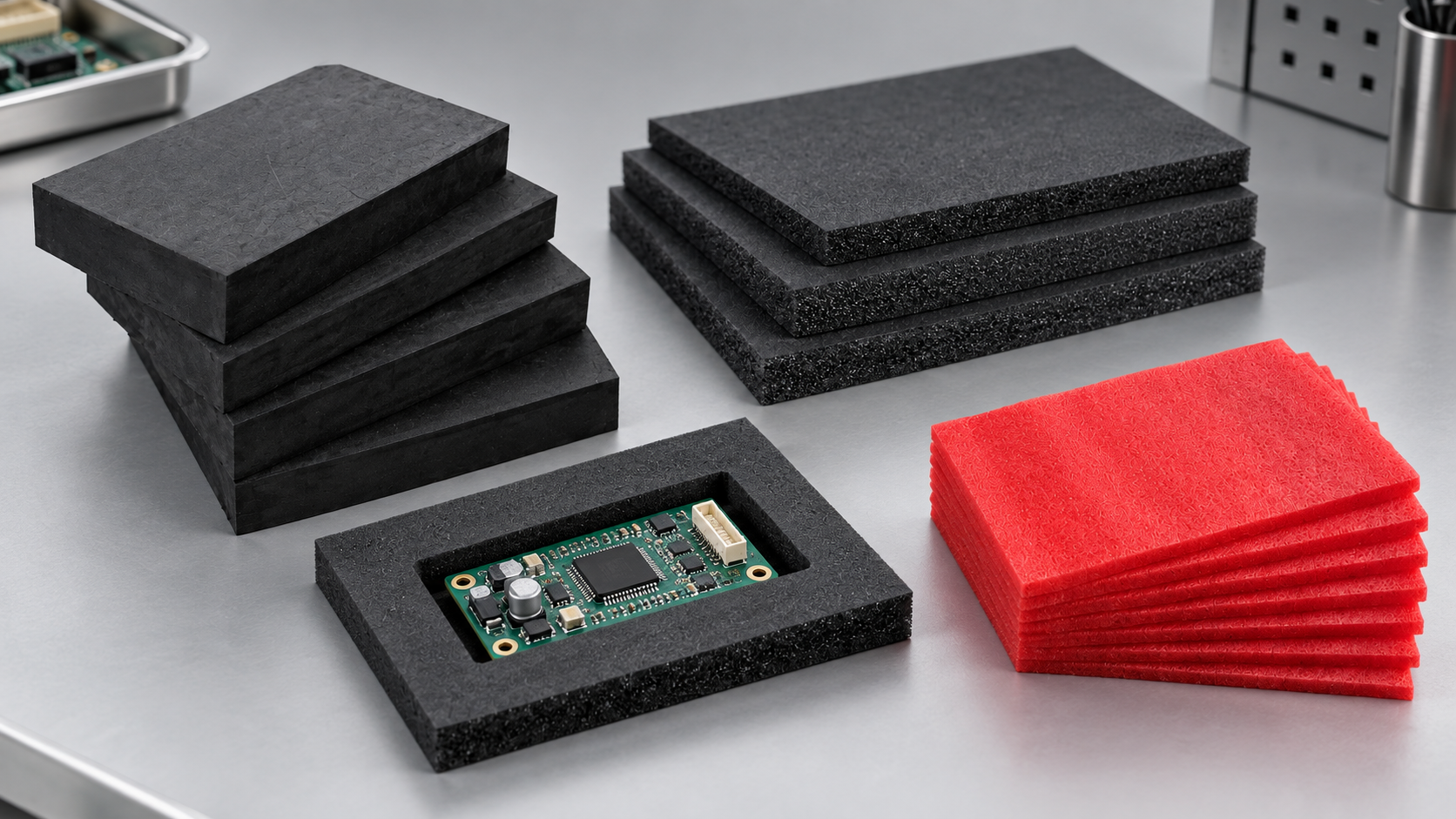
The current CH-ESD foam product page lists EVA, IXPE, PU, and EPE options, plus sheets, rolls, die-cut shapes, and custom profiles. Treat these as available starting points. The offered grade still needs a drawing, electrical data, and physical sample before approval.
For each listed family—EVA, IXPE, PU, or EPE—ask the supplier to identify the offered grade, cell structure, density or hardness, compression behavior, cleanliness limits, and recommended fabrication method. Compare those answers with the real support, cushioning, and contamination task. The family name alone does not establish an electrical class, mechanical result, cleanliness level, or lifetime for a specific CH-ESD grade.
Compare materials using the real load. Check whether the offered grade supports the approved surfaces, limits movement, and maintains the required clearance after the intended dwell time. For a die-cut insert, validate bridge width, cavity depth, finger access, orientation, part-removal method, and sheet thickness on a loaded sample.
4. Specify and verify the finished insert
Provide the part drawing or maximum envelope, weight, approved support surfaces, sensitive areas, quantity, orientation, drop or vibration requirement if one exists, packaging layers, and route. Add the desired foam material family only when the physical reason is clear. Ask the supplier to propose the grade and identify the electrical property separately.
- Confirm the exact foam grade, color, thickness, density or hardness, and lot identification.
- Request the electrical property, test method, conditioning, test date, and acceptance range for the offered grade.
- Approve the cavity drawing, tolerances, adhesive or lamination, and part-removal access.
- Test a loaded sample inside the complete packaging system, not as an isolated foam coupon.
- Define what material, process, or supplier change requires reapproval.
For transport, combine the approved insert with the correct bag or enclosure and rigid outer package. The ESD Box family can provide a rigid handling route, but the complete pack must still be verified as one configuration.
Sampling should include the finished cut part, not only a flat sheet. Check cavity position, edge tearing, loose particles, compression set after the intended dwell time, and removal force on the real component. If the insert uses layers, adhesive, or a cover sheet, identify each material in the approved drawing. A change to density, thickness, additive system, lamination, or cutting process can affect fit or electrical behavior and should trigger a documented review.
Color is useful for visual management only when the purchasing record defines what the color means. Do not use black as automatic evidence of conductivity or pink as automatic evidence of low charging. Keep the grade code and test record as the controlling identification.
Document the result.
References
- NASA ESD Control Handbook overview — distinction between dissipative packaging and shielding.
- NASA-STD-8739.6B — ESD protective-packaging context.
- EOS/ESD Association: ANSI/ESD S541-2026 — packaging-property and test-method context.