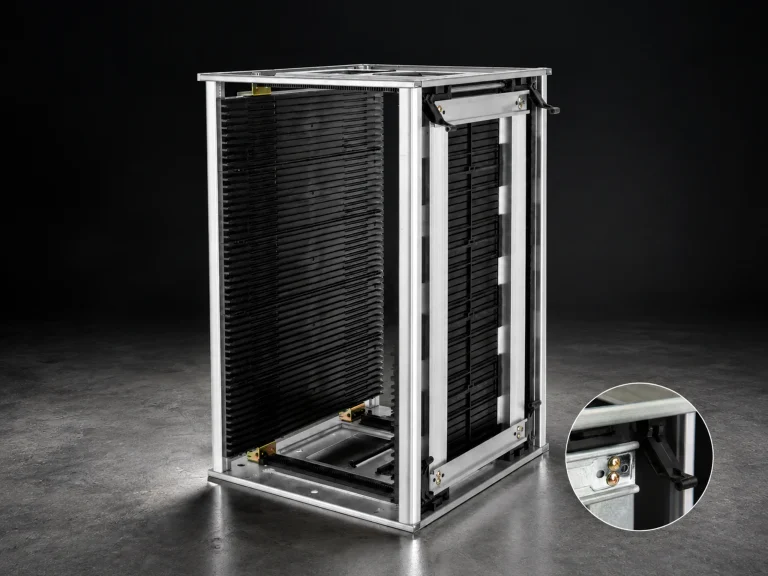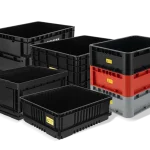


ESD packaging boxes are selected by the component envelope, closure, cushioning, shielding need, and shipping route together. A box name or ESD mark is not enough to choose the right configuration. Define what the box must protect, how it will be opened and moved, and what evidence the supplier must provide for the actual material and closure.
1. How to choose esd packaging boxes for the shipping route
Record the largest component or subassembly, protrusions, inner bag or tray, quantity per box, stacking condition, and the outer shipping carton if one is used. Note whether parts are loose, bagged, boxed, or nested. The box should close without crushing the contents and should preserve separation during the expected movement route.
Separate storage from shipment decisions. A reusable tote at a workstation may need different access and cushioning from a closed box that moves through receiving, transport, and inspection. Include handling points, drop or compression concerns, and the maximum normal time in transit when describing the requirement.

2. Choose material, closure, and shielding evidence
Ask the supplier to state the material category, wall or construction description, closure method, insert or divider compatibility, and test basis for any static-control or shielding claim. The appearance of a box does not identify its electrical behavior, and a conductive or dissipative description may apply only to a defined configuration.
If the box is used with an inner bag, foam, divider, or lid, treat the combination as the working package. Request the evidence and handling instructions for the package as supplied. Keep numerical values and certification claims conditional until they are tied to the selected model, material, and test method.
3. Design access, identification, and reuse
Select the closure around the normal pick and replenishment pattern. A lid can help during movement, while an open access format can reduce repeated handling at a workstation. Check whether the operator can identify the contents and remove a part without disturbing adjacent pieces.
Use labels, lot separation, and status rules that remain visible when boxes are stacked or placed in a rack. If boxes are reused, define inspection, cleaning, and retirement criteria. A damaged lid, puncture, or contaminated surface should trigger a review of the package before it returns to controlled use.
4. Send a complete box specification request
Send component envelope, quantity, inner packaging, closure preference, cushioning or divider need, route, stacking condition, identification method, and required ESD evidence. Ask for a proposed box size and construction, accessory list, shipping configuration, handling limits, and the verification method for the supplied package.
Use the CH-ESD ESD Box family route as the first-party starting point. For a lidded configuration, compare the matching ESD box product page with the component envelope and movement route, then request model-specific documentation before approving the shipment package.
Approve the package with a representative packing trial. Use the real component, inner bag or tray, divider, label, closure, and outer carton. Move the packed box through the expected route, then open it at the normal workstation. Check for shifting, compressed cushioning, blocked labels, sharp contact points, and handling steps that force the operator to touch the part unnecessarily.
If the requirement includes static shielding, name it explicitly and request the applicable construction and evidence. An ESD box may serve as a durable handling container while a separate inner package provides another protective function. The supplier should describe the intended combination so purchasing does not substitute a visually similar box with a different material or closure.
For receiving inspection, compare the supplied model, material description, lid or closure, inserts, dimensions, and lot record with the approved specification. Inspect damage and contamination before reuse, and define when a box is retired. Revalidate the package when the component, inner tray, route, stacking load, or outer carton changes. These checks keep ESD packaging materials tied to the real process instead of a broad product label.
Keep an approved packing sample or photo sequence with the purchase specification. It should show part orientation, inner protection, divider placement, label face, closure, and outer-carton position. This gives receiving and packing teams a concrete reference and reduces substitution when several ESD boxes look similar.
References
- EOS/ESD Association: ESD Fundamentals, Part 3 — ESD control procedures and material categories.
- EOS/ESD Association: ANSI/ESD S541-2026 — Packaging properties and test-method reference for electrostatic-sensitive items.
- IEC 61340-5-1:2024 — ESD control-program requirements and implementation context.
- Current SERP product reference — A current US search result used as topic context, not as a CH-ESD specification.
- Additional current SERP reference — A current US search result used as topic context, not as a CH-ESD specification.