

ESD flooring is conductive or static-dissipative flooring used as part of a controlled path to ground. In electronics manufacturing, its performance depends on the installed floor system, suitable footwear, grounding connections and the equipment that moves across it. A material label or a floor-only resistance reading does not establish that every person and cart is adequately controlled.
The purchasing task is therefore to select and verify a system. The floor finish matters, but so do the interfaces: shoe to floor, wheel to floor, and floor assembly to the grounding arrangement. Those interfaces should be part of the specification before an installer or supplier proposes a material.
This guide explains how to compare options, separate the different tests, and build an acceptance record for an electronics facility.
What does an ESD floor actually do?
An ESD floor provides a route for electrostatic charge to dissipate when the intended electrical connections are present. For personnel grounding, that route includes the person, footwear and floor. For a mobile cart, it includes the cart assembly, its wheel contact and the floor.
The distinction matters when a facility changes a single component. A new shoe type, floor finish or trolley wheel can change an interface even though the floor itself looks unchanged. The practical question is whether the combination used in production still performs as intended.
“Anti-static” also needs context. A product described as reducing nuisance static does not necessarily establish the controlled grounding behavior needed for exposed electronic components. Ask which measured property and test method support the claim.
Choose the floor format around the production task
Compare the installed construction and its documented use conditions, rather than selecting solely by material name. Conductive and dissipative options exist, but neither label identifies a universally better floor.
| Option to investigate | What to clarify with the supplier | Evidence to request |
|---|---|---|
| Tile or sheet system | Backing, joints, adhesive, surface treatment and grounding arrangement | Documentation for the complete proposed construction and installed verification. |
| Purpose-designed resin or coating system | Substrate preparation, specified layers, finish and approved service conditions | System specification and the acceptance tests for the finished installation. |
| A localized floor-control area | Where the controlled boundary starts and what happens when people or carts leave it | A defined grounding and verification plan for the actual work area. |
For a line that changes layout frequently, the specification should address what happens when equipment is moved. For a fixed assembly cell, access, cleaning and the intended contact points may dominate the discussion. A heavily used transfer route adds wheel traffic and route continuity to the decision.
Turn these observations into questions rather than assuming that one format solves them automatically. Ask how the supplier’s proposed construction supports the intended use, and which changes would require a new review. Ordinary floor paint should not be treated as an ESD system merely because its color matches an existing controlled area.
Plan the grounding path and its interfaces
The floor, its construction layers and its grounding arrangement must function together. The EOS/ESD Association’s 2026 discussion of flooring pitfalls highlights why a tile, adhesive, substrate, finish and connection cannot be assessed as unrelated purchases.
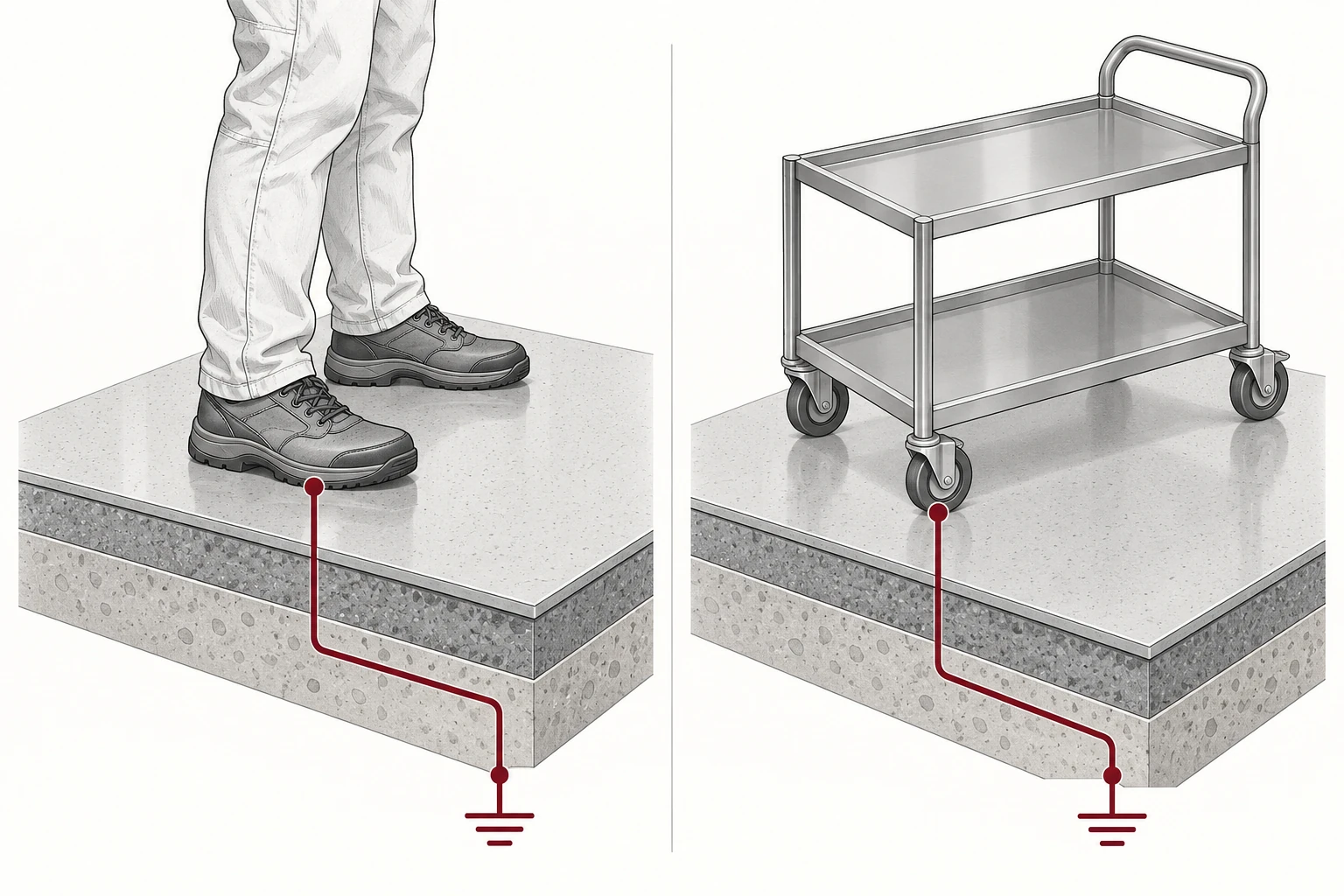
Have the responsible facility engineer and flooring specialist define the proposed construction and ground connections. Ask the installer to identify the approved materials and the records that will demonstrate the completed system’s condition. This is a coordination task; an illustration cannot determine the grounding layout for a particular building.
Footwear deserves its own line in that discussion. The shoe sole has to interact with the installed surface. Separate favorable results for the shoe and floor do not establish the behavior of their combination during walking.
Before approving substitutions, identify which part of the path changes. An alternative adhesive, finish or shoe should be evaluated against the system specification, rather than accepted on a similar product description alone.
How is ESD flooring tested?
Separate floor measurements from person-system measurements and walking-voltage measurements. Each answers a different question.
| Check | Question answered | Limit of the result |
|---|---|---|
| Floor resistance measurements | How does the specified floor behave between the measured points or toward ground? | A floor-only result does not establish the wearer’s walking voltage. |
| Person–footwear–floor system resistance | Does the actual combination provide the intended electrical path? | The result belongs to the tested combination and conditions. |
| Walking body voltage | What voltage develops on a person while moving on that floor with the specified footwear? | A different footwear/floor pairing needs its own assessment. |
| Mobile-equipment verification | Does the assembled cart have the required path in its operating environment? | It cannot be inferred from a wheel or frame label. |
EOS/ESD Association public guidance describes personnel-grounding system resistance below 1.0 × 10⁹ ohms and walking body voltage below 100 V, with both conditions satisfied. These are system-level guidance points, not a declaration that a floor product alone is certified. The facility’s ESD coordinator must apply the requirements appropriate to the devices handled and its control program.
The method also matters. IEC 61340-4-5:2018 addresses footwear and flooring in combination with a person. Its catalogue explicitly limits results to the combination tested and distinguishes that evaluation from individual product qualification. A test-method reference should therefore stay attached to the result it actually describes.
For acceptance, request the floor identification, footwear identification, measurement locations, method, conditions and results in one record. Ask the reviewer to identify any areas or combinations not covered. An unexplained “pass” beside a resistance value is less useful than a report that lets the next engineer understand exactly what was assessed.
Include trolleys and transfer routes in the review
A floor that works for personnel does not automatically establish the grounding of everything rolling over it. Mobile equipment needs suitable contact and electrical continuity through the assembled item.
Quan Dun’s ESD trolley range provides a starting point for PCB and component-handling configurations. Specify the intended load, wheel arrangement, floor conditions and route, then ask how the assembled cart will be verified. A conductive wheel fitted to a cart is only one part of that discussion.
Describe transitions between the assembly area, storage and the normal parking position. Identify where the cart stops, which routes it uses, and which parts of the load are exposed during transfer. Those details help the ESD coordinator decide what checks belong in the control plan.
Keep the cart and flooring responsibilities visible in the procurement record. The flooring contractor’s acceptance report and the cart supplier’s data may cover different objects. Someone at the facility needs to confirm how those objects work together.
Keep the system usable after installation
Cleaning, wear and later changes deserve a planned review. A visually clean floor can still have a surface condition that changes electrical contact. The current EOS/ESD pitfalls guidance identifies residues, unsuitable finishes and wear among the causes of degraded behavior.
Use the approved system’s maintenance instructions. Ask which cleaning products and finishes are permitted, how staff should report damage, and which events call for additional verification. A generic instruction to wax every floor or to retest at an invented fixed interval can conflict with the selected construction.
A useful supplier request can be short, provided it separates the decisions:
- Production task: What components are handled, where are they exposed, and who owns the ESD control plan?
- Proposed construction: Which floor, adhesive, finish and grounding components make up the complete system?
- Personnel interfaces: Which footwear combinations will be evaluated?
- Mobile equipment: Which carts, loads and routes need verification?
- Acceptance evidence: Which measurements, conditions and identification records will be supplied?
- Ongoing use: Which maintenance actions and changes trigger review?
Compare proposals against those answers. A low material price and a conductivity statement are difficult to evaluate without knowing what installation, testing and maintenance each proposal includes.
Questions that remain after selecting a floor
Can workers use ordinary shoes on ESD flooring?
Do not assume that ordinary shoes provide the intended personnel-grounding path. Assess the footwear/flooring combination actually used, including its walking-voltage behavior.
Does ESD floor marking tape make a floor ESD-safe?
A marking tape does not establish the performance of the surrounding floor system. Treat boundary identification and electrical performance as separate requirements, and check evidence for the complete arrangement.
Does the floor replace other workstation controls?
No single floor specification defines the entire ESD program. Personnel grounding, work surfaces, packaging and material handling must be selected for the work performed. The floor’s role should be explicit within that larger plan.
References
- EOS/ESD Association: common pitfalls with ESD flooring systems — May 2026 guidance on construction, grounding and maintenance.
- EOS/ESD Association: understanding footwear and flooring — contact interfaces and combined-system behavior.
- EOS/ESD Fundamentals, Part 3 — personnel-grounding guidance and mobile-equipment considerations.
- IEC 61340-4-5:2018 catalogue — scope of testing footwear and flooring with a person.
- Stonhard: ESD flooring systems — examples of purpose-designed resin systems.