

A finger cot is a flexible cover worn over an individual finger. In electronics handling, it can cover the fingertip that touches a small component while leaving the rest of the hand uncovered. Choosing one requires more than a material name: the contact area, fit, contamination controls and any static-control requirements must suit the actual job.
Finger cots are useful to consider when contact is localized. If a palm, several uncovered fingers or the side of a hand also touches the controlled surface, individual covers may leave a gap in the process. Full-hand coverage may be the more appropriate starting point.
This guide focuses on thin, flexible industrial finger covers, including latex finger cots. Rigid finger guards and products intended for clinical care answer different needs. A similar shape or search-result label does not establish the same use.
Choose a finger cot by coverage first, then by its stated properties
Start by identifying every part of the hand that can contact the item. A precise fingertip operation and a two-handed transfer can require different coverage, even when both involve the same component. Observe the complete handling sequence, including picking, turning, inspection and release.
Material, processing and performance labels describe different things. “Latex” names a material; “powder-free” describes a product characteristic. A cleanroom designation or an ESD claim needs its own supporting information. These labels should not be treated as interchangeable levels on a single quality scale.
| Description | What it identifies | What still needs checking |
|---|---|---|
| Latex or nitrile | Material family | Exact model, fit and permitted use |
| Powder-free | Absence of added powder as specified | Other cleanliness requirements |
| Rolled rim | Opening construction | Position and stability in use |
| ESD or antistatic | A stated static-control purpose | Applicable model evidence and facility acceptance |
| Cleanroom | A stated controlled-environment application | Evaluation scope, packaging and supporting results |
For example, a powder-free latex cover can still be unsuitable for a process that excludes natural-rubber latex. NIOSH identifies latex sensitivity as a material concern. Removing powder does not change latex into a different material; follow the workplace’s material restrictions when selecting samples.
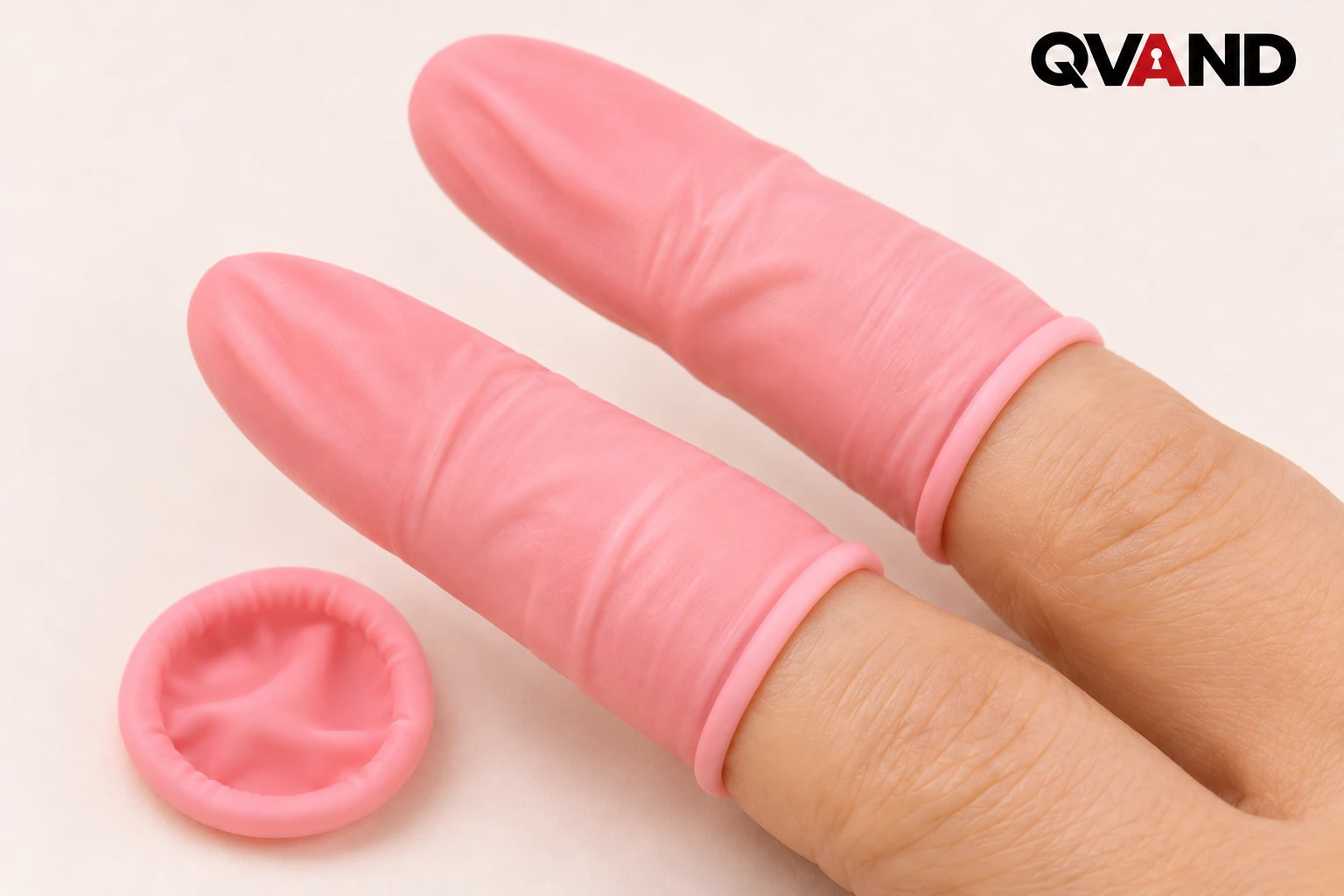
Likewise, a pink appearance does not prove an electrical property. Colour is useful for recognizing a listed product, but the accepted item should be identified by model and specification. Purchasing by colour alone makes it difficult to distinguish a genuine reorder from an unapproved substitution.
When fingertip coverage cannot contain all relevant hand contact, investigate the full-hand glove options instead. That decision should follow the contact pattern, rather than a preference for the smallest disposable item.
Match finger cots to the handling task
Describe the operation in ordinary production terms before requesting a product. “Hold a small housing while inspecting its edge” is more useful than “need clean finger cots.” The first description identifies where contact occurs and lets a supplier ask relevant questions.
Include the moments before and after the main operation. An operator may pick up a part correctly, then rest an uncovered finger against it while moving it to a tray. A cover that suits the central action may not cover the entire route.
| Handling situation | Question to resolve | Selection implication |
|---|---|---|
| Fingertip positioning of small parts | Which fingertips touch the controlled surface? | Evaluate coverage on those fingers through the complete motion |
| Turning a component for inspection | Does contact move beyond the covered area? | Check the grip change as well as the initial pickup |
| Carrying an item in the palm | Does the palm contact a controlled surface? | Consider full-hand coverage |
| Handling through a fixture | Which contact remains after the fixture is used? | Evaluate the remaining contact rather than assuming it disappears |
The useful output is a contact description, not a universal recommendation. Record the component or surface, the fingers involved and any prohibited contact. This helps the sample assessment distinguish a poor fit from a coverage problem.
Also identify what the cover is meant to accomplish. Controlling direct finger contact with a surface differs from protecting a worker against a hazard. This industrial selection guide does not establish protection against chemicals, cuts, heat or other hazardous exposures.
Check finger-cot size and fit during the actual movement
A size label is not a complete measurement. Ask how the supplier defines the dimensions for that exact model. A flat width, an internal diameter and a size name describe different information; do not substitute one for another without the supplier’s convention.
A manufacturer’s dimensional sheet can help explain its own range. The FC-G datasheet listed in References is an example of model-specific sizing information. Its dimensions belong to that product and should not be copied into an order for another model.
Assess the proposed size through the normal range of motion. Look at whether the opening stays where intended, whether the fingertip can reach the work and whether loose material interferes with placement. A photograph of a stationary hand cannot answer all three questions.
Include the fingers actually used in production. A size that suits one person’s index finger may not suit another operator or another finger. Record the proposed size mix with the sample results, rather than treating one satisfactory sample as approval for every hand.
Keep the observations concrete. “Opening moved during part rotation” identifies a problem that can be discussed. “Uncomfortable” may be valid feedback, but needs enough detail to distinguish pressure at the rim, restricted movement or an unsuitable coverage length.
There is no QD-9701 dimensional chart in the product information reviewed for this guide. Request current dimensions and their measurement convention before confirming a size. A supplier’s answer should refer to the exact offered model, not a generic chart selected because the product looks similar.
Separate cleanliness evidence from static-control evidence
Powder-free is one characteristic, not a complete cleanliness specification. The public scope of IEST-RP-CC005.4 distinguishes cleanliness, physical and chemical integrity, and other evaluation areas for gloves and finger cots. Use the scope to identify questions; it is not proof that a particular product passed every evaluation.
For a controlled process, first establish what information the process requires. Ask the supplier for the applicable product results, the item and packaging they cover, and the revision or date. A report about a different model is not a substitute for the offered item.
Keep visible cleanliness and documented cleanliness separate in the sample record. An operator may report a visible mark on a handled surface. That observation does not establish a particle classification, extractables result or another laboratory property. Record what was observed without giving it a stronger technical label.
Static control is another decision. The EOS/ESD Association’s public guidance places materials within a facility’s ESD-control program and refers to in-use glove and finger-cot resistance testing. A material description alone cannot establish suitability for every handling arrangement.
Ask the person responsible for that program what evidence and acceptance apply. The required answer concerns the proposed cover in its intended use. This guide does not prescribe a resistance limit or provide a new test procedure.
Keep the purchasing record readable by separating the questions: material identity, cleanliness information, static-control information and packaging. If one is unresolved, name it specifically. A single “ESD approved” checkbox can conceal the fact that the supplied document covers only one part of the requirement.
Set handling and replacement rules for the process
Use an accepted handling method that keeps the intended contact surface from being contaminated during application. Arrange the work so operators can obtain the covers without mixing unused stock, used items and unidentified substitutes. The practical method belongs in the facility’s work instruction.
Agree on replacement triggers before production use. Examples to address include a torn cover, a cover that moves out of its accepted position, contact with an unapproved surface, and a change of task. These are decisions for the process owner, not a universal wear-time schedule.
Do not solve a slipping cover by ignoring the coverage requirement. Record the occurrence and reconsider the size, model or handling arrangement. Repeated adjustments can also change which surfaces are touched; include that action in the contact review.
A disposable listing does not support an improvised cleaning or reuse cycle. For the QD-9701 example below, plan around its listed single-use format. If a process requires a different use cycle, request a product and supporting instructions that expressly address it.
Make the replacement stock easy to identify. The model, size and batch information should remain associated with the supply used at the station. That simple record gives purchasing something specific to investigate if operators notice a change between deliveries.
What the QD-9701 listing establishes
Quan Dun’s QD-9701 disposable finger-cot page provides a concrete starting point for a sample request. It lists a pink latex product with a powder-free finish, rolled rim and disposable format, intended for fine electronics handling and related small-part work.
| Item | Listed information | Confirm for the order |
|---|---|---|
| Identity | QD-9701 | Current model and offered revision |
| Material and colour | Pink latex | Material restrictions in the intended process |
| Construction | Powder-free; rolled rim | Fit and required cleanliness documentation |
| Use format | Disposable | Site replacement and disposal instructions |
| Size and performance data | No numerical values adopted here | Exact dimensions and applicable model-specific evidence |
This is a candidate model, not a finding that it suits every electronics process. The reviewed listing does not supply a numerical resistance range, dimensional chart or cleanliness classification for this guide to reproduce. Those remain questions for the actual offer.
Send a sample request that can become a repeatable order
A useful inquiry connects the proposed model to the work it must perform. Send the handling description together with the requested evidence, rather than asking a supplier to infer the application from a product name.
- Contact task: identify the part, controlled surface, fingers involved and full movement.
- Fit request: ask for the offered sizes, dimensional convention and a representative sample mix.
- Evidence: name the required cleanliness and static-control information separately.
- Supply: specify the requested quantity and ask how pieces, bags and cartons are counted.
- Repeat order: retain the accepted model, size mix, packaging identification and relevant document revisions.
Ask the quotation to identify any proposed substitute explicitly. A change in material, size convention or packaging should be visible to the buyer before an order is confirmed. The accepted sample record then becomes a practical reference for receiving and future purchases.
At receiving, compare the delivery identification with the accepted order before distributing stock. Keep any unexplained difference separate for clarification. This is an identity check, not a replacement for the facility’s technical acceptance. It helps prevent an apparently minor commercial substitution from becoming an unnoticed process change.
For repeat orders, give the supplier the accepted reference as well as the new quantity. If packaging units change, reconcile the total piece count before comparing prices. Otherwise, a cheaper bag may simply contain fewer covers rather than represent a better offer.
Additional purchasing questions
Can one sample request include several finger-cot sizes?
Yes. State that the request is for a fit assessment and ask the supplier to identify each size separately. Keep the result tied to the operator group and task; a mixed bag without size identification is difficult to turn into a reliable reorder.
Can a finger cot be worn over an existing glove?
Treat that combination as a different arrangement. The extra layer changes fit and the contact interface. Have the process owner assess the combination rather than assuming that acceptance of either item separately covers both together.
Does approval carry over to a changed formulation?
Do not assume so. Ask what changed and whether the accepted documents and sample decision still cover the offered product. Record the replacement model or revision before it becomes routine stock.
References
- Mauritius Revenue Authority: latex finger-cot product description — terminology and industrial applications.
- IEST-RP-CC005: public recommended-practice scope — evaluation areas; not the full paid text.
- EOS/ESD Association: basic control procedures and materials — facility-program context.
- NIOSH: latex allergy awareness — natural-rubber latex material considerations.
- FC-G general-purpose finger-cot datasheet — an example of model-specific sizing, not QD-9701 dimensions.