

Vinyl gloves use PVC; nitrile gloves use synthetic nitrile rubber. For industrial handling, choose between exact models by fit, contact task, required product evidence and accepted-use cost. Material alone does not establish ESD suitability, cleanroom performance, chemical protection or medical use.
A useful vinyl vs nitrile gloves comparison begins with the job. What does the operator handle? Which surfaces must remain controlled? What evidence does the process require? Answering those questions makes a sample comparison more useful than choosing a material from a general ranking.
Here, the buying task is ordinary industrial product handling. Quan Dun’s clear PVC QD-9515 and blue nitrile QD-9516 provide real model examples. Their listed features help identify candidates, while task acceptance and any specialist protection requirements remain separate decisions.
There is no universal winner. A lower quoted unit price may suit one accepted task and prove expensive in another if the actual consumption differs. Equally, paying more for a material name does not establish that the offered product meets a requirement the buyer never specified.
Vinyl vs nitrile gloves: compare material and fit separately
Vinyl and nitrile identify different polymer families. Their behaviour also depends on the product’s formulation, construction, size and thickness. A broad material description helps organize the options, but it cannot replace the dimensions and information for the exact glove being offered.
Fit should be judged through the work, not just when the hand is held still. During a sample assessment, observe the fingertip position, palm fit and cuff movement while the operator performs the intended handling sequence. Record the model and size alongside the observations.
| Factor | Vinyl/PVC candidate | Nitrile candidate | What to compare |
|---|---|---|---|
| Material identity | PVC formulation | Synthetic nitrile formulation | Exact product specification |
| Fit during movement | Depends on the offered model and size | Depends on the offered model and size | Fingertip position, palm fit and cuff movement |
| Surface construction | Check the model listing | Check the model listing | Actual texture and handling contact |
| Process suitability | Requires task-specific acceptance | Requires task-specific acceptance | Required evidence and observed handling |
| Purchase cost | Use the actual quote | Use the actual quote | Consistent units and accepted-task consumption |
A comparison can become misleading when different sizes are treated as equivalent. If one sample has excess material at the fingertips, determine whether that is a size issue before attributing the result to the polymer. Ask whether another size is available for the same model.
Texture is another model feature, rather than a result. A textured fingertip can be identified in a listing, but the effect on a particular part must be assessed in that handling task. Do not convert the presence of texture into an unsupported percentage improvement in grip.
Ansell’s material-selection bulletin, cited below, discusses composition and selection factors in a medical-glove context. Those basic distinctions help explain the terminology here. Its clinical comparisons and performance claims are not ratings for Quan Dun’s industrial models.
Define the task before choosing either material
Separate product-contact control from protection against a hazard. An operator placing a clean component into a tray has a different selection problem from someone exposed to a hazardous substance. The same glove colour or polymer name does not make those tasks equivalent.
| Task | First selection question | Decision needed |
|---|---|---|
| Small-part assembly | Can the operator position and release the part consistently? | Accepted model and size for the handling motion |
| Surface-sensitive inspection | What contact and cleanliness requirements apply? | Specified product evidence and sample observations |
| ESD-sensitive handling | What does the facility’s ESD program require? | Model-specific acceptance within that program |
| Chemical exposure | What exact substance and conditions are involved? | Qualified selection using applicable product data |
| Medical use | Is the product intended and labelled for that use? | Appropriate medical product, not an industrial-material assumption |
CCOHS explains that no glove material resists every chemical. This comparison therefore does not recommend either model for a named substance or provide breakthrough times. Where chemical exposure is involved, the selection must use applicable product data and the workplace’s responsible decision-maker.
For ordinary handling, write down the task’s acceptance conditions before opening the samples. Examples include keeping the glove in its intended position, completing the required grip change and avoiding prohibited contact. These are proposed observations, not proof of a protection classification.
Specify who owns the decision. Purchasing can compare offers and packing units, while the process owner confirms the accepted handling arrangement. That division prevents a commercially attractive substitute from being mistaken for a technically approved one.
Two actual models: PVC QD-9515 and nitrile QD-9516
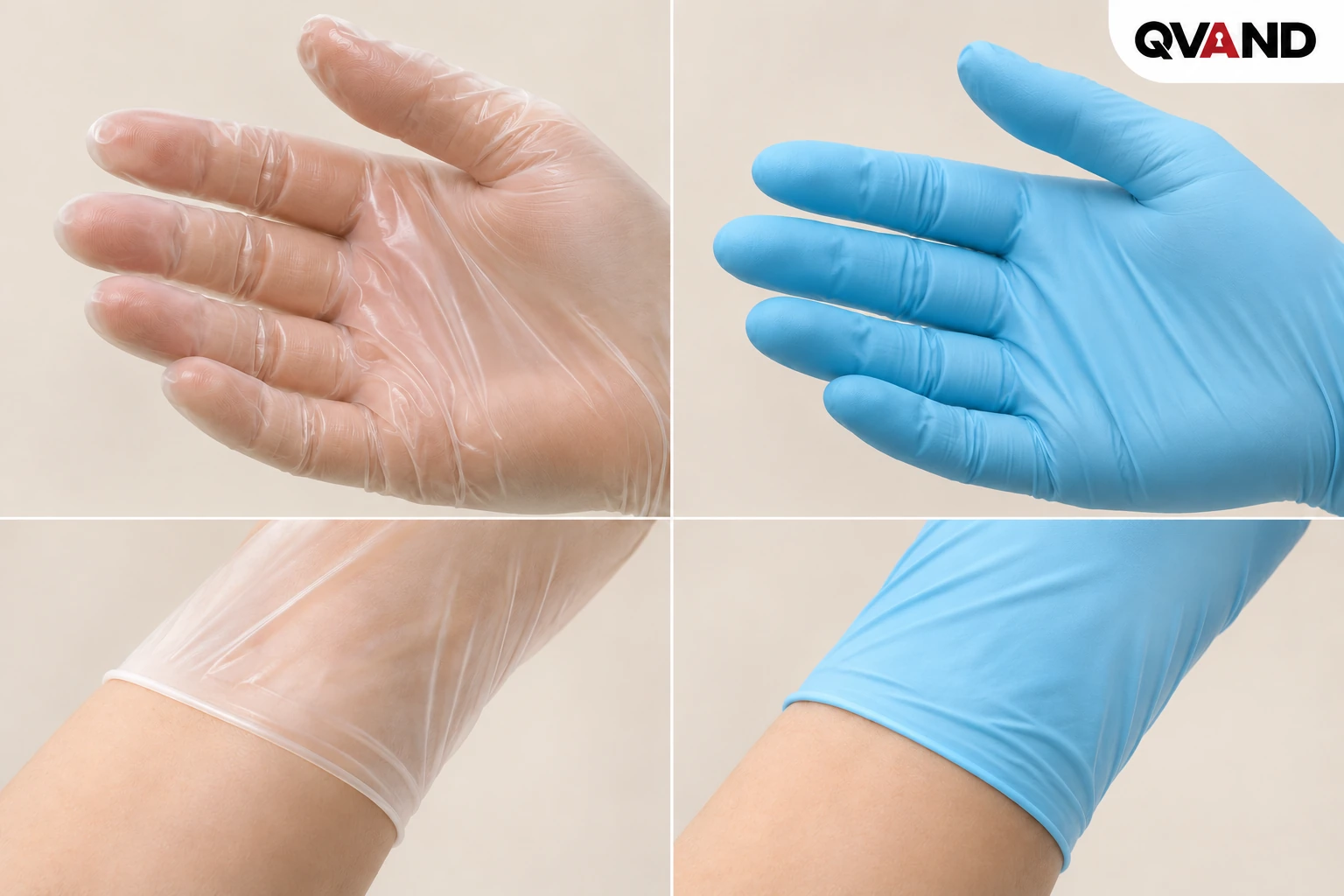
The QD-9515 PVC glove listing describes a clear or translucent, powder-free disposable product with a rolled wrist cuff. It is the vinyl/PVC example in this comparison.
The QD-9516 nitrile glove listing describes a blue, powder-free disposable product with textured fingertips and a rolled wrist cuff. These are listed features, not results from a comparative trial.
| Feature | QD-9515 | QD-9516 |
|---|---|---|
| Material | PVC/vinyl | Nitrile |
| Listed appearance | Clear/translucent | Blue |
| Powder | Powder-free | Powder-free |
| Use format | Disposable | Disposable |
| Wrist opening | Rolled cuff | Rolled cuff |
| Fingertip texture | No texture claim adopted here | Textured fingertips listed |
| Dimensions and test results | Request applicable model data | Request applicable model data |
Neither column is a finding that the model suits every industrial environment. The reviewed information does not establish comparative service life, a chemical rating or a cleanroom classification. Do not add those properties to a purchase specification merely because a general material guide discusses them.
Ask the quotation to preserve the model identity. A supplier may offer another glove in the same material, but it should be shown as an alternative with its own data. Otherwise, the buyer may assess one sample and receive a different item under a broad “nitrile gloves” order description.
Use these two products to start a focused inquiry, not to eliminate the need for one. The useful next answer is which offered model and size can be evaluated against the stated process requirements.
Powder-free, cleanroom and ESD claims answer different questions
Powder-free does not describe every cleanliness property. IEST’s public recommended-practice scope separates cleanliness from physical, chemical and static evaluation areas. A relevant evaluation result must identify the product and the property it addresses.
Ask for the information required by the actual controlled process. Keep particle, packaging and other specified requirements distinct instead of accepting an unspecified “clean” claim. The public scope of a recommended practice is not evidence that either glove model conforms to it.
Material also does not establish ESD acceptance. For that separate decision, use the existing guide to nitrile-glove ESD suitability and model evidence. It addresses the qualification task in more detail; this comparison concentrates on selecting between material and product candidates.
The EOS/ESD Association’s program guidance supports treating gloves within the intended facility arrangement. A general “antistatic” description should not stand in for the evidence that arrangement requires.
Medical suitability is separate again. The FDA’s medical-glove information concerns products intended for that use. A vinyl or nitrile material name does not turn an industrial listing into a medical product. No medical clearance or clinical-use claim is made for either Quan Dun example here.
Keep these evidence requests proportionate to the job. The buyer needs the required information for the actual use, rather than a collection of unrelated certificates that does not identify the offered model.
Compare cost after the task has accepted the product
Price per box is not enough when box counts or actual consumption differ. Normalize the quote to a consistent unit, then use the number of gloves consumed under the accepted work instruction. Confirm whether a supplier’s price means one glove, one pair, a box or a carton.
The following worksheet is hypothetical. Its prices and consumption assumptions are invented only to demonstrate arithmetic. They are not Quan Dun quotations, observed change frequencies, safe wear times or evidence that nitrile lasts longer than vinyl.
| Input | PVC scenario | Nitrile scenario |
|---|---|---|
| Operators | 20 | 20 |
| Assumed pairs per operator per day | 12 | 6 |
| Assumed price per pair | $0.08 | $0.14 |
| Arithmetic | 20 × 12 × $0.08 | 20 × 6 × $0.14 |
| Illustrative daily purchase cost | $19.20 | $16.80 |
The formula is operators multiplied by actual accepted-task pairs per operator, multiplied by price per pair. In this example, the higher unit price produces a lower calculated total only because the assumed consumption is lower. Change the consumption inputs and the result can change.
Do not reduce replacement frequency to make a cost column look better. Required changes, damage, contamination events and task transitions follow the accepted instruction. Cost comparison comes after those requirements, not before them.
If the workplace uses individual gloves rather than pairs, calculate the entire worksheet in individual gloves. Mixing a per-glove quotation with a per-pair usage count creates a unit error, not a material advantage.
For a real decision, replace every assumed value with the actual quote and the recorded consumption for the accepted task. Keep freight, packaging and other commercial items visible if they are included. This simple worksheet compares purchase cost; it is not a full productivity or total-cost study.
Run a sample comparison that produces a purchasing decision
Compare the proposed products on the same defined handling task. Identify each model, size and sample batch before distribution. If the task or handling instruction changes during the comparison, record that change rather than presenting the results as directly equivalent.
Include the operators and sizes the eventual order must serve. A sample that fits one hand well does not establish the size distribution for the whole team. Ask for separately identified sizes so feedback can be turned into an orderable size mix.
| Record | Useful entry | Decision it supports |
|---|---|---|
| Product identity | Model, size and batch identification | Whether the result matches the offered item |
| Handling sequence | Part, grip changes and contact restrictions | Whether both candidates faced the same task |
| Fit observations | Fingertip position and cuff movement | Whether another size or model is needed |
| Handling observations | Observed slips, tears or surface marks | Whether the stated acceptance conditions were met |
| Consumption | Actual count under the accepted instruction | Consistent purchase-cost calculation |
| Disposition | Accepted use, rejection or unresolved question | What purchasing may order |
Describe observations without inventing laboratory conclusions. A surface mark is an observed mark; it is not automatically a chemical compatibility result. A tear is an occurrence to investigate, not enough by itself to calculate a general durability ratio between polymers.
Keep unresolved results visible. If the fit is acceptable but required product information is missing, the record should say so. That is more useful than averaging the two issues into a single favourable score that hides the missing evidence.
After the sample decision, send the supplier the accepted reference and the requested quantities. For a broader choice of candidate models, use the Quan Dun glove product family and identify the intended handling task in the inquiry.
- Specify the item: accepted model, size mix, relevant specification and any agreed substitute policy.
- Describe the work: part contact, handling sequence and required product evidence.
- Normalize the offer: price unit, gloves per pack, packs per carton and total requested pieces.
- Control the reorder: retain model and batch identification, the sample decision and document revisions.
Ask the supplier to flag changes before substituting stock. A different cuff, size convention, formulation or packaging arrangement can reopen a question the sample assessment appeared to resolve. Purchasing should be able to see that change before confirming the repeat order.
Receiving checks should use the same units as the purchase order. Confirm the delivered model, size identification and stated pack counts before issuing stock to the workstations. A delivery that looks similar but carries a different reference should remain an open question until the agreed substitution policy has been applied.
Keep the accepted sample identification with the order record. If operators later report a change in fit or handling, compare the delivered identity and documents before drawing a conclusion about the material. This makes the investigation specific to the offered product rather than an argument about vinyl and nitrile in general.
Request any commercial details that still affect the buying decision, including the offered packing arrangement and sample-to-order correspondence. Record the supplier’s actual answers. Do not fill missing quantities, lead times or price breaks with assumptions from another product.
Additional questions about nitrile vs vinyl gloves
Does glove colour identify the material?
No. Colour helps distinguish the two listed examples here, but it is not a universal material code. Use the labelled model and product specification. Blue appearance alone does not establish nitrile composition or any protective property.
Can another model in the same material replace an accepted glove?
Not automatically. Ask what differs and whether the existing task decision and supporting documents cover the replacement. Keep the proposed alternative identifiable; an accepted polymer family is not the same thing as an accepted model.
References
- Ansell: guide to medical glove selection — material terminology and selection factors only; not ratings for these industrial models.
- CCOHS: chemical protective glove selection — limits of material-only selection.
- IEST-RP-CC005: public scope — distinct evaluation areas for gloves and finger cots.
- FDA: medical gloves — intended-use boundary.
- EOS/ESD Association: basic control procedures and materials — ESD-program context.