
Are nitrile gloves ESD safe? Only when the specific glove and the way it is used meet your process requirements. The word nitrile, a blue color, or a powder-free label does not establish that. Before ordering ESD nitrile gloves for electronics assembly, ask for model-specific electrical evidence and confirm performance in your actual handling process.
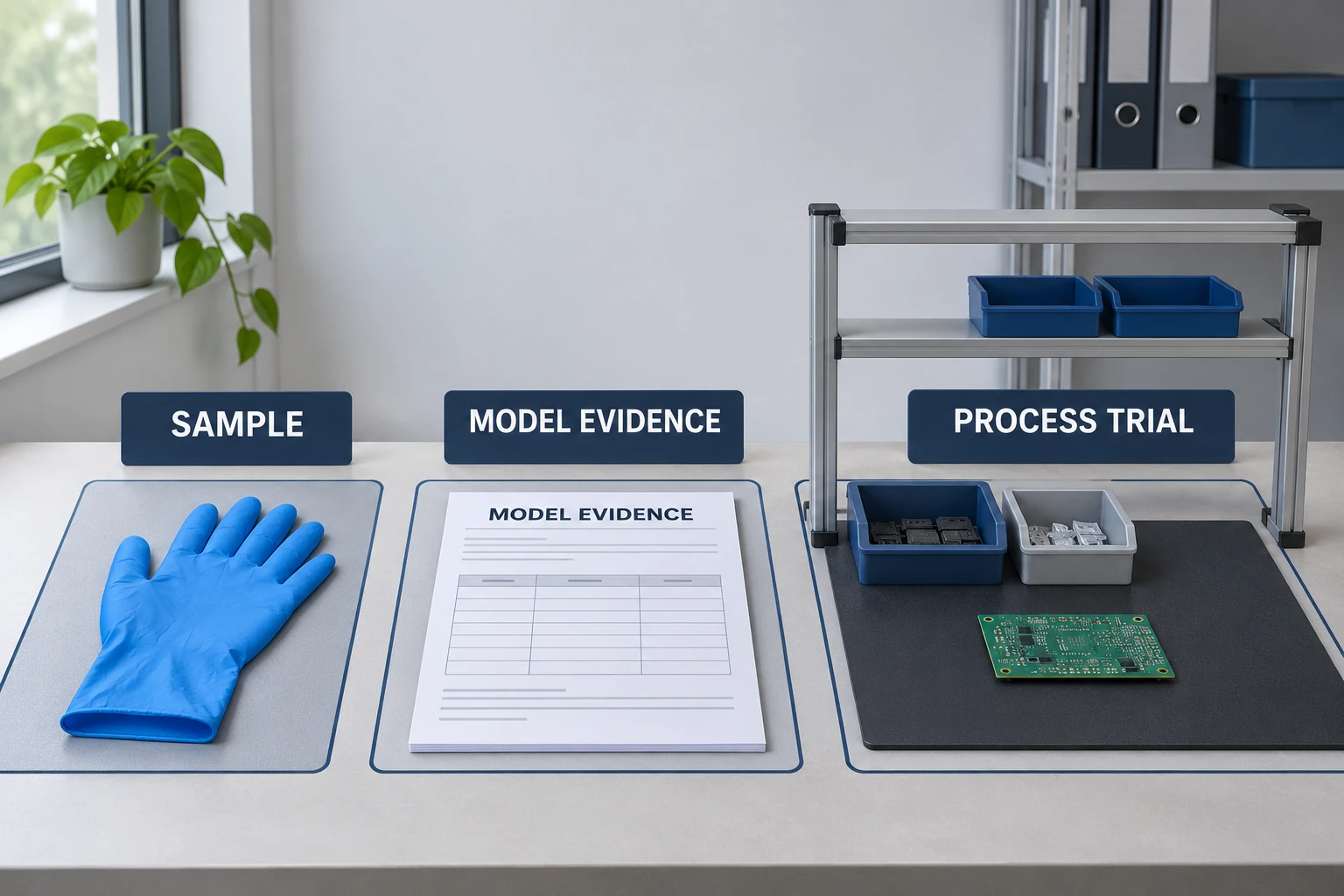
A useful purchasing decision has three parts: identify the glove being supplied, review the evidence for that model, and approve a representative sample in use. This guide separates those checks so that a supplier can answer a precise inquiry rather than simply send another “anti-static” product description.
Why a grounded operator still needs the right glove
Grounding the operator does not, by itself, establish that the glove surface is suitable for handling sensitive components. The EOS/ESD Association identifies insulating gloves as a concern and discusses conductive or dissipative alternatives. A published Desco nitrile glove data sheet illustrates model-specific documentation: it names the product and test method. Its figures do not automatically apply to another glove.
For a buyer, that means the glove is a process-control item, not just a disposable consumable. A statement about its material should be followed by evidence for its electrical behavior and its use with personnel grounding. The responsible ESD coordinator should define acceptance criteria for the operation; a generic resistance figure from another manufacturer’s glove is not a specification for the product you are buying.
These are electronics-handling considerations. ESD suitability does not establish electrical shock protection, chemical protection, sterility or suitability for every cleanroom task. Those are separate purchasing requirements with their own evidence.
Are nitrile gloves ESD safe for your process? Check model evidence
A report is useful only when you can connect it to the ordered item. Ask the supplier to identify the model, material formulation or controlled product version, test method and conditions. If the available document covers a different glove, the model match remains unresolved.
| Buyer check | What to request | What remains unanswered without it |
|---|---|---|
| Product identity | Exact model, available sizes, sample label and current data sheet | Whether the tested glove is the glove being quoted |
| Electrical evidence | Test method, measured property, conditions and model identification | What the electrical result actually describes |
| Use in your process | A sample suitable for evaluation with the normal handling and grounding arrangement | Whether the glove works acceptably in the intended operation |
| Supply continuity | Lot identification and the supplier’s proposed change-notification arrangements | How a later order will be related to the approved sample |
Do not treat missing conditions as a small paperwork omission. A number without its measured property, method or sample identity cannot answer the same question as a traceable report. Ask the supplier to close that gap before you define the glove as an approved substitute.
What Quan Dun’s nitrile glove listing establishes
Quan Dun’s anti-static blue nitrile glove listing describes a powder-free, single-use nitrile glove with textured fingertips and a rolled cuff. These are useful starting points for reviewing handling, fit and the proposed consumable format.
The listing does not publish a numerical electrical test result with its conditions. It also does not provide a complete size matrix, a chemical permeation rating or model-specific cleanroom certification. Request the relevant documents and available sizes as part of the inquiry. Do not infer those properties from the product name or photograph.
Use the listing to identify a candidate for evaluation. For example, a buyer who needs disposable gloves for repeated small-component handling can ask whether this model is available in the required size mix and request the corresponding electrical evidence. Approval should follow the buyer’s defined acceptance process, rather than the broad category label.
Run a sample trial with a written decision
A sample trial should answer your production questions under defined conditions. Keep the sample identity and the operation visible in the record. A favorable impression during an informal demonstration is difficult to reproduce when a different size or lot arrives.
The following is a proposed buyer worksheet, not a report of tests performed by Quan Dun:
- Operation: Record the component, handling task, contact surfaces and normal personnel-grounding arrangement.
- Sample: Record model, size, lot or sample reference, and the supplier documents received.
- Fit and handling: Observe fingertip control, grip, comfort, donning and any interference with the actual task.
- Process evidence: Have the responsible ESD personnel document the applicable verification method and acceptance decision.
- Release: Identify who approved the sample, any use restrictions, and which changes require evaluation again.
Resolve size selection separately from electrical acceptance. A glove can have relevant electrical documentation yet still be unsuitable for the operator’s work. Conversely, a comfortable glove is not automatically ESD safe. Keeping the decisions separate makes a rejected sample easier to discuss with the supplier.
Send an inquiry that can become a repeat-order specification
For an ESD-safe nitrile glove inquiry, include the intended electronics operation, required sizes and quantities, expected consumption, cleanliness requirements and the documentation your ESD coordinator needs. State whether you are evaluating a new glove or replacing an approved item.
If you are replacing an existing glove, attach its controlled specification or list the characteristics that must be matched. Ask the supplier to identify any proposed differences rather than label the new item “equivalent.” Keep the accepted sample reference and final model on the purchase specification.
Send Quan Dun your glove qualification requirements with the product link and the sample information above. Ask for model-specific evidence, available size options and a quotation for the defined supply scope. This gives both sides a clear basis for the next decision.
References
- EOS/ESD Association: ESD Fundamentals, Part 3 — background on gloves and personnel ESD control.
- Desco: Dissipative Nitrile Gloves data sheet, January 2018 — a manufacturer-specific example of product and test-method identification, not a Quan Dun specification.