

Minimum circuit ampacity (MCA) is the minimum current-carrying capacity specified for the supply conductors of a piece of equipment. It is an equipment-rating term, commonly encountered on HVAC nameplates. It is not the current the equipment necessarily draws at that moment, and it is not automatically the breaker rating.
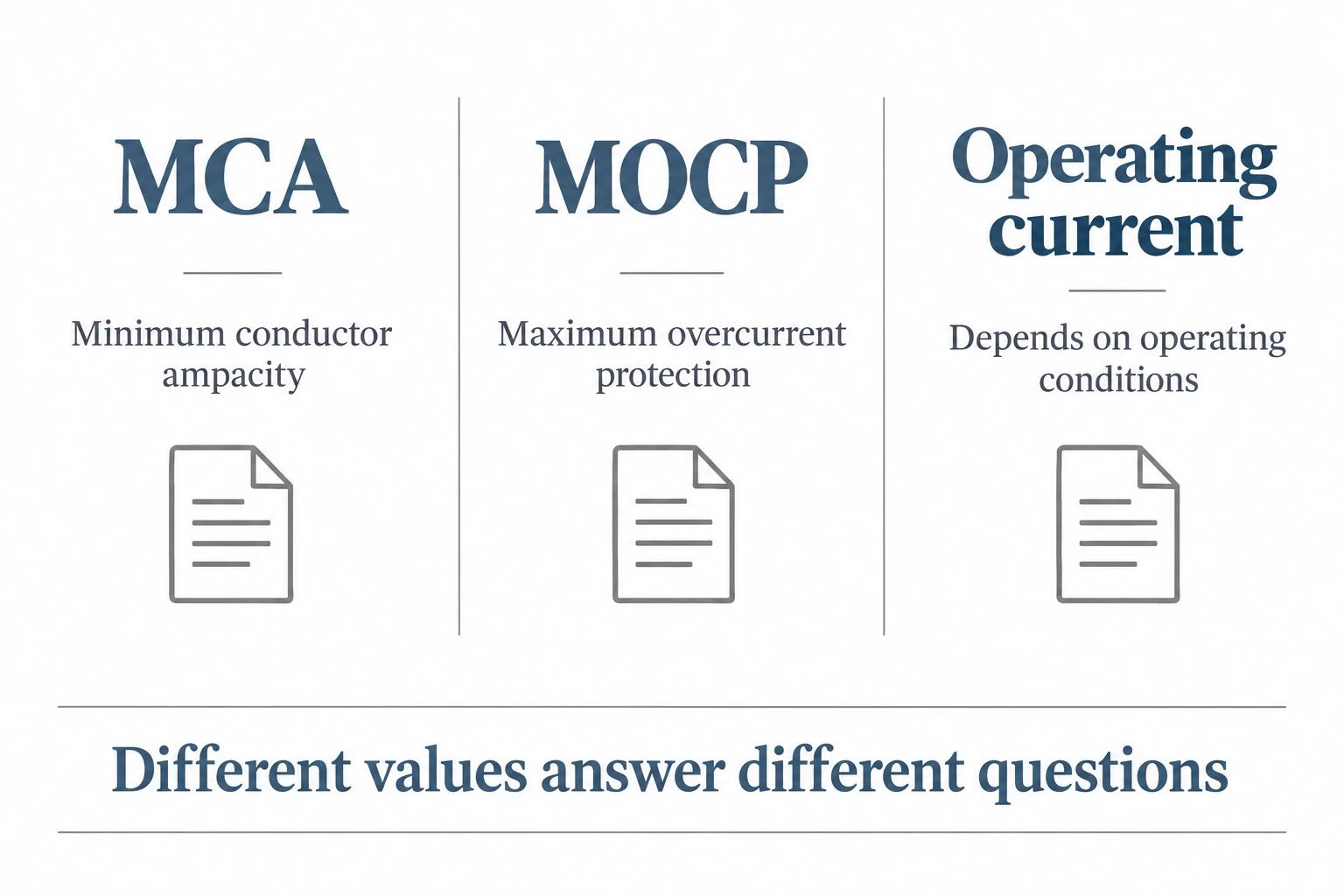
If you are asking what is minimum circuit ampacity because several different amp values appear on a label, keep their names attached to the numbers. MCA, operating current and maximum overcurrent protection answer different questions.
Scope: US-oriented equipment terminology, reviewed against the sources below on November 1, 2026. This is a nameplate-reading explanation, not a conductor-sizing, installation or code-approval procedure.
What is minimum circuit ampacity telling you?
A useful reading is “minimum ampacity required of the supply conductors.” The word minimum applies to conductor capacity. It does not mean the smallest current at which the appliance operates, and it does not describe an energy-saving mode.
Eland Cables distinguishes this calculated design value from normal running current. Its explanation also identifies MOCP as the separate maximum overcurrent-protection rating. Reading those two labels together is more informative than copying either number without its heading.
| Label or record | Question it addresses | What it does not establish |
|---|---|---|
| MCA | What minimum supply-conductor ampacity is specified? | Actual current at a particular moment |
| MOCP or MOP | What maximum overcurrent-protection rating is specified? | A universal wire-size conversion |
| Operating-current measurement | What current occurred under the recorded conditions? | The complete installation requirements |
| Voltage and phase | Which supply configuration does this information describe? | Interchangeability with another configuration |
MCA versus MOCP: preserve the two headings
Consider a fictional document showing “MCA 18 A” and “MOCP 25 A.” These are illustrative labels, not ratings for a real product. The first is a minimum ampacity specification; the second is a maximum protective-device specification. The numbers are not competing estimates of the same quantity.
That document alone is not a complete installation design. It does not identify a conductor material, a wire gauge, a permissible installation method or every condition attached to the equipment. A purchasing note that reduces both entries to “25-amp unit” loses an important distinction.
Why a running-current number cannot replace MCA
A measured value belongs to a particular observation. Before comparing it with a document, identify the equipment, operating state and measurement record. A value copied from a different model or an unspecified test condition is a poor substitute for the relevant nameplate.
For example, a maintenance note saying “12 A observed” does not erase an MCA entry of 18 A in our fictional record. It describes an observation; the MCA entry describes a design requirement. Neither should be silently renamed to make the numbers appear consistent.
Is there one MCA formula for every appliance?
No single calculation should be copied indiscriminately between equipment categories. Neptronic’s manufacturer explanation provides an MCA calculation for its humidifier example and discusses MOP within that application. A worked humidifier example should not become a universal heat-pump, compressor or motor formula.
For an actual equipment review, preserve the manufacturer’s stated values and the matching document revision. If a label and a manual appear to disagree, identify the configuration and obtain clarification instead of choosing the more convenient number. This article intentionally does not calculate an installation wire size or a replacement breaker.
A useful information handoff
Collect the full model identifier, the complete accessible nameplate, supply voltage and phase, MCA, MOCP/MOP, and the matching manufacturer document. Keep optional heater or accessory information with the record when it appears in that document. A cropped photograph containing only one amp value is much harder to interpret.
Do not remove equipment covers to obtain information for this exercise. Existing documentation or an externally accessible label is sufficient for preparing a question for the equipment manufacturer or a qualified electrical professional.
Related control components have their own ratings and functions. Our explanation of alternating-current contactors covers that separate topic; a contactor rating does not replace an equipment MCA or MOCP entry.