

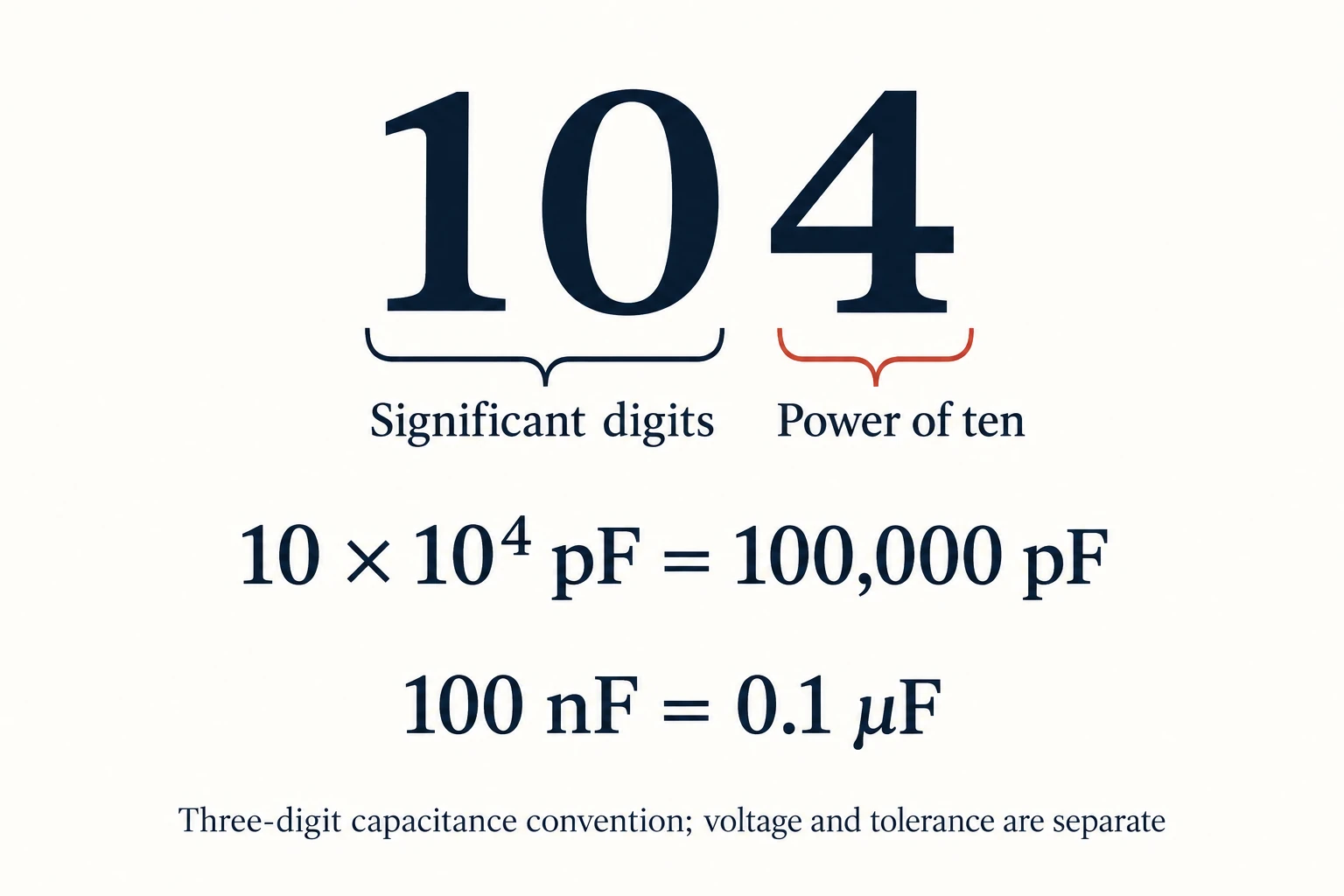
The value of capacitor 104 is 100,000 picofarads (pF), 100 nanofarads (nF), or 0.1 microfarads (µF) when 104 is being used as the common three-digit capacitance code. These are three ways to express the same nominal capacitance.
The code does not mean 104 µF or 104 pF. It also does not tell you the voltage rating. Before identifying an unknown component, establish that the marking is a capacitance code rather than another manufacturer identifier.
Decode the value of capacitor 104 step by step
In the three-digit pF convention, the first two digits are the significant digits and the third digit is the exponent of ten. For 104, retain 10 and multiply it by 10⁴. That gives 10 × 10,000 = 100,000 pF.
KYOCERA AVX’s KAM-series ordering information explicitly describes this two-digit-plus-zero-count convention. It is useful documentary evidence for reading the code, but a part-number field should not be confused with a promise that every physical capacitor carries the same visible marking.
To change units, divide picofarads by 1,000 to obtain nanofarads, then divide nanofarads by 1,000 to obtain microfarads. NIST’s SI-prefix definitions establish those scale factors. Keep the unit written beside each number during the conversion.
Compare 103, 104 and 105 without losing a decimal place
Changing the final digit changes the multiplier. The following examples use the same convention and are calculations, not a list of parts approved for a circuit.
| Code | Calculation in pF | nF | µF |
|---|---|---|---|
| 102 | 10 × 10² = 1,000 | 1 | 0.001 |
| 103 | 10 × 10³ = 10,000 | 10 | 0.01 |
| 104 | 10 × 10⁴ = 100,000 | 100 | 0.1 |
| 105 | 10 × 10⁵ = 1,000,000 | 1,000 | 1 |
| 473 | 47 × 10³ = 47,000 | 47 | 0.047 |
A quick plausibility check is to compare adjacent rows: code 103 represents 10 nF, one tenth of the 100 nF represented by code 104. Code 105 represents 1,000 nF, ten times that capacitance. If your conversion makes 103 larger than 104, revisit the multiplier or unit.
What about 104 K or 104 J?
A following letter can describe tolerance in a manufacturer’s marking system. In the cited KYOCERA AVX documentation, J denotes ±5%, K ±10%, and M ±20%. Confirm the particular product’s code definition before applying those meanings to an unidentified marking.
For a hypothetical nominal 100 nF component specified at ±10%, the arithmetic interval is 90–110 nF under the applicable reference conditions. That calculation is a tolerance example, not a prediction of every operating condition or an assessment of a loose part.
Why 104 does not establish the voltage rating
The capacitance code and voltage specification answer different questions. A full manufacturer part number can contain separate fields for capacitance, tolerance, voltage, dielectric and package. Reading only the 104 field discards the rest of that information.
Murata’s selection guide compares capacitor technologies across several characteristics, including temperature behavior, bias behavior and frequency performance. Consequently, matching 0.1 µF is only one part of identifying a suitable component. A similar shape or identical nominal value is not sufficient evidence of interchangeability.
For a replacement request, preserve the complete manufacturer identifier and the equipment’s approved specification. Do not infer polarity, voltage capability or suitability for a safety-related position from 104 alone. This guide decodes markings; it does not instruct removal, discharge or testing of installed capacitors.
Keep the decoded value with its evidence
A useful component record includes the exact marking, nominal value with units, full part number if known, and the datasheet used to interpret it. Keep unknown fields blank and identified as unknown rather than filling them from a similar-looking online photograph.
For production handling, organize verified parts separately from unidentified stock. When assessing a Quan Dun ESD tray for an assembly or component workflow, record physical dimensions and support requirements independently of the electrical identification. A storage choice does not verify the component value.
The reliable result is “104 decodes to 100 nF under this convention, with these other fields verified separately.” That is much more useful than treating three digits as a complete replacement specification.