

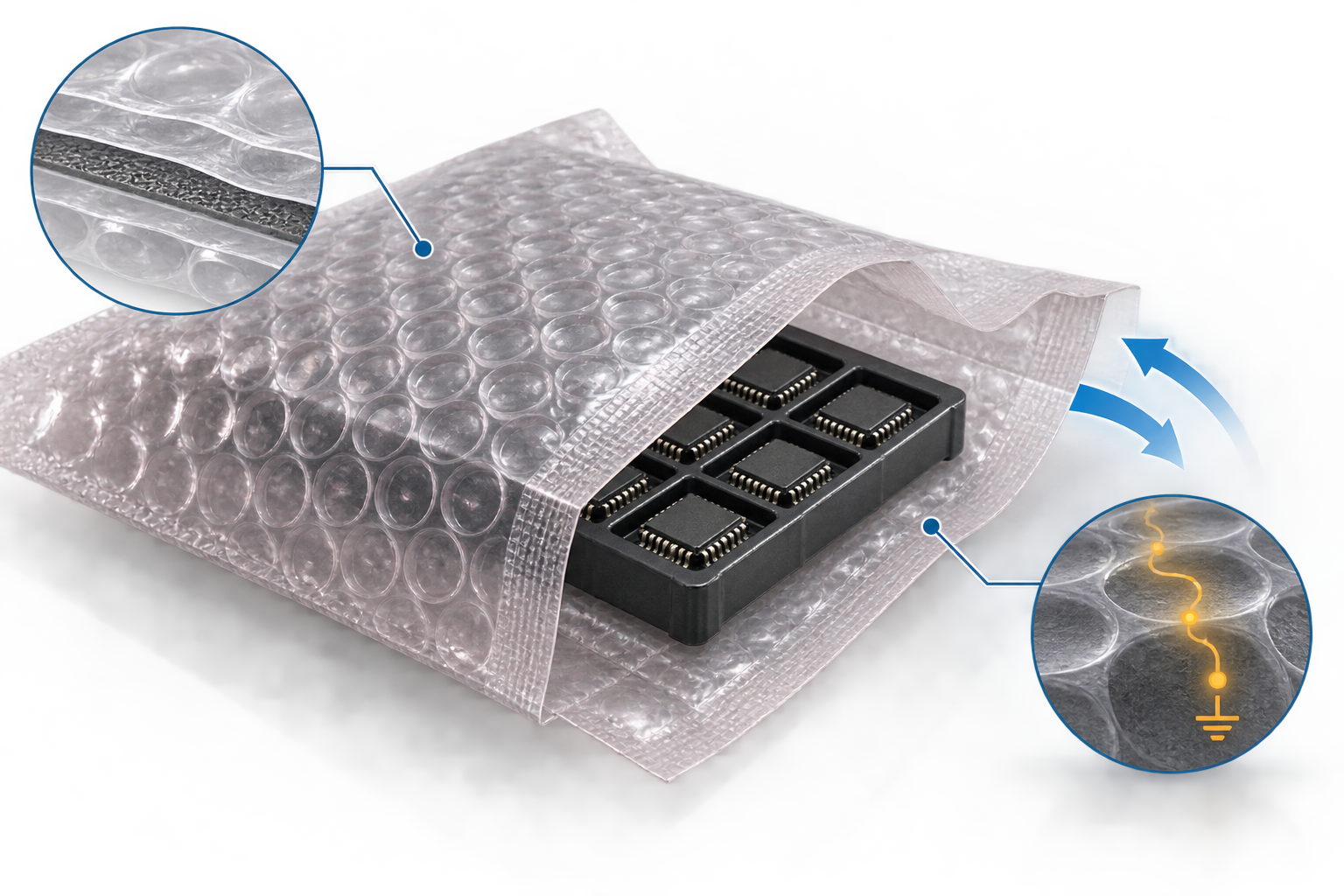
An ESD bag is only useful when its protective envelope, cushioning, closure, and handling route match the component. ESD bubble bags add impact separation around sensitive parts, but the bubble layer does not by itself prove a complete static-control solution. Start with the largest package, the normal movement route, and the evidence required for the actual bag construction.
1. How to choose esd bubble bags for the component route
Record the largest component, board, connector, or subassembly that will enter the bag. Include protruding pins, sharp corners, loose parts, and whether the item is already in a tray or inner package. The bag must close without crushing the part or leaving an opening that exposes the item during handling. For mixed inventories, separate sizes by the real envelope rather than selecting one nominal size for every SKU.
Also define the moment when cushioning matters. A bag used inside a tote has a different job from a bag carried between receiving and a production cell. Note the drop, rubbing, stacking, and transfer risks that the package must control, then ask the supplier which bubble construction and closure are intended for that route.
2. Separate cushioning from static-control evidence
Treat cushioning and electrostatic protection as related but separate decisions. Ask for the material description, layer construction, closure details, and the test basis for the static-control claim. A visible bubble texture does not identify the electrical category, and an ESD label does not establish the performance of every size, seam, or accessory.
If the item is shipped, record the outer carton, inner separation, moisture or contamination concerns, and the point where the bag is opened. Confirm how the bag is handled in the controlled area and what verification record accompanies the supplied configuration. Keep configuration-specific resistance or shielding values conditional until the supplier provides the applicable evidence.
3. Plan access, identification, and reuse
Choose the opening and closure around the operator’s normal motion. A bag that is easy to open may be appropriate for repeated picking, while a closed format may be better for movement between process steps. Leave enough access to identify the contents without repeatedly exposing the component to unnecessary handling.
Use labels or lot records that remain readable after the bag is nested in a tote or carton. If bags are reused, define inspection, cleaning, retirement, and traceability rules. A damaged seam, puncture, or contaminated inner surface can change the package behavior even when the printed product name is unchanged.
4. Prepare a supplier-ready bag request
Send the component envelope, quantity per bag, cushioning requirement, access preference, inner or outer package, movement route, and required evidence in one request. Ask the supplier to return a proposed size, construction, closure, packing method, and the test basis for the selected configuration. Include whether the bag must fit a tray, tote, rack, or shipping carton.
Use the CH-ESD ESD shielding bag product route as the first-party starting point. For a specific quote, reference the related ESD storage tote guide and attach the component envelope and quantity. The supplier should confirm exact dimensions and configuration-specific properties before approval.
Before approving a sample, run a packing trial with the largest and most fragile representative part. Pack it using the same inner tray, label, outer carton, and closure intended for production. Open the package at the normal workstation and confirm that the operator can remove the item without dragging leads or corners across the bag opening. Photograph the accepted packing sequence and keep the approved bag code with the work instruction.
Storage conditions also affect the choice. Ask whether bags will be compressed in a tote, exposed to repeated handling, or stored near sharp fixtures. Confirm how the supplier packs unused bags so folds, contamination, and mixed sizes do not enter the process. If the application needs shielding, treat that as a named requirement and request the corresponding construction and test documentation rather than assuming every pink or bubble material provides the same function.
For receiving inspection, check size and closure against the purchase record, sample the seam and surface condition, and retain the lot or shipment reference. When a process changes component size, tray type, outer carton, or route, repeat the packing trial. These controls make anti static bubble bags a repeatable packaging choice instead of a generic consumable selected only by appearance.
References
- EOS/ESD Association: ESD Fundamentals, Part 3 — ESD control procedures and material categories.
- EOS/ESD Association: ANSI/ESD S541-2026 — Packaging properties and test-method reference for electrostatic-sensitive items.
- IEC 61340-5-1:2024 — ESD control-program requirements and implementation context.
- Current SERP product reference — A current US search result used as topic context, not as a CH-ESD specification.
- Additional current SERP reference — A current US search result used as topic context, not as a CH-ESD specification.