

Pink ESD bags are generally used as low-charging packaging, but pink color does not prove electrostatic-field shielding. A bag can reduce charge generation from handling and still leave an electrostatic-sensitive device exposed to a discharge or field outside a controlled area.
Use a pink bag only when its documented properties match the item and route. If a bare ESDS device will leave an ESD protected area, travel through normal shipping, or face an uncontrolled field, evaluate a verified shielding package rather than treating color as the protection specification.
1. What pink ESD bags protect against
The practical purpose of a pink antistatic bag is to reduce charge generation compared with ordinary high-charging plastic. That can be useful for non-sensitive items used near an ESD process, secondary packaging, or a route where the control program explicitly permits the material.
The protection boundary is narrow. Low-charging behavior does not automatically establish a dissipative path, shielding performance, moisture protection, puncture resistance, or suitability as primary packaging. Surface treatment can also be affected by the product formulation and use conditions, so the supplier should identify the material, property, method, and applicable conditions.
2. Why pink is not the same as shielding
A shielding bag uses a construction designed to limit an external electrostatic field from reaching the item. A pink polyethylene bag is visibly different, but appearance alone still cannot verify either package. Review the data for the exact bag construction.
NASA-STD-8739.6B states in its program context that topically treated pink poly provides antistatic protection only under specified conditions and should not be used as primary packaging for ESDS hardware unless verified. A NASA ESD handbook also distinguishes dissipative plastic from shielding and calls for an outer shielding container for shipping in its context. These sources explain why “pink ESD bag” and “shielding bag” should not be used as synonyms.
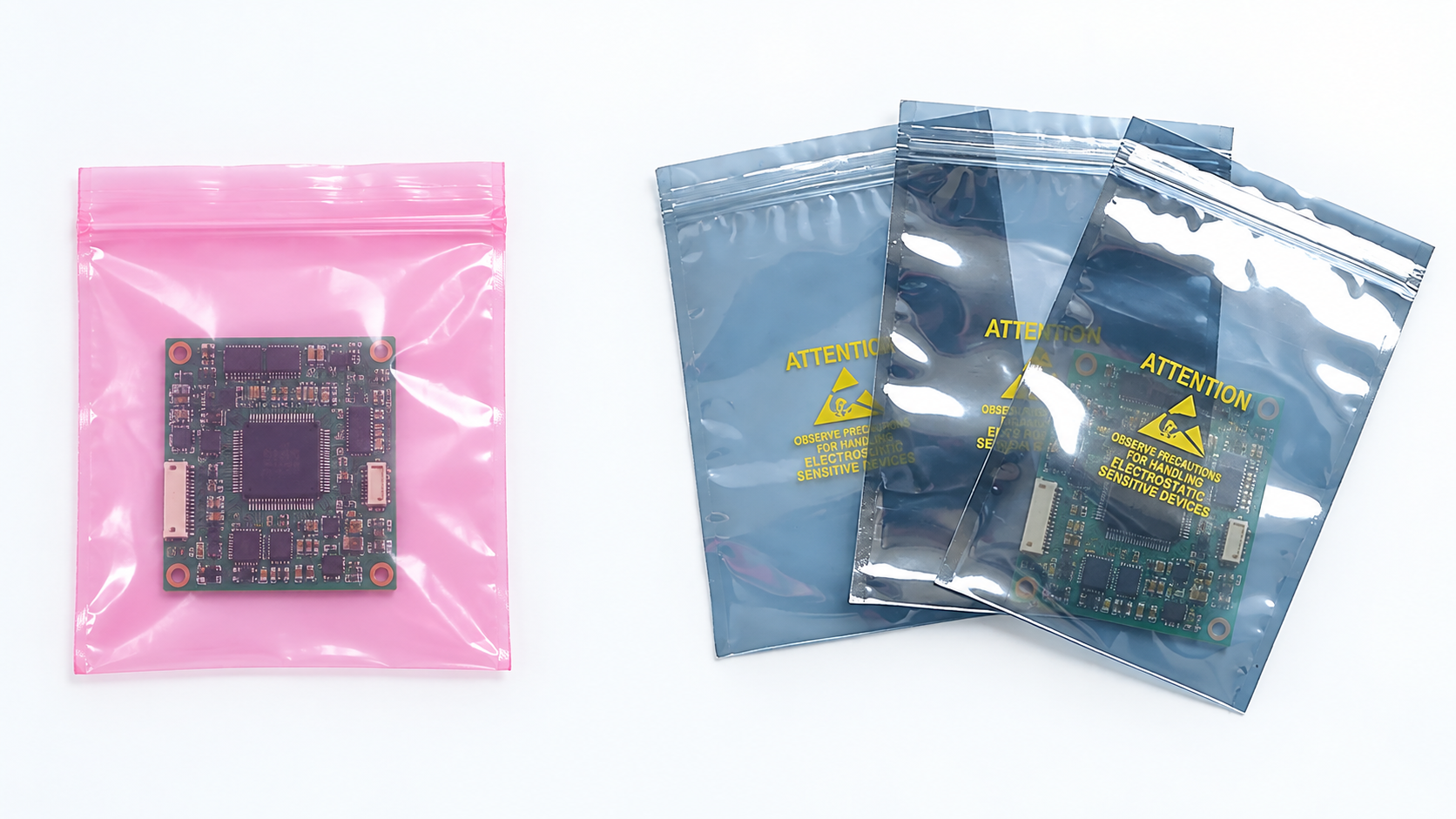
| Route | Pink low-charging bag alone? | Decision |
|---|---|---|
| Inside a controlled ESD protected area | Possibly, if the local control plan and item allow it | Verify the bag property, condition, and handling steps |
| From protected area to uncontrolled warehouse or carrier | Do not assume it is sufficient | Assess a verified shielding enclosure and mechanical protection |
| Bag used as secondary dust cover around a protected item | May be suitable | Confirm it does not replace the qualified primary package |
| Returnable package with repeated opening | Requires review | Inspect closure, cleanliness, damage, property, and reuse rule |
3. Choose packaging by the handling route
Map where the device is exposed. Note whether it is bare or already sealed, where it enters and leaves the protected area, who opens the package, and whether it returns. Add mechanical hazards such as abrasion, sharp leads, puncture, crushing, and moisture only when they exist on that route.
For a shipping route, select the primary electrical package before the tote or carton. The current CH-ESD metallized shielding-bag page lists a multi-layer bag with configurable sizes, thicknesses, and opening styles. That page describes a different product class from a generic pink bag. Request the exact construction and test basis rather than transferring the product-page wording to every bag.
Add a rigid ESD box or suitable outer carton when the route needs containment, stacking, or mechanical protection. The outer container does not remove the need to verify the inner electrical package.
4. Inspect and specify the bag
- Name the item, sensitivity basis, quantity, package orientation, and handling route.
- Specify bag construction, usable inner size, closure or seal, thickness, and any print or label area.
- Request low-charging, dissipative, or shielding evidence by property, method, condition, and revision.
- Inspect for punctures, tears, seal damage, contamination, and worn closures before reuse.
- Define a reuse limit or inspection rule; do not assume a bag remains acceptable because it looks clean.
Keep the approved bag sample, supplier data, sealing instruction, and revision together. When the construction, film supplier, closure, thickness, or print changes, compare the change with the original requirement before release.
FAQs
Are pink ESD bags shielding bags?
No. Pink color commonly indicates a low-charging or antistatic material, but it does not prove electrostatic-field shielding. Use a product with verified shielding construction and test evidence when shielding is required.
Can pink ESD bags be used for shipping?
They may be one layer in a documented package, but should not be assumed sufficient as primary protection for an exposed ESDS device. Assess the route, item sensitivity, shielding need, cushioning, closure, and outer package together.
A receiving inspection can catch obvious damage but cannot confirm shielding or low-charging performance by sight. Match the bag label and supplier lot to the approved specification, then apply the sampling or test plan defined by the control program. Store opened bags away from contamination and conditions that the supplier excludes. When a bag is heat sealed, verify the seal width and continuity on the actual material rather than assuming one machine setting works for every thickness.
For reusable bags, define what “reusable” means operationally. Set inspection points for tears, creases, abrasion, contamination, closure wear, and unreadable labels. A bag that passes a visual check may still require periodic property verification under the local ESD program. Replace bags when the approved limit is reached or when traceability is lost.
The product label should distinguish the bag construction from its intended use. Record the manufacturer, material or construction code, size, thickness, closure, lot, and revision. If the same pink appearance is available from more than one film source, do not combine inventory until the approved properties and traceability match. Train operators to identify the approved package by its controlled label rather than by color alone. This prevents an ordinary pink sleeve, a dissipative bag, and a metallized shielding bag from being treated as equivalent during a busy packing step.
References
- NASA-STD-8739.6B — current NASA ESD control and packaging guidance.
- NASA ESD Control Handbook overview — dissipative-material and shielding distinction.
- EOS/ESD Association: ANSI/ESD S541-2026 — packaging properties and test-method context.