

Standard capacitor values are preferred nominal values arranged in repeating series, such as E3, E6 and E12. The series describes the available value steps within a decade. It does not, by itself, identify the capacitor’s voltage rating, dielectric, package or guaranteed tolerance.
Read a capacitor specification in two passes: establish the capacitance and unit, then identify the rest of the part. This prevents an apparently correct value from becoming an unsuitable replacement or purchasing substitution.
Standard capacitor values: E3, E6 and E12
A decade is a tenfold interval. The same preferred-number pattern repeats at larger or smaller scales. For example, the E3 pattern can appear as 1, 2.2 and 4.7, then 10, 22 and 47, then 100, 220 and 470. The unit still needs to be supplied.
| Series | Values within the 10–100 interval | How to read it |
|---|---|---|
| E3 | 10, 22, 47 | Three nominal steps per decade |
| E6 | 10, 15, 22, 33, 47, 68 | Six nominal steps per decade |
| E12 | 10, 12, 15, 18, 22, 27, 33, 39, 47, 56, 68, 82 | Twelve nominal steps per decade |
Multiply the entries by a power of ten to move to another decade. In the E6 pattern, 4.7 nF, 47 nF and 470 nF share the same preferred-number position, but they are different capacitances. Conversely, 47 nF and 0.047 µF are different notations for the same capacitance.
Murata describes preferred steps and also notes that the steps used depend on the capacitor series and temperature characteristics. Do not assume every theoretical value is offered in every voltage rating, size or dielectric. The manufacturer’s current part list determines what can actually be ordered.
Convert pF, nF and µF before comparing parts
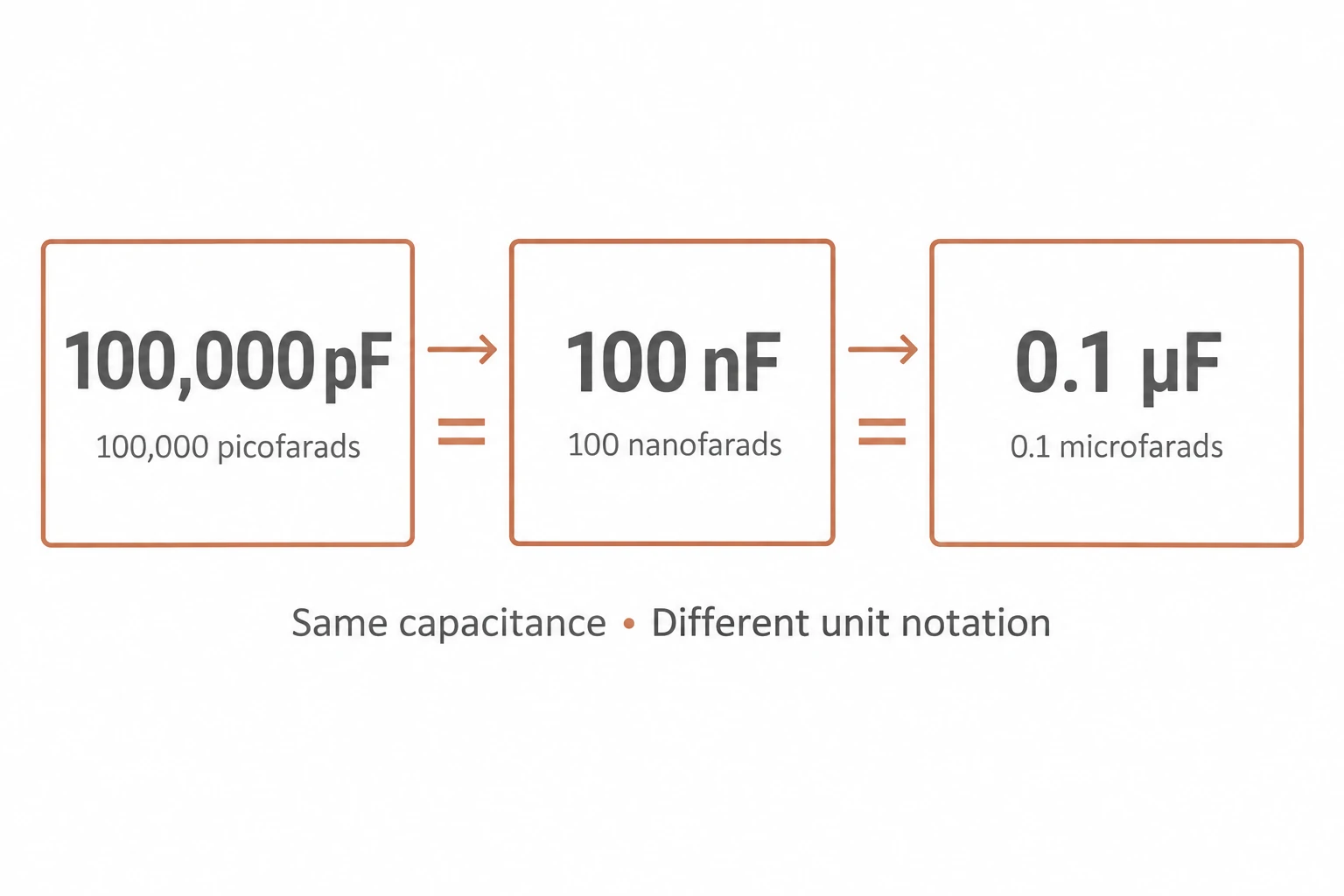
The SI prefixes pico, nano and micro represent progressively larger fractions of a farad. One nanofarad equals 1,000 picofarads; one microfarad equals 1,000 nanofarads. Moving from pF to nF therefore divides the numerical value by 1,000.
For example, 100,000 pF = 100 nF = 0.1 µF. Divide the numerical value by 1,000 each time you change from pF to nF or from nF to µF. The component’s capacitance has not changed—only the unit used to express it has.
For a parts comparison sheet, normalize capacitance to one unit before sorting. Retain the original marking in a separate field. Normalize capacitance to compare entries. Before merging two part records, verify the manufacturer and part number.
Tolerance is a separate field
The E-series label is not sufficient proof of an individual capacitor’s tolerance. Read the tolerance from the actual part specification. A nominal 100 nF value with an explicitly specified ±10% tolerance gives a calculated nominal tolerance interval of 90–110 nF under the stated specification conditions.
This arithmetic does not establish the capacitance under every operating condition. Nor does it decide whether a substituted part will work in the circuit. The designer’s requirement and the component’s applicable characteristics remain part of that decision.
Keep a measured result separate from the nominal specification. Record the measurement conditions and instrument method when they matter to acceptance. A value observed on a meter is not a complete description of the capacitor’s behavior in service.
Why equal capacitance does not mean equal parts
Murata’s selection guide distinguishes capacitor technologies by their ranges and performance properties. Two items marked with the same capacitance can belong to different technologies and packages. A unit conversion cannot establish that they are interchangeable.
A useful purchasing record includes manufacturer part number, nominal capacitance, tolerance, voltage rating, technology or dielectric, package dimensions and any application-specific requirement. Link that record to the manufacturer’s specification rather than copying only the visible value from a photograph.
When a required nominal value is unavailable, an adjacent preferred value is not automatically an approved substitute. Identify the design function and obtain the responsible designer’s acceptance before changing the specification. The preferred-number table is a reference for available steps, not a redesign rule.
Keep value identification with the assembly
During kitting, preserve the association between the part label, the approved material record and the assembly revision. Quan Dun’s ESD trays can support an organized assembly-handling process when selected for the actual board geometry. They do not establish capacitor ratings or authorize substitutions.