

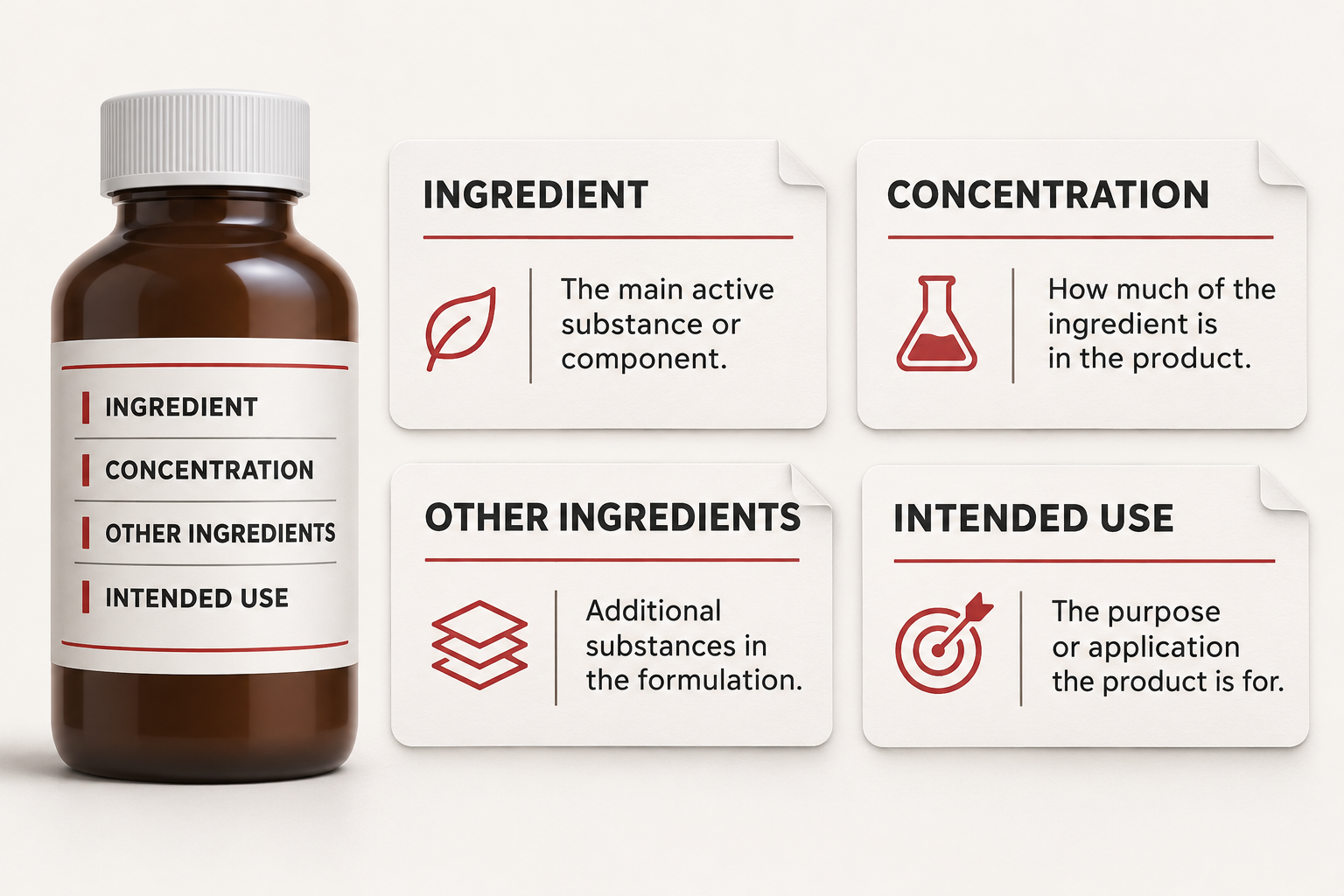
Rubbing alcohol is often an isopropyl-alcohol formulation, but the names are not exact synonyms. Isopropyl alcohol, also called IPA, identifies a chemical. Rubbing alcohol identifies a product whose active ingredient, concentration and other ingredients must be read from the label.
To answer “is rubbing alcohol the same as isopropyl alcohol,” read the active ingredient first. Some rubbing-alcohol products contain ethanol instead. Even when a bottle contains IPA, its formulation and intended use may differ from another IPA product. To decide whether two bottles are equivalent for a cleaning task, compare their complete descriptions rather than the familiar name on the front.
Is rubbing alcohol the same as isopropyl alcohol?
The answer depends on which product you are holding. “Isopropyl rubbing alcohol” makes the active chemical clearer than “rubbing alcohol” alone, but the rest of the label still matters. A concentration statement does not identify every ingredient or establish suitability for every surface.
A useful counterexample appears in DailyMed: a published Walgreens Ethyl Rubbing Alcohol label identifies ethyl alcohol at 70% by volume. Its inactive ingredients include acetone, denatonium benzoate, methyl isobutyl ketone and water. That specific product is evidence that the everyday rubbing-alcohol name does not always mean IPA.
This example should not be turned into a formula for all rubbing alcohol. Its value is narrower: it shows why a buyer must read the active ingredient and the complete product information.
| Description | What it identifies | What you still need |
|---|---|---|
| Isopropyl alcohol / IPA | A chemical identity | Concentration, grade and product information |
| Isopropyl rubbing alcohol | A formulated product containing IPA | Full ingredients and intended use |
| Ethyl rubbing alcohol | A formulated product containing ethanol | Its own label and supporting documents |
| Rubbing alcohol | An incomplete everyday description | The active ingredient before making a comparison |
Read the active ingredient before the product nickname
Begin with the product identity and active ingredient. The two should connect clearly to the bottle being considered. If a supplier sends a document for a similar product, ask whether it covers the exact offered item.
Then read the concentration and how it is expressed. In the DailyMed example, the label states 70% by volume. Preserve that basis when recording the product; do not silently turn it into a different kind of percentage.
Finally, look for other ingredients and intended use. A product described for one purpose has not automatically been approved for another. A buyer can understand its composition without assuming that its original application transfers to a precision-cleaning process.
This sequence avoids an easy mistake: comparing concentration numbers before checking that the products contain the same active chemical. Two labels can display the same percentage and still describe different products.
Concentration and purity answer different questions
A concentration statement tells you how much of a specified ingredient is present on the stated basis. A grade or specification describes additional requirements associated with the offered product. Neither should be treated as a universal shorthand for compatibility.
For example, Chemtronics offers a named 99.9% technical-grade IPA cleaning solvent together with product documents. The useful lesson is not that the largest percentage is always the best choice. It is that the concentration belongs to a particular product and specification.
When two quotations differ, ask what the difference means for the actual task. Is the relevant issue declared water content, other ingredients, a documented specification or a surface restriction? That question is more productive than asking which bottle is simply “stronger.”
Keep a quoted grade name attached to the supplier’s definition. Do not assume that a grade from one document proves every impurity limit that another application might require. If a particular limit matters, request the relevant specification or batch information.
This article does not provide a dilution formula. Selecting an identified, documented product is a different task from preparing a mixture, and a naming comparison should not be used as preparation instructions.
Why inactive ingredients matter to a cleaning task
The word inactive is used within a product’s stated context. It does not mean an ingredient is irrelevant to every industrial cleaning decision. The DailyMed ethyl rubbing-alcohol example lists several ingredients beyond the active alcohol and water.
A precision-cleaning buyer should therefore compare the complete formulation information available, not only the active ingredient. An additive that belongs in one product description may be a reason to ask further questions for another application.
A product label, safety data sheet and technical specification serve different purposes. Read them together where relevant, and request clarification when a required detail is not stated. Missing information should remain a question rather than becoming an assumption of absence.
For instance, if a process has a specific residue requirement, ask what evidence addresses that requirement for the offered product. Do not infer the answer solely from a familiar alcohol name or a statement that the liquid dries quickly.
Keep the claim narrow enough to verify. “This product has a documented specification addressing our requirement” is a defensible purchasing basis. “All IPA leaves no residue on every surface” is not an adequate description of the decision.
What changes when cleaning precision parts
A naming comparison becomes an application decision when a cleaning material is selected for a particular part. The relevant questions include the surface, any coating, the soil to be removed, the intended cleaning method and the requirements for the result.
Obtain the device or material manufacturer’s guidance where applicable. A general solvent description cannot establish compatibility with every coating, adhesive, plastic or assembled product. Likewise, a result on one sample should not be silently extended to a different item.
The wipe is also part of the process. Its construction, edge and condition may matter alongside the chosen liquid. Buying a named alcohol does not remove the need to select an appropriate contact material.
For industrial use, the process owner should define the acceptance requirements and evaluation before a substitution. This guide addresses identification and selection questions; it does not provide instructions for cleaning energized equipment, treating skin or preparing a solvent mixture.
That boundary keeps the initial question useful. Understanding the names helps you request the correct documents and identify differences. Application approval still belongs to the actual product and process.
A label-reading decision tree
- 1. Identify the bottle. Record its exact product name or code and the corresponding document.
- 2. Identify the active ingredient. If the description says only rubbing alcohol, resolve the chemical identity first.
- 3. Record the concentration and basis. Keep the supplier’s wording rather than rewriting the unit.
- 4. Check other ingredients and grade information. Ask about any requirement the available documents do not address.
- 5. Compare the intended use. Connect the offered product to the actual surface and cleaning objective.
- 6. Record the decision or the gap. A familiar name is not a substitute for a documented answer.
The sequence is a documentation aid, not an instruction to approve a solvent. It helps a buyer identify where a comparison is complete and where the process owner needs additional information.
Worked examples: same name, different decision
Two bottles both say rubbing alcohol
One label identifies IPA; the other identifies ethanol. They are not identical products simply because the front labels share an everyday name. Compare each formulation and its intended use. If the requirement names IPA specifically, the ethanol product does not satisfy that identity requirement.
The ingredient matches, but the concentration differs
Two products identify IPA but state different concentrations. Record the difference without assuming which is suitable. Ask whether the applicable product guidance or process specification calls for one of them and whether the remaining formulation information is comparable.
A supplier offers a substitute with incomplete documentation
The offered bottle has a familiar name, but the supplied document does not identify its other ingredients or cover the required specification. The comparison remains incomplete. Request information for the exact item rather than borrowing a specification from a different supplier’s product.
The liquid is unchanged, but the wiping material changes
The bottle identity has not changed, yet the proposed wipe has a different construction. Treat that as a separate process variable. Keeping the solvent constant does not establish equivalence between two contact materials.
These are illustrative selection situations, not reports of laboratory tests or customer outcomes. Their purpose is to show how apparently small wording differences change the information needed for a decision.
Match the wipe and solvent as one process
Quan Dun’s clean-wiper listing includes polyester cleaning consumables. Use the selected item’s specification to discuss construction and intended use. The listing does not establish compatibility with every alcohol formulation.
A useful purchasing enquiry identifies both the cleaning liquid and the wipe requirement. Include the surface, relevant restrictions and the evidence the process owner needs. This allows a supplier to discuss a defined task instead of guessing what “alcohol wipe” means in that facility.
Keep the approved liquid identity and wipe identity together in the process record. If either changes, the record makes that change visible. This is more useful for repeat purchasing than a broad instruction to reorder rubbing alcohol and a white cloth.
Keep a usable product-identification record
A practical comparison record can contain the exact product name, the supplier item code, the active ingredient, the stated concentration basis and the date or revision of the supporting document. Add the required application information in a separate field. This lets another person see which bottle was evaluated and why.
When a supplier sends a revised document, compare the information that affects the task. A changed product code requires an identity check. A changed ingredient statement raises a formulation question. A changed commercial pack description may be a different kind of update. Recording the actual change avoids treating every update as either harmless or automatically unacceptable.
Questions about the names and grades
Does a higher percentage prove better cleaning?
No. A concentration number is one piece of the product description. The surface, soil, formulation and intended process still matter. Choose against a defined requirement rather than a percentage alone.
Does the name IPA prove suitability for a cleanroom?
No. Identify the offered grade, its relevant specification and the complete application requirements, including the contact material. A chemical name is not a finished-process qualification.
References
- DailyMed: Ethyl Rubbing Alcohol label — specific active and inactive ingredient example.
- Chemtronics: IPA cleaning solvent — an identified technical-grade product and its documents.
- Alliance Chemical: Rubbing alcohol versus IPA — chemical identity and formulated-product comparison.