
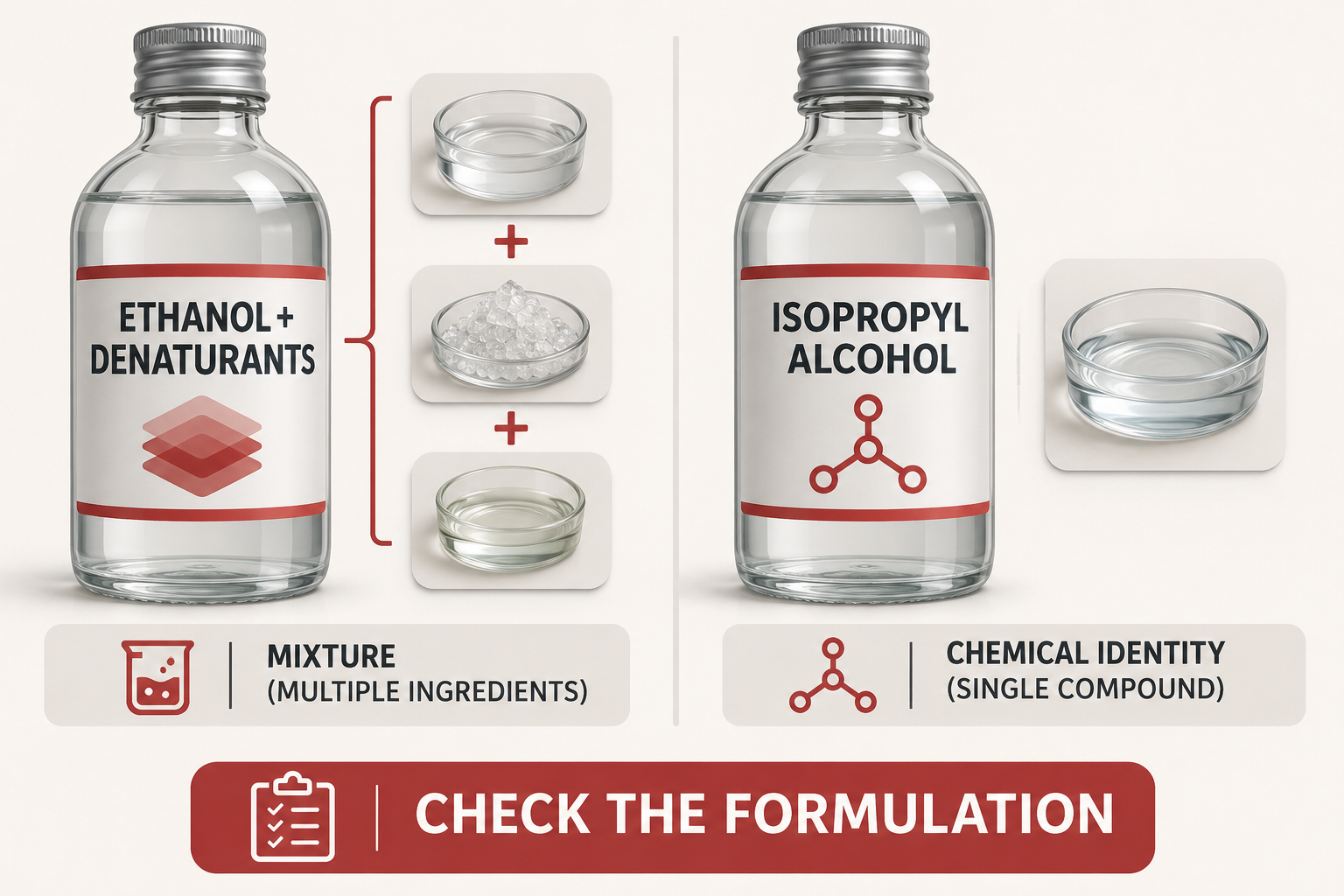
Denatured alcohol and isopropyl alcohol are different material descriptions. Denatured alcohol is ethanol containing added denaturants. Isopropyl alcohol, or IPA, identifies a different chemical. An offered IPA product can also be a specified formulation, so neither short name is a complete cleaning-material specification.
The practical question in a denatured alcohol vs isopropyl alcohol comparison is whether the exact offered product suits the intended task. Compare the formulation, relevant specification, surface restrictions and supporting documents before treating one solvent as a substitute for another.
Denatured alcohol vs isopropyl alcohol: the essential difference
The Solvents Industry Association’s explanatory note describes denatured alcohol as ethanol made unfit for human consumption by added denaturants. The document is UK guidance from 2021; it is useful for understanding the term, not for assuming current rules in every country.
IPA identifies isopropyl alcohol, a different chemical from ethanol. A supplier’s complete product description should then identify the offered concentration, grade and other relevant formulation information.
| Comparison point | Denatured alcohol | Isopropyl alcohol product |
|---|---|---|
| Identity | Ethanol with denaturants | IPA with the offered product specification |
| Information needed | Blend identity and relevant ingredients | Concentration, grade and formulation details |
| Application decision | Evaluate the exact blend | Evaluate the exact offered product |
| Substitution basis | Documented requirements for the task | The same requirements, checked independently |
A comparison based only on the word alcohol therefore stops too early. The two products may be discussed for similar cleaning purposes, but that does not make their formulations or application limits identical.
Why the denaturant is part of the specification
Denatured alcohol is not described fully by saying that ethanol is its base. The added ingredients are part of the product being offered. Different blend descriptions should remain visible when reviewing a proposed substitution.
Ask for the exact product identification and the documents covering it. If an enquiry refers only to “denatured alcohol,” the supplier still needs enough information to identify which offering is under discussion.
A safety data sheet is relevant to product identification and hazards, while a technical specification or other supplier information may address additional process requirements. Do not assume that one document answers every question simply because it uses the correct product name.
If a required detail is absent, ask the supplier about that detail. For example, a process may have a particular restriction concerning other ingredients or residue. A broad statement that the solvent contains ethanol cannot resolve that requirement.
Do not compare a blend with a pure-chemical value
A table can appear precise while comparing unlike information. A physical property listed for pure ethanol is not automatically the specification of a formulated denatured-alcohol product.
Before using a numerical comparison, check the object being described. Is the value for the pure chemical, a named blend, a particular concentration or a particular supplier item? Also check the conditions and the source. Without those details, the apparent precision may not help the decision.
The same caution applies to IPA. Chemtronics, for example, offers a named 99.9% technical-grade IPA product. That description belongs to the identified offering. It should not be copied into a comparison of every product called isopropyl alcohol.
For purchasing, use the actual product specifications side by side. A missing value should remain missing until it is resolved. Filling the gap with a number from another product can make the comparison look complete while making it less accurate.
When a number is unnecessary to the decision, a qualitative distinction may be clearer. Chemical identity, declared ingredients and an application restriction can be more important than a broad table of physical constants.
Application fit: start with the surface and soil
A useful cleaning-material comparison begins with what needs to be cleaned and what must remain unchanged. Identify the surface or assembly, relevant coatings or finishes, the soil and the required result.
Then obtain the applicable product or equipment guidance. A solvent’s general use as a cleaner does not establish compatibility with every surface. The offered formulation and the finished item both matter.
Keep a proposed substitute separate from an approved process. A buyer can collect the information needed for evaluation without declaring that the replacement has already been accepted. The process owner should define how the relevant requirements will be evaluated.
This article addresses identity and selection literacy. It does not provide solvent-mixing instructions, treatment advice or procedures for cleaning energized equipment. Those are different tasks from understanding what the product names mean.
A substitution evidence matrix
The matrix below helps identify which questions remain unanswered. It is a documentation aid rather than a laboratory method or automatic approval system.
| Question | Evidence to request | If the answer is missing |
|---|---|---|
| What exact product is offered? | Product code and matching documents | Resolve identity before comparing |
| What formulation matters to the task? | Relevant ingredient and concentration information | Ask about the specific gap |
| Does guidance cover the surface? | Applicable material or equipment guidance | Do not infer compatibility |
| What result must be achieved? | Defined acceptance requirements | Define the task before evaluation |
| What else changes? | Wipe, contact and process description | Separate the variables |
Review the matrix against both the current material and the proposed replacement. Otherwise, a well-documented current product can be compared unfairly with a substitute whose missing information is treated as favorable.
Record whether a result is supported, unresolved or outside the supplied information. Those categories are more useful than a single “equivalent” checkbox because they show exactly what the next discussion must resolve.
What to ask for before changing a cleaning material
Make the request specific enough that the supplier can identify the offered product and the process question. A request for “something like IPA but cheaper” leaves several technical assumptions unspoken.
- Current material: Identify the existing product and the specification being used.
- Proposed material: Request the exact product code and corresponding documentation.
- Application: Describe the surface, soil and relevant restrictions.
- Acceptance: State which requirements the proposed substitute must address.
- Contact material: Identify the wipe or other material used with the liquid.
- Review responsibility: Record who owns the application evaluation and the change decision.
Keep these details in the comparison record. If a quotation changes later, the record makes it possible to identify whether the price, product identity or formulation description changed.
Where confidential composition information is involved, ask the supplier how it can address the relevant requirement. Lack of a public formula does not justify inventing one, nor does it justify assuming that every required characteristic has been satisfied.
Worked examples of incomplete evidence
A familiar name without a matching document
A quotation says denatured alcohol but links to a general ethanol data sheet. The base chemical may be relevant, but the document does not fully identify the offered blend. Request information covering the actual product before using it as the basis for substitution.
A pure-chemical number used for a mixture
A comparison table assigns a pure-ethanol property to the proposed denatured blend. Ask whether the supplier has specified that value for the blend. If not, remove the unsupported comparison instead of treating it as an established product characteristic.
A cleaner comparison without a defined surface
Two products are compared as general cleaners, but the intended surface includes a coating that has not been addressed. The missing application information matters. A broad cleaning claim cannot answer a specific compatibility question.
A trial that changes more than the solvent
A proposed evaluation changes the liquid and the wipe together. If the result differs, the comparison will need to account for both changes. Record the variables so the evaluation does not attribute every outcome to the alcohol identity alone.
These are illustrative review situations, not reported experiments. Their purpose is to show where an apparently simple substitution can contain several unresolved decisions.
Wipe compatibility and contamination checks
The liquid and the contact material should be considered together. A wipe’s construction, edge, preparation and intended application are relevant to the process description, alongside the chosen solvent.
Quan Dun’s clean-wiper listing provides a product-family starting point for discussing a cleaning consumable. It does not qualify every solvent-and-wipe combination.
For a defined industrial task, request the selected wipe’s specification and explain the intended liquid and surface. Ask which information supports the requirements that matter. This is more useful than assuming all white cloths behave alike or that all alcohol formulations can share the same contact material.
Keep cleanliness and electrical requirements distinct as well. A solvent comparison does not establish a complete ESD-controlled process. Any relevant finished-item property should be identified and supported separately.
Record the reason for a substitution decision
A useful change record identifies the current product, the proposed product, the reason for considering a change and the requirements that must remain satisfied. It should also distinguish supplied documentation from the process owner’s evaluation. A supplier statement and an application acceptance are different entries.
For example, a purchasing team may be considering an alternative because the existing item is unavailable. Availability explains why the review started; it does not demonstrate equivalent formulation or surface suitability. The technical questions remain the same even when the commercial pressure is urgent.
If the comparison cannot be completed, record which information is missing and who needs to resolve it. Do not turn “not yet checked” into “equivalent.” Equally, do not describe the alternative as unsuitable merely because a document has not yet been supplied. A precise unresolved status preserves the actual state of the decision.
After an item is accepted, keep the product identity and relevant documents with the process record. A later offer under the same broad alcohol name can then be compared with the actual accepted item, rather than with someone’s recollection of a solvent category.
Questions about solvent substitution
Is denatured alcohol simply another name for IPA?
No. Denatured alcohol describes an ethanol-based mixture with denaturants. IPA identifies a different chemical. Compare exact offered products rather than treating the names as synonyms.
Does a shared use as a cleaner prove interchangeability?
No. Shared broad applications do not establish the same formulation, surface compatibility or process result. Those questions need product- and application-specific information.
What is the most important missing detail?
That depends on the task. Unresolved product identity should be addressed first. After that, identify the requirement the available documents do not cover and ask a focused question about it.
References
- Solvents Industry Association: Denatured Alcohols — 2021 UK explanatory guidance.
- Alliance Chemical: Denatured alcohol and IPA comparison — chemical identities and supplier-product context.
- Chemtronics: IPA cleaning solvent — identified technical-grade product information.