
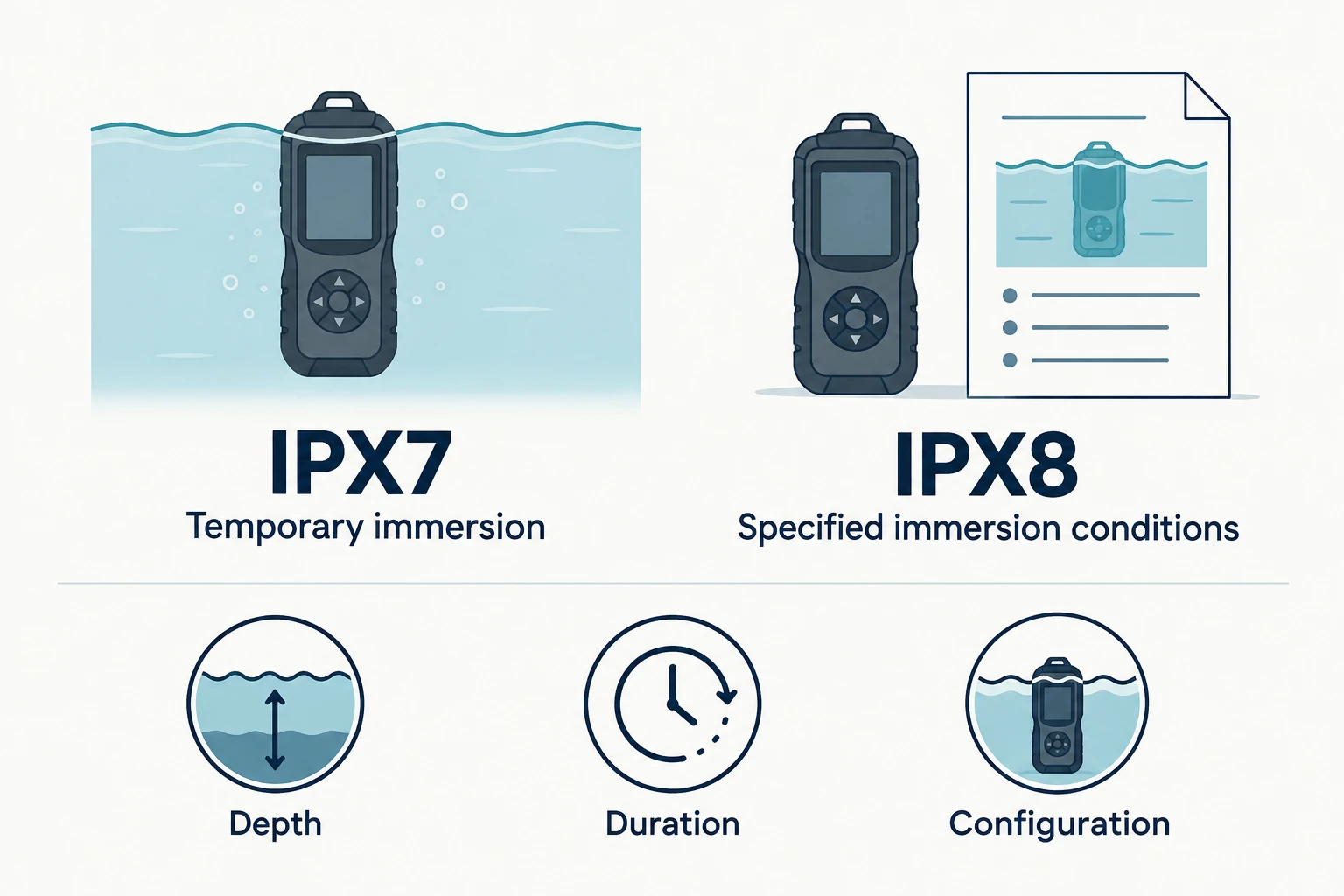
IPX8 indicates protection for immersion under specified conditions. Unlike a vague promise that a product is “waterproof,” a useful IPX8 claim must be read together with the manufacturer’s depth, duration and configuration limits. The rating alone does not supply one universal underwater operating specification.
IPX7 concerns temporary immersion. IPX8 addresses a different immersion classification, but neither label automatically answers questions about dust, water jets, salt water, chemicals or operation while submerged.
How to read IPX8 without adding promises
IEC 60529 is the enclosure-protection classification framework. In IPX8, the X leaves the solid-particle category unspecified; the 8 concerns immersion protection. An X is not evidence that the enclosure was tested and failed a dust test. It simply does not provide that classification in this marking.
KEYENCE’s protection-rating table distinguishes temporary immersion from continuous immersion under stated conditions. “Continuous” still needs those conditions: do not turn it into an unlimited depth or lifetime claim. The equipment instructions and supporting specification remain necessary.
IPX8 versus IPX7: compare the information you actually have
| Question | IPX7 | IPX8 |
|---|---|---|
| Which water category? | Temporary immersion | Immersion under specified conditions |
| Does the marking specify dust protection? | No; the X leaves it unspecified | No; the X leaves it unspecified |
| Can the numeral alone describe intended operation? | No | No |
| What should accompany the claim? | Applicable test and product conditions | Manufacturer-defined immersion limits and product conditions |
The comparison becomes meaningful only when both products’ descriptions are available. A more prominent numeral cannot compensate for an unclear specification, an unsupported accessory configuration or a use that the manufacturer excludes.
Read two product descriptions as different promises
Consider two invented catalogue examples, not actual product specifications. Instrument A states IPX8 at 2 metres for 60 minutes, with the connector cover closed and no underwater operation. Instrument B states IPX8 at 3 metres but omits duration. A gives a bounded exposure statement; B cannot be compared with it until its time limit and configuration are supplied. The larger depth does not establish that B withstands a longer exposure. For an IPX7 alternative, obtain its temporary-immersion conditions and operating restrictions rather than importing either fictional IPX8 specification.
Write down the intended task before comparing them. Is the concern an accidental drop into water, storage in a wet location, or deliberate underwater operation? Then ask whether the instructions address that exact task. If the proposed use needs a cable attached, obtain the evidence for that assembled connection rather than relying on the rating of the uncabled body.
Why immersion does not settle the cleaning question
A water jet and immersion create different exposure conditions. ABB’s guide explicitly separates immersion ratings from jet protection. Do not assume that IPX8 establishes the ability to withstand every hose, spray or cleaning process simply because 8 is larger than 5 or 6.
Similarly, an immersion statement does not independently establish compatibility with cleaning agents, high temperatures or salt water. List those conditions separately in a purchasing request. This makes it possible for the manufacturer to identify which claims are supported and which require further evaluation.
Keep the configuration attached to the purchasing record
Retain the model and revision, closures, accessories, depth and duration statement, operating restrictions and the relevant report or specification. A replacement seal, changed connector or different enclosure variant should trigger a review of whether the original documentation still describes the product you are buying.
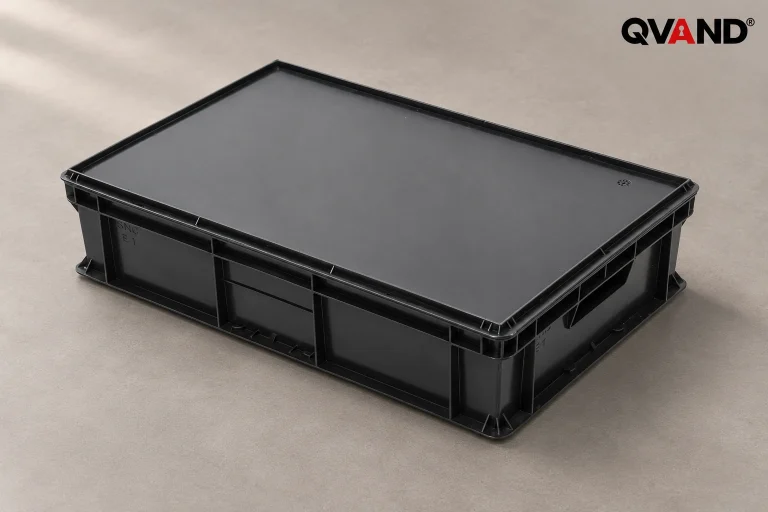
Packaging has a separate role. CH-ESD’s ESD storage and transfer boxes address component handling; their conductivity is not proof of a moisture barrier or an IPX8 enclosure. If boards need both electrostatic protection during handling and environmental protection in service, specify and evaluate each requirement separately.
The best comparison is therefore a pair of complete statements, not two bare ratings. Choose the evidence that matches the intended exposure and configuration, and leave unanswered conditions visible rather than filling them with assumptions.
When a specification gives only a depth, ask where the duration is stated. When it gives only a duration, ask for the corresponding depth. Preserve the linked conditions together; separating them into unrelated catalogue fields can make a restricted claim appear broader than its source.