Introduction
If you’ve ever had to track down the source of an unexplained ESD failure or verify whether your ionisers are actually doing their job, you know that static charge is invisible but anything but harmless. That’s where an electrostatic field meter comes in. Unlike resistance testers that require physical contact, these handheld devices let you measure static charge on surfaces from a safe distance—quickly, reliably, and without disturbing the object under test. Whether you’re auditing a production floor, troubleshooting a cleanroom issue, or simply doing routine static surveys, a good electrostatic field meter is your eyes for the invisible.
What Exactly Is an Electrostatic Field Meter?
At its core, an electrostatic field meter is a non‑contact instrument that detects the electric field generated by a charged object. It works on the principle of electrostatic induction—sensing the field strength and converting it into a voltage reading, typically in kilovolts per unit distance. Because it doesn’t draw any current from the object, it can measure delicate electronic components, packaging materials, and even human body charges without affecting the charge itself. This makes it fundamentally different from a surface resistance tester, which measures ohmic conductivity.
The SIMCO FMX‑003 Electrostatic Field Meter
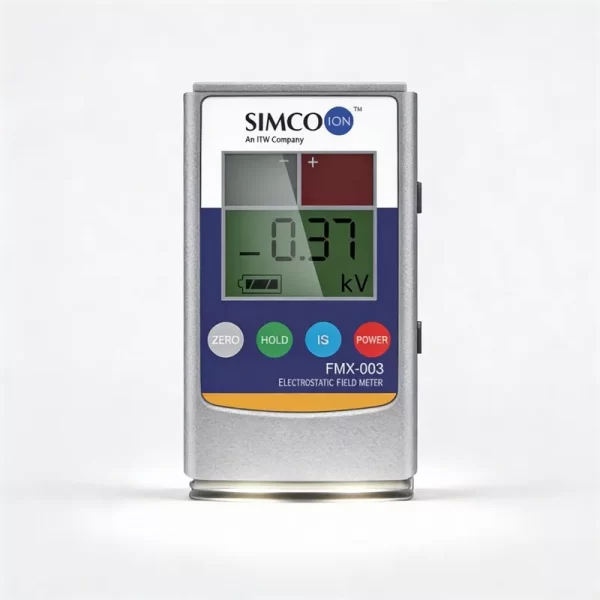
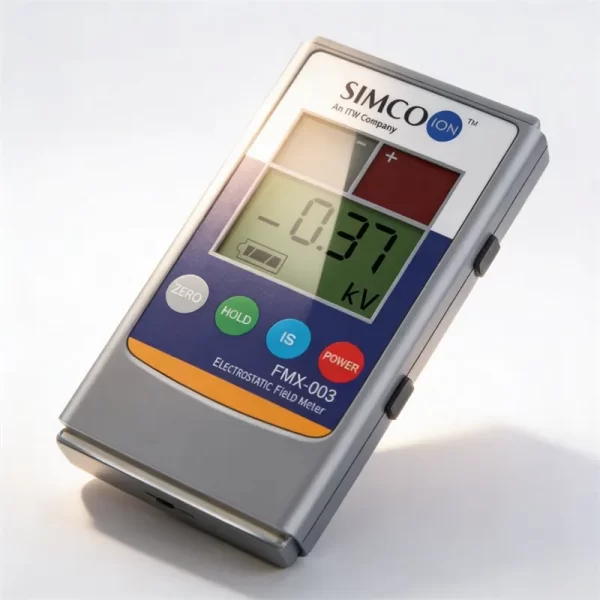
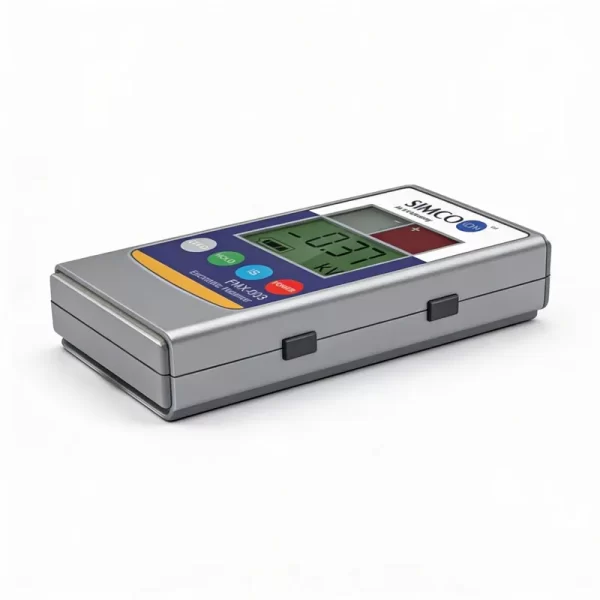
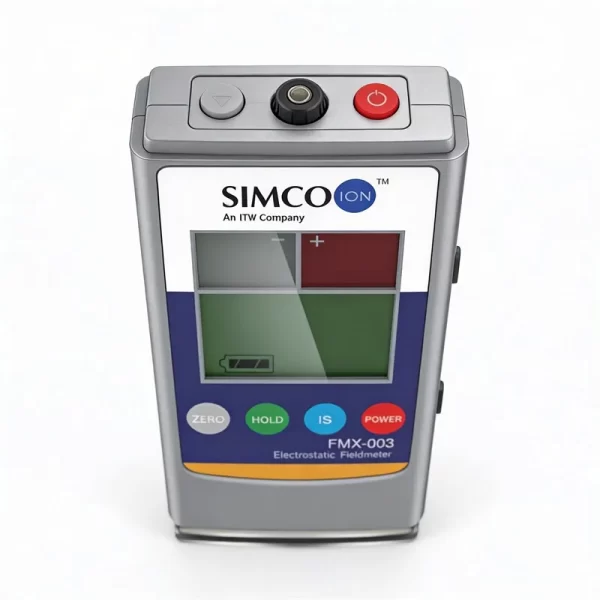
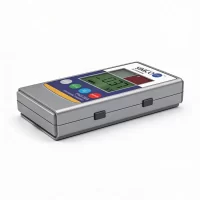
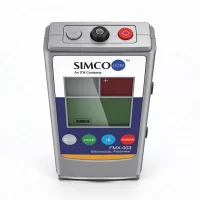
If there’s one model that has earned a reputation for reliability in the ESD community, it’s the SIMCO FMX‑003 electrostatic field meter. This pocket‑sized unit measures static voltages up to ±22 kV at a fixed distance of 1 inch (25 mm) – a distance that’s easily maintained thanks to two built‑in LED guide lights that show you exactly where to position the sensor. The display gives you both a numerical value and a colour‑coded bar graph (red for positive, blue for negative), so you can read results at a glance even in dim lighting. It also includes an ion balance mode for checking ioniser offset voltage (0 to ±220 V), a HOLD function to freeze readings, and an audible alarm for out‑of‑range measurements. Weighing just 170 g and featuring a conductive case with a grounding snap, it’s designed for real‑world field use—not just lab conditions.
Why Electrostatic Field Meter Calibration Matters
You might have the best instrument on the market, but without regular electrostatic field meter calibration, your readings are just educated guesses. Calibration ensures that the sensor’s response remains linear and accurate over time, compensating for component drift and environmental factors. Reputable manufacturers typically provide NIST‑traceable calibration certificates with each unit, and industry best practice recommends recalibration at least annually—or more frequently if the meter sees heavy use. Standards like IEC 61340 outline specific procedures for verifying performance, including test voltage levels, distance accuracy, and environmental conditions. Skipping calibration isn’t worth the risk: a false low reading could leave you with an unchecked static hazard, while a false high reading might send you chasing problems that don’t exist.
Where You’ll Actually Use a Handheld Electrostatic Field Meter
The list of applications for a handheld electrostatic field meter is longer than most people think. In electronics assembly, it’s the go‑to tool for auditing ESD workstations, checking charge buildup on PCBs and components, and verifying that packaging materials aren’t generating excessive static. In cleanrooms and medical device manufacturing, it helps prevent particle attraction—static charges can pull in dust and contaminants, compromising product sterility. In printing and converting, it identifies static issues that cause ink misregistration or material misalignment. And in R&D labs, it’s used for material characterisation and comparative studies. Essentially, any environment where static charge could affect quality, safety, or reliability is a candidate for regular electrostatic field meter use.
Technical Specification
| Model | Measurement Range | Accuracy Range | Test Distance | Size (L×W×H) | Weight |
| QD-7802(FMX-003) | ±20KV | 10% | 25mm | 122×65×27mm | 130G |